Poitiers Cathedral
At the bottom of the great Crucifixion Window, completed around 1165, Henry II of England and Eleanor of Aquitaine kneel together, holding up a model of the window they commissioned. It is one of the earliest stained-glass cathedral windows in France, and the royal couple who paid for it would eventually become one of the most famously estranged partnerships in medieval history. But in this glass, they are united -- presenting their gift upward to the sacred figures who rank above them, frozen in a moment of shared piety that their marriage would not sustain. Poitiers Cathedral, the largest medieval monument in the city, still holds this window and the complicated human story embedded in its colored light.
A Church Built by Rivals
Construction of the cathedral began in 1162, initiated by Henry II and Eleanor of Aquitaine on the ruins of a Roman basilica. Eleanor was Duchess of Aquitaine in her own right, and Poitiers was the capital of her ancestral domain. The cathedral was both an act of devotion and a statement of territorial authority in a region where English and French crowns competed for influence. Work advanced rapidly, and by the end of the 12th century the structure was largely complete. The result is the best-known example of a hall church in the Angevin Gothic style -- a form where the nave and flanking aisles are nearly equal in height and width, creating an interior of unusual spaciousness and light. The three vessels decrease slightly in width toward the west, enhancing the sense of perspective as you move through the space. The central vault rises 89 feet above the pavement, and the total length stretches 308 feet.
Light Through Eight Centuries
The stained glass is the cathedral's greatest treasure. Most of the windows in the choir and transepts preserve their original 12th- and 13th-century glass, a survival rate that is extraordinary for any medieval church. The Crucifixion Window, the masterwork, tells its story across three registers in a lancet window. At the top, in the lunette, Christ ascends within a mandorla, bearded, haloed, holding a book, flanked by angels who contort their bodies to fit the surrounding frame. Below, the Crucifixion itself: Christ on a ruby red cross with a blue border suggesting the Tree of Paradise. The Virgin Mary stands at the left in blue and rose robes, her hands clasped. Longinus holds his spear ready. St. John carries a jeweled book at the right. A hierarchical scale governs every figure -- Christ largest, the Virgin next, then apostles, soldiers, and attendants in diminishing size.
The Oldest Stalls in France
Below the windows, the choir stalls carved between 1235 and 1257 rank among the oldest surviving examples in France. Where the glass tells sacred narrative through color and light, the stalls tell it through wood and shadow -- carved figures and scenes worked into the seats where clergy have sat for nearly eight centuries. The cathedral's exterior presents a heavier appearance than its luminous interior might suggest. The broad facade, wider than it is tall, features unfinished side-towers begun in the 13th century, one standing 105 feet and the other 110 feet. They were never completed, giving the building a truncated silhouette that contrasts with the soaring verticality typical of northern Gothic cathedrals. This is Angevin Gothic, a regional interpretation that values width and light over height and drama.
Fire, Silence, and the Clicquot Organ
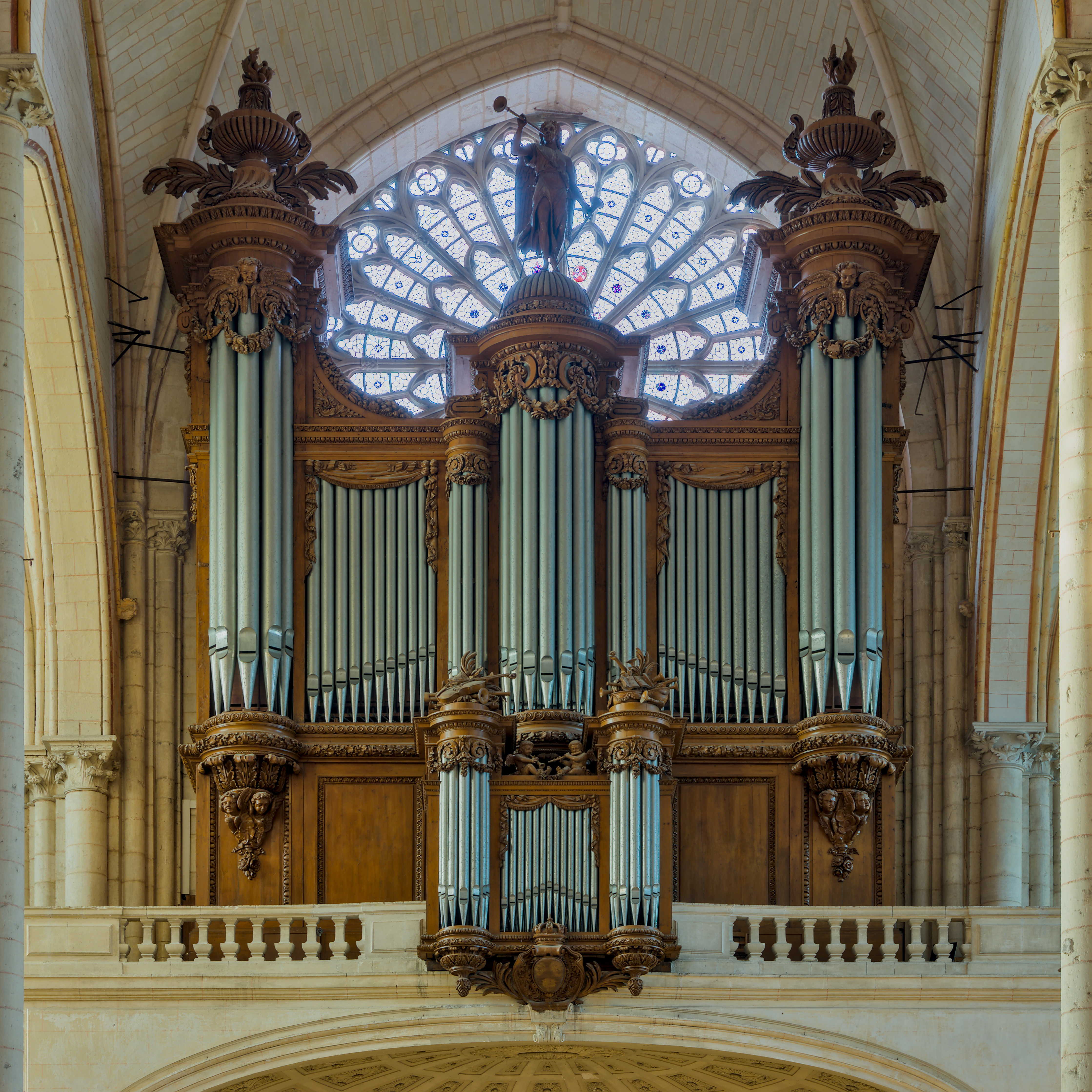
On Christmas night, 1681, fire destroyed the cathedral's organ. Nearly a century would pass before a replacement was commissioned. In 1770, Francois-Henri Clicquot, then the leading organ builder in France, was appointed to construct it. He worked on the instrument for two decades but died on Pentecost 1790 without finishing. His son Claude-Francois completed the work, delivering the organ in March 1791 -- just as the Revolution was dismantling the institutional framework of the church that housed it. The instrument survives largely intact, a beautiful example of 18th-century French organ design that speaks to both the continuity and the disruption of religious life in Poitiers. The cathedral endured the Revolution, the centuries before it, and the centuries after. Its glass still catches the afternoon light. Its stalls still hold their carved figures. The organ still sounds.
From the Air
Located at 46.58N, 0.35E in the historic center of Poitiers, in western-central France. The cathedral is the largest medieval structure in the city, identifiable from the air by its broad facade and two unfinished side-towers of slightly different heights. Best viewed at 2,000-4,000 ft AGL. Nearest airport is Poitiers-Biard (LFBI). The cathedral sits on elevated ground in the old city, surrounded by the dense medieval street pattern of central Poitiers.