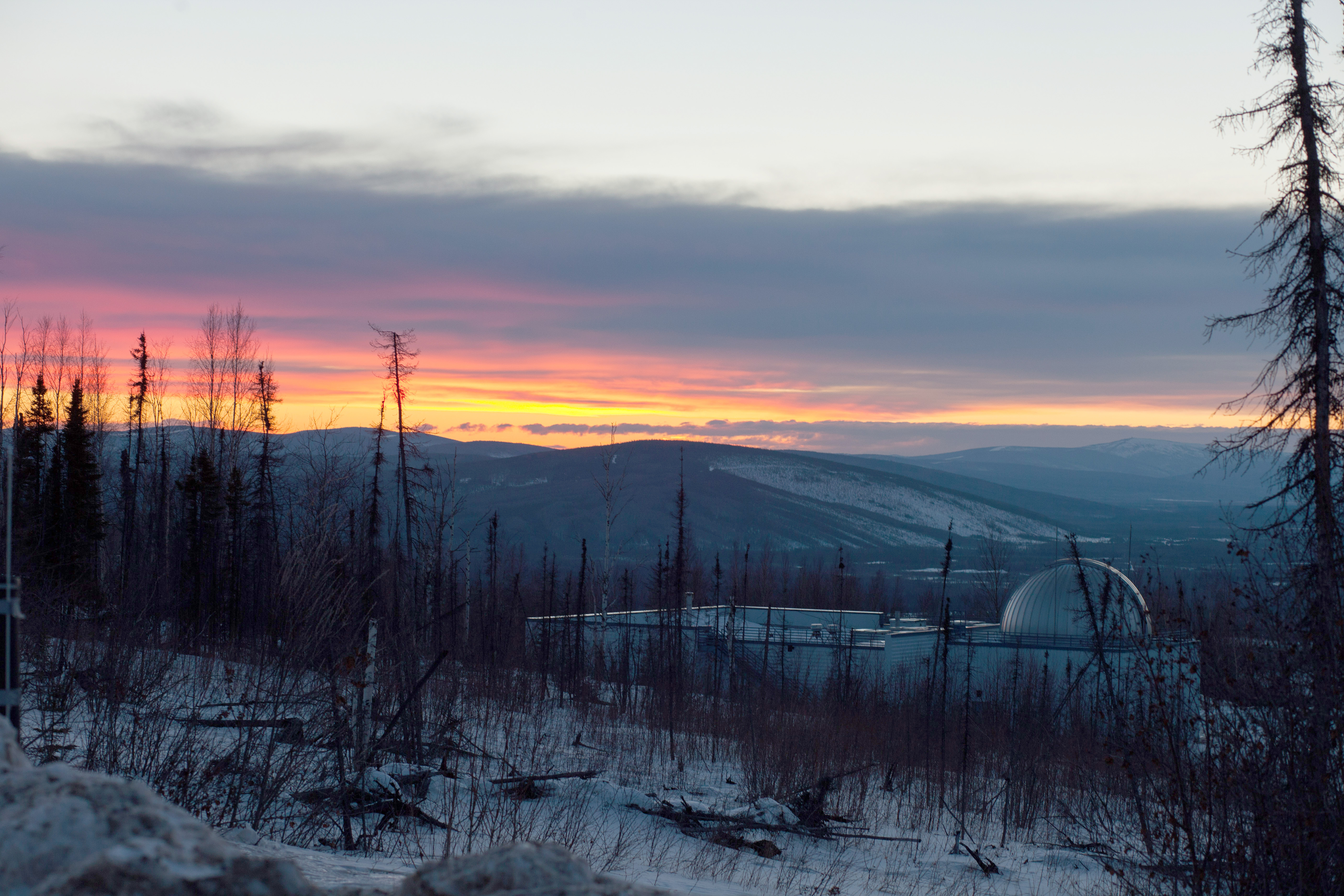
Poker Flat Research Range
North of Fairbanks, Alaska, where the aurora borealis dances overhead for months each winter, scientists launch rockets directly into the northern lights. Poker Flat Research Range is the largest land-based rocket range in the world and the only university-owned rocket facility in the United States. Operated by the University of Alaska Fairbanks Geophysical Institute, the range has launched over 3,000 sounding rockets since 1968, most designed to study the upper atmosphere and the physics of the aurora. The location is ideal: far enough north to sit beneath the auroral oval, remote enough to provide safety zones, and cold enough that the upper atmosphere phenomena being studied occur regularly overhead. When conditions are right, rockets punch through the green curtains of light in pursuit of scientific data.
The Range
Poker Flat covers 5,132 acres of boreal forest and tundra approximately 30 miles north of Fairbanks. The facility includes multiple launch pads, assembly buildings, telemetry stations, and support infrastructure. The range was established in 1968 as a joint project of the University of Alaska and the U.S. military; today it's operated entirely by the university's Geophysical Institute. The name comes from Poker Flat, a nearby mining area named after Bret Harte's short story. The facility launches sounding rockets - suborbital rockets that carry scientific instruments into the upper atmosphere for minutes of data collection before falling back to Earth. Most land in unpopulated wilderness northeast of the range.
The Aurora Research
Poker Flat's location beneath the auroral oval makes it uniquely suited for aurora research. The northern lights occur when charged particles from the sun interact with Earth's atmosphere; understanding this process has implications for space weather forecasting, satellite operations, and fundamental physics. Sounding rockets can carry instruments directly into auroral displays, measuring electric fields, particle precipitation, and atmospheric chemistry that can't be observed from ground or satellite. Launch campaigns often run through the winter when aurora activity peaks - scientists wait for the right conditions, then launch multiple rockets in sequence to capture different aspects of the phenomenon.
The Rockets
Poker Flat launches various sounding rocket types, from small meteorological rockets to larger scientific vehicles reaching altitudes over 1,000 kilometers. Rockets include Black Brant, Terrier-Orion, and Oriole types. Most flights last 10-20 minutes from launch to impact; instruments transmit data throughout flight. Some rockets deploy multiple payloads or release tracer chemicals (like trimethyl aluminum) that glow in sunlight, allowing researchers to track upper atmosphere winds. The range also supports scientific balloon launches and ground-based instruments. NASA, the National Science Foundation, and international researchers all use Poker Flat's facilities for missions that couldn't be conducted elsewhere.
The Facility
The range operates year-round but concentrates launches in winter when aurora activity is strongest and darkness allows visual tracking. Launch operations require coordination with aviation authorities and local communities - rockets launch over sparsely populated wilderness, but flight paths must be cleared. The university operates an information line that announces upcoming launches; locals and visitors sometimes gather on the road outside the facility to watch. The remote location presents logistical challenges - everything from rocket motors to catered meals must be trucked up from Fairbanks on roads that freeze and thaw with the seasons.
Visiting Poker Flat
Poker Flat Research Range is located 30 miles north of Fairbanks on the Steese Highway. The facility is not open to the public for safety reasons, but launches can sometimes be observed from the highway. The Geophysical Institute at the University of Alaska Fairbanks campus has educational displays about aurora research. Launch schedules are announced via the university when conditions and science requirements align. Fairbanks is the access point for all visitors - Fairbanks International Airport has service from Anchorage and the Lower 48. Peak aurora viewing season runs September through April. The Poker Flat area is within prime aurora viewing territory; numerous tour operators offer northern lights excursions from Fairbanks.
From the Air
Located at 65.13°N, 147.47°W north of Fairbanks, Alaska. From altitude, Poker Flat Research Range appears as a small cleared facility in boreal forest - launch pads, buildings, and access roads amid wilderness. The Steese Highway passes the facility. The Chatanika River valley stretches to the northwest. Fairbanks is 30 miles southwest, visible as the largest settlement in Interior Alaska. The Alaska Range is visible to the south. The terrain is rolling boreal forest with isolated clearings. During aurora events, the facility sits beneath the glowing curtains - rockets punch upward through the light to gather data no satellite can collect.