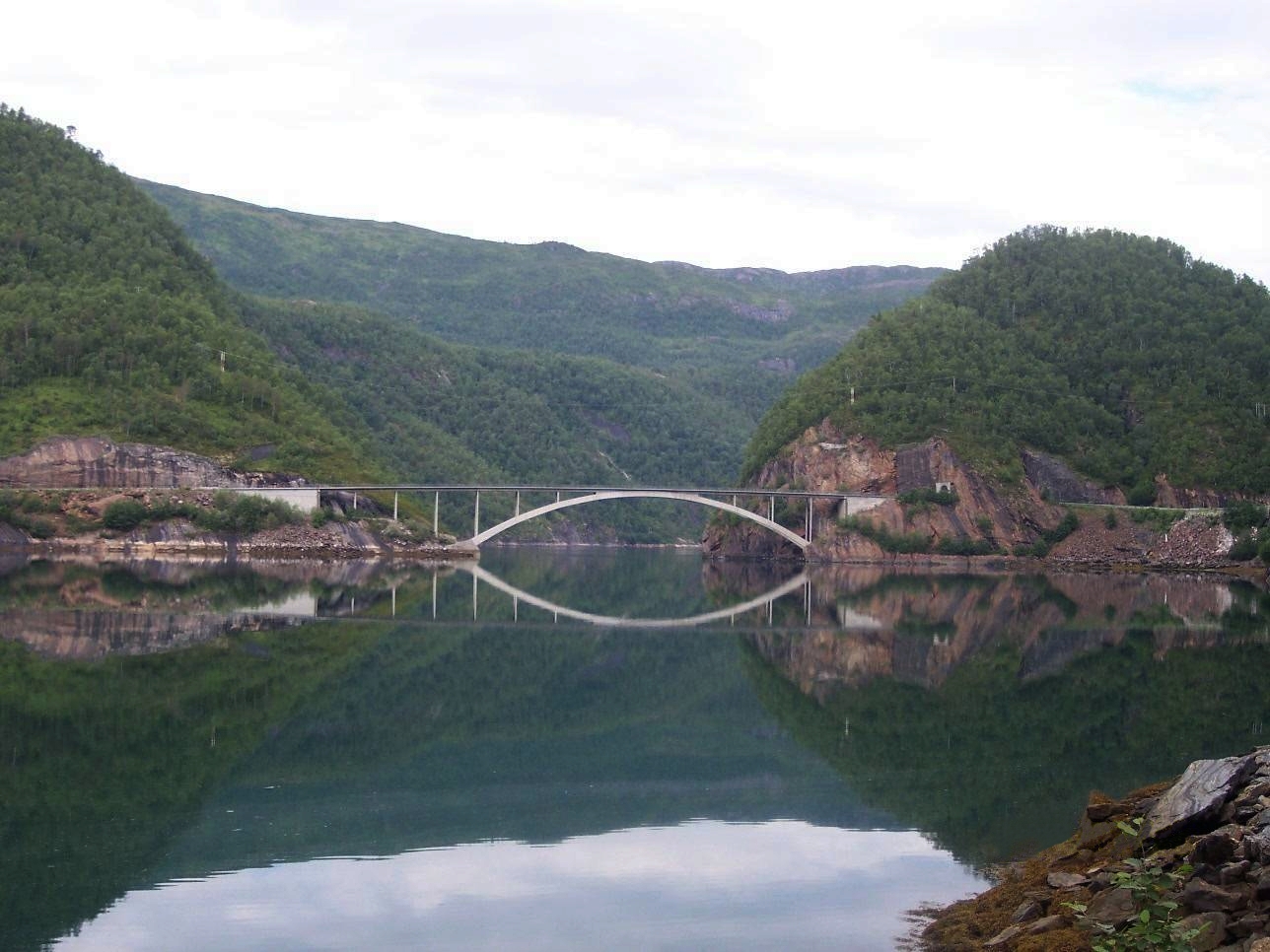
Polar Line
Tunnels that lead nowhere. Bridge abutments that support nothing. Along the mountainous coast of Nordland county in northern Norway, the remains of a railway that was never finished emerge from the landscape like the bones of an unbuilt future. The Polar Line was meant to run from Fauske to Narvik and eventually 1,215 kilometers to Kirkenes, linking Norway's entire northern coast by rail. Instead, it became one of the most ambitious abandoned infrastructure projects in Scandinavian history—a line conceived by the Wehrmacht, constructed with forced labor, and left to the elements when the war ended.
A Railway for Fortress Norway
The Polar Line was a product of wartime ambition. During the German occupation of Norway, the Wehrmacht undertook the construction as part of Festung Norwegen—Fortress Norway—a sprawling defensive network intended to protect occupied Scandinavia from Allied invasion. At Fauske, the new line was to connect with the existing Nordland Line, extending rail access deep into the Arctic. Construction began at Finneid and pushed northward through terrain that fought back at every meter: mountain valleys, fjord crossings, and subarctic wilderness. By the time of German capitulation on May 8, 1945, most of the right-of-way through Fauske was completed, and construction had reached as far north as Drag in Tysfjord Municipality. Dozens of tunnels had been bored, bridges built, and stations planned. But the line was far from finished, and the human cost of what had been completed was enormous.
Engineering Against the Landscape
The planned route was a testament to engineering ambition pushed to extremes. From Finneid, the line passed through the Bratthaugen Tunnel to Fauske, then continued northward across Svartosen on a bridge and along the lake of Vallvatnet. Stations were planned at regular intervals—Straumen, Kvarv, Hellbukta—each requiring its own access routes and infrastructure. Between stations, the terrain demanded extraordinary solutions: on the 4.9-kilometer section from Hellandsjøen to Buvik alone, five tunnels were planned. The Mågården Tunnel reached 554 meters before work stopped. Power stations were built at Røyrvatnet and Kvarv to supply construction operations. The 2,710-meter Espenes Tunnel was planned but never completed. Each kilometer of the route tells the same story: massive effort applied against unyielding geography, in a race against a war that the builders were losing.
What the War Left Behind
After liberation in 1945, Norwegian authorities evaluated the partially built railway and decided it was not worth completing. The terrain was too difficult, the cost too high, and peacetime Norway had other priorities. The Polar Line was abandoned. But abandonment does not mean disappearance. Tunnel mouths still open into mountainsides along the coast. Concrete bridge supports stand in river valleys, waiting for rails that will never come. Some sections of the graded right-of-way were eventually absorbed into the European Road E6 highway, meaning that drivers today unknowingly travel segments that were first cut through rock by forced laborers eight decades ago. The infrastructure that remains serves as both an archaeological record and a reminder: the tunnels and cuttings were not carved by machines alone but by the labor of prisoners whose names the landscape does not remember.
The Ghost of a Northern Railway
The idea refused to die entirely. Beginning in the 1970s, plans for a Fauske-to-Tromsø railway resurfaced under the name Northern Norway Line, reviving the general concept if not the specific route. Studies were commissioned, consultants appointed, and economic analyses produced. A 2019 study concluded that a Fauske-to-Tromsø railway was not economically viable, and the project was shelved once more. Norway's north remains connected by road, sea, and air, but not by rail beyond Bodø. The Polar Line endures as a ghost in the landscape—a network of tunnels and earthworks that mark where one of history's most destructive regimes tried to build something permanent and failed. The rail never ran. The tunnels stand empty. The mountains, as always, won.
From the Air
The Polar Line route runs north from Fauske (67.26°N, 15.39°E) toward Narvik along the coast of Nordland county. The article's coordinates center at 67.42°N, 15.67°E. From the air, remnants of the railway—tunnel entrances, bridge abutments, and graded roadbed—are visible along the mountainous fjord coastline, particularly between Fauske and Tysfjord. Much of the E6 highway follows or parallels segments of the original route. Best viewed at 3,000–8,000 ft to spot tunnel mouths and earthworks against the mountain terrain. Nearest airports: Bodø Airport (ENBO) to the southwest, Harstad/Narvik Airport (ENEV) to the north.