Polaria
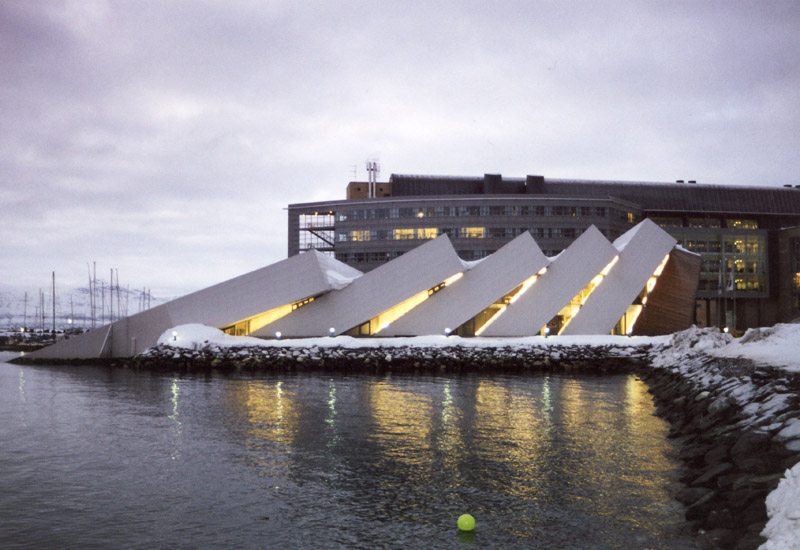
The building looks like it is falling down. Slabs of pale concrete lean against each other at improbable angles, as if a pressure ridge of sea ice has been shoved onto the Tromsoe waterfront by an Arctic storm. That is exactly the idea. Polaria, the world's most northerly aquarium, opened in May 1998 not as a conventional marine science facility but as something more ambitious: a gateway to the Arctic itself, designed to make the polar world accessible -- especially to children who may never see pack ice or a bearded seal in the wild.
Ice Architecture on the Waterfront
The building's tilted concrete panels echo the Arctic Cathedral visible across Tromsoe harbor in Tromsdalen, creating a visual dialogue between two of the city's most striking pieces of modern architecture. Where the cathedral's soaring triangular form suggests spiritual aspiration, Polaria's cascading slabs evoke the raw physics of the frozen north -- pressure, weight, collapse. Inside, the design philosophy continues. Rather than the clinical arrangement of a research aquarium, visitors follow an experiential path through Arctic environments. A five-screen panoramic cinema surrounds them with footage of Svalbard's landscapes. The Arctic Walkway displays polar exploration equipment alongside simulated permafrost and stuffed specimens of northern wildlife. The approach is immersive rather than taxonomic, atmospheric rather than encyclopedic.
The Bearded Seals of 69 North
The centerpiece of Polaria is an open pool where a group of bearded seals -- Erignathus barbatus, the largest of the northern true seals -- swim, dive, and perform trained behaviors that keep them mentally and physically engaged. Observation blisters set into the sides of the enclosure allow visitors to look upward at the animals from below the waterline, reversing the usual perspective. A transparent tunnel crosses the bottom of the pool, placing visitors inside the seals' world rather than peering down at it from above. The effect is startling: these animals, which in the wild haul out on drifting sea ice across the Arctic basin, pass overhead close enough to see individual whiskers. The training sessions serve a dual purpose, keeping the seals active while giving visitors a chance to watch their remarkable underwater agility.
From Svalbard to the Seafloor
Beyond the seal pool, conventional aquaria display the marine life of northern Norway's coast. Open tanks hold rock-shore animals that children can observe up close, while display tanks house baby fish and other species chosen as much for their approachability as their scientific interest. Most of the educational content focuses on Svalbard, the Norwegian archipelago that lies roughly midway between the mainland and the North Pole. At 69 degrees north, Tromsoe itself sits well above the Arctic Circle, but Svalbard -- at 78 degrees -- represents an entirely different order of polar environment: glaciers covering sixty percent of the land, polar bears outnumbering people, and winter darkness lasting four months. Polaria bridges that gap, bringing the high Arctic to visitors who have reached the edge of mainland Norway but cannot easily travel further north.
A Hunting Ship Next Door
Less than a hundred meters from Polaria's entrance, another piece of Arctic heritage sits preserved under glass. The Polstjerna, one of Norway's most storied seal hunting vessels, is displayed in its own museum building. The ship's working life spanned the decades when Norwegian sealers pushed into the ice of the Greenland Sea and the waters around Svalbard -- a tradition that shaped the economy of northern Norway for centuries. Visitors buy tickets to the Polstjerna from Polaria's front desk, linking the two sites into a single narrative about the relationship between northern Norwegians and the marine Arctic. Together, Polaria and the Polstjerna tell a story that runs from historical exploitation to modern conservation, from wooden ships navigating pack ice to transparent tunnels beneath a seal pool in the city that calls itself the Gateway to the Arctic.
From the Air
Located at 69.64N, 18.95E on the Tromsoe waterfront in northern Norway. Best viewed from low altitude approaching from the west over Tromsoeysundet. The distinctive tilted-slab architecture is visible near the harbor. Tromsoe Airport Langnes (ENTC) is 4 km northwest. The city sits on an island connected by bridges, with the Arctic Cathedral visible across the sound to the east. During polar night (late November to mid-January) the city is illuminated but receives no direct sunlight.