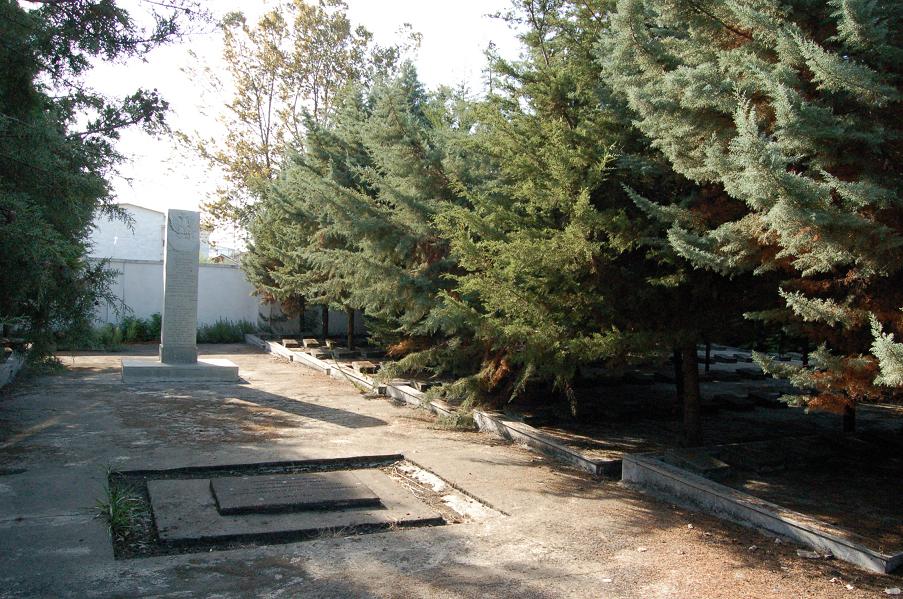
Polish Cemetery in Bandar-e Anzali
The padlocked gate reads CMENTARZ POLSKI in large iron letters. Behind it, 639 headstones stand in precise rows on a narrow strip of land between the Caspian Sea and the streets of Bandar-e Anzali, a humid port town in northern Iran that most Poles had never heard of before the spring of 1942. That year, tens of thousands of starving, typhus-ravaged refugees stumbled off Soviet oil tankers and coal ships into a makeshift tent city on this shore, having crossed the Caspian in one of the war's most desperate evacuations. The cemetery is what remains of those who did not survive the crossing or the diseases that followed, a sliver of Poland pressed into Iranian soil by circumstances no one could have predicted.
The Long Road from Siberia
The story begins not in Iran but in the frozen labor camps of the Soviet Union. After the Soviet invasion of eastern Poland in September 1939, Stalin's regime deported an estimated 1.5 million Polish citizens to Siberia, Kazakhstan, and Central Asia. Families were separated. Thousands died of cold, starvation, and forced labor. When Germany invaded the Soviet Union in June 1941, the geopolitical calculus shifted overnight. Stalin suddenly needed allies, and the Polish government-in-exile negotiated an amnesty for its deported citizens. General Wladyslaw Anders, himself recently released from Moscow's Lubyanka prison, was tasked with forming an army from these scattered survivors. What followed was an exodus across thousands of kilometers of Soviet territory, as soldiers and civilians alike made their way south toward Iran and freedom.
Landfall on the Caspian
Between March and October 1942, approximately 115,000 Polish soldiers and civilians crossed the Caspian Sea from the Turkmen port of Krasnovodsk to Bandar-e Anzali, then known as Pahlevi. The Iranian and British officials watching the first ships list into harbor on March 25 had little idea what to expect. What they found were people in the final stages of deprivation: skeletal, lice-ridden, many too weak to walk. The Iranian army erected over 2,000 tents along the shoreline, stretching for several miles on either side of the lagoon, with improvised bathhouses, latrines, disinfection stations, bakeries, and a field hospital. Despite these efforts, dysentery, typhoid, and malaria claimed lives daily. Approximately 2,800 of the evacuees died on Iranian soil. The 639 buried in this cemetery represent those who perished in or near Bandar-e Anzali itself.
Stones and Names
At the center of the cemetery stands a tall rectangular column of white marble, engraved with a Polish eagle. Below the eagle, inscriptions in English and Polish honor the dead. Eighteen concrete headstones line each row, recording names, birth dates, death dates, and military ranks where known. Where identity was lost, the headstone reads simply "Nieznany" -- unknown. Of the 639 graves, 163 belong to soldiers of Anders' Army. The remaining 476 are civilians: women, children, and elderly people whose bodies gave out after years of Soviet labor camps and the grueling journey south. The cemetery can only be entered through the adjacent Armenian graveyard, the two separated by a low wall. A worn Persian-language plaque on the street gate notes that burials took place here between 1939 and 1945.
Iran's Forgotten Hospitality
The Polish cemetery is a physical reminder of a chapter rarely taught in either Polish or Iranian history. Iran took in tens of thousands of desperate refugees at a time when the country itself was under Allied occupation and struggling with its own wartime shortages. Isfahan became home to so many Polish children that it earned the nickname "City of Polish Children." The survivors who regained their strength were eventually dispersed across the British Empire to camps in India, East Africa, and Palestine. Many of the soldiers went on to fight at Monte Cassino and other Italian front battles. Few ever returned to Bandar-e Anzali. The cemetery endures as a quiet testament to the convergence of two distant nations, brought together by the upheavals of war, preserved in headstones that face the sea the refugees once crossed.
From the Air
Located at 37.478N, 49.439E on the southwestern shore of the Caspian Sea. The cemetery sits within the port town of Bandar-e Anzali in Gilan Province. The Caspian coastline and the lagoon that splits the town are clearly visible from altitude. Nearest airport is Sardar-e-Jangal International Airport in Rasht (OIGG), approximately 35 km to the southwest. The lush green coastal plain of Gilan contrasts sharply with the Alborz Mountains rising to the south. Best viewed at 3,000-5,000 feet to appreciate the town's position between lagoon and sea.