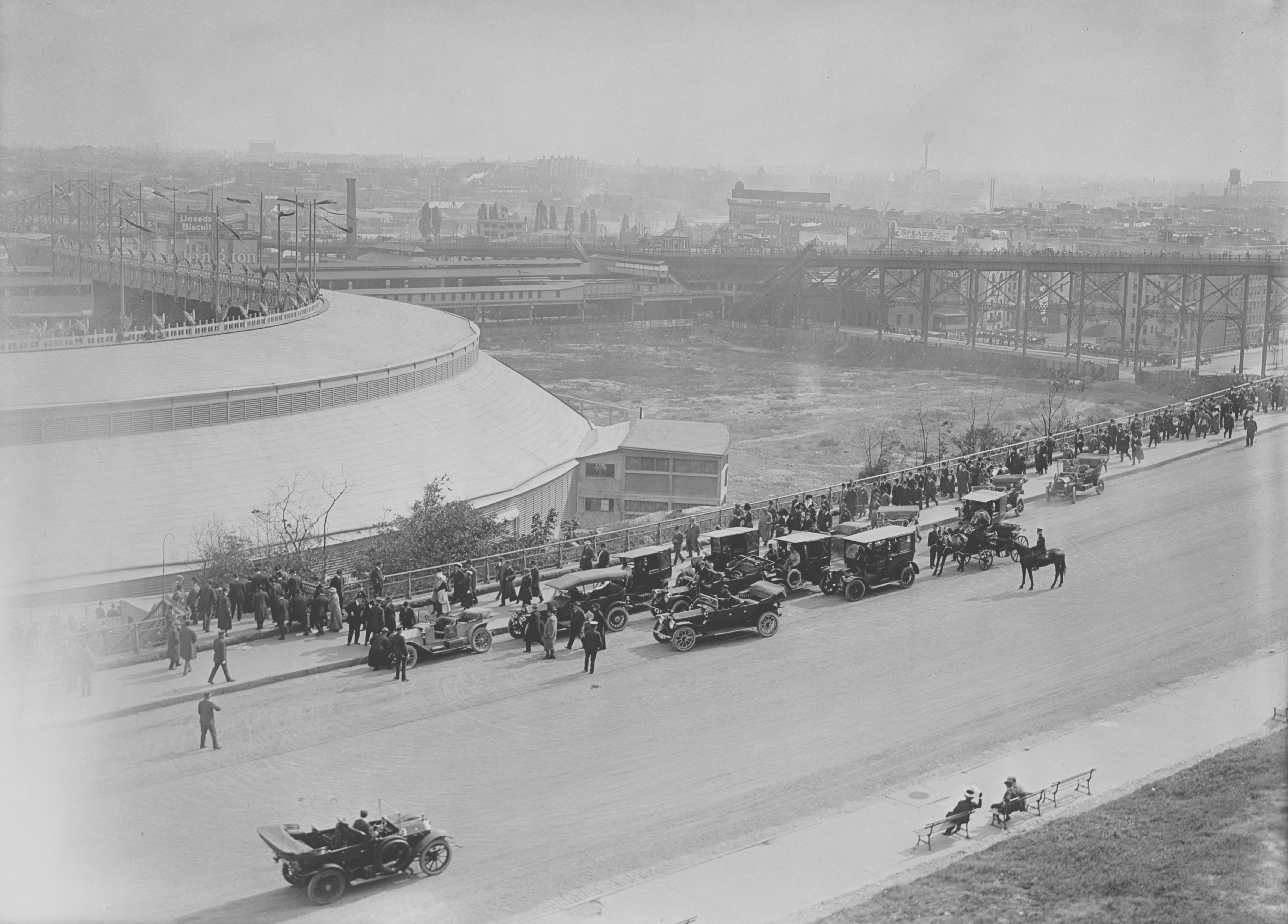
Polo Grounds
On October 3, 1951, Bobby Thomson stepped to the plate at the Polo Grounds in Upper Manhattan with two runners on base and the New York Giants trailing the Brooklyn Dodgers 4-2 in the bottom of the ninth. What happened next -- the "Shot Heard 'Round the World" -- became arguably the most famous home run in baseball history. But the stadium where that ball sailed over the left field wall had been shaping American sports for decades before Thomson's swing, and its peculiar dimensions guaranteed that no two games ever played quite the same.
Four Stadiums, One Name
The Polo Grounds was not one stadium but a series of four, each built on a different Manhattan site, spanning 1880 to 1963. The original, opened in 1879 between 110th and 112th Streets just north of Central Park, was actually built for polo before the New York Metropolitans leased it for baseball in 1880. When the city extended its street grid through the grounds in 1889, the Giants scrambled to find a new home, bouncing from Jersey City to Staten Island before settling in Coogan's Hollow at 155th Street. The seats from the old park were physically relocated to the new one. A Players' League franchise built Brotherhood Park next door in 1890, and when that league folded after a single season, the National League Giants moved into the larger structure and brought their stadium name with them. Between Polo Grounds II and IV, they would remain in Coogan's Hollow for 69 seasons.
The Bathtub
A fire of uncertain origin swept through the stadium's horseshoe grandstand in the early morning of April 14, 1911, consuming wood and leaving only steel uprights. Giants owner John T. Brush rebuilt in concrete and steel, reopening just two and a half months later. The 1923 expansion gave the stadium its famous shape -- a horseshoe that critics and fans alike called "The Bathtub." The dimensions were gloriously absurd. Down the foul lines, the walls stood just 279 feet from home plate in left and roughly the same in right, with a 21-foot overhang in left that turned catchable fly balls into home runs. But straightaway center field stretched to 483 feet, so deep that no batter ever cleared the clubhouse wall. The bullpens sat on the outfield warning track, in play. The outfield sloped downward from the infield, leaving people in the dugouts able to see only the top halves of the outfielders. Willie Mays made "The Catch" against Vic Wertz in the 1954 World Series nearly 500 feet from home plate -- a routine fly ball in most modern stadiums.
More Than Baseball
The Polo Grounds hosted the first professional football game ever played in New York City on December 4, 1920, when the Buffalo All-Americans beat the Canton Bulldogs 7-3. The NFL's New York Giants called it home from 1925 to 1955, hosting four championship games there. The AFL's Titans, later the Jets, played their home games in the stadium from 1960 to 1963. Soccer arrived as early as 1894, and in 1947 the only All-Ireland Senior Gaelic Football Final ever played outside Ireland took place on this Manhattan field, with Cavan beating Kerry. Boxing drew enormous crowds: Jack Dempsey fought Luis Angel Firpo here in 1923, and Floyd Patterson became the first heavyweight to regain his championship when he defeated Ingemar Johansson in 1960. Stock car racing circled a quarter-mile paved oval in 1958 and 1959. In 1916, a chorus of 1,200 singers and a 120-piece New York Philharmonic Orchestra performed Verdi's Requiem under the open sky.
Death by Neglect
The end came slowly, then all at once. The stadium had almost no parking -- it had opened two years after the Model T was introduced -- and the surrounding neighborhood declined through the late 1940s. The football Giants departed for Yankee Stadium after 1955. The baseball Giants, even after winning the 1954 World Series, drew only 1.1 million fans that year, and attendance collapsed further during a disastrous 1956 season. Owner Horace Stoneham, whose sole income was the franchise, could not afford maintenance and laid off the stadium's entire upkeep staff. The Giants decamped for San Francisco after 1957. The expansion Mets played two forlorn seasons in the crumbling stadium before Shea Stadium opened in 1964. On December 14, 1963, the Jets lost to the Buffalo Bills 19-10 in what became the Polo Grounds' final sporting event. Casey Stengel, managing the hapless Mets, had already delivered the eulogy: "At the end of this season, they're gonna tear this joint down. The way you're pitchin', the right field section will be gone already!"
What Remains
The wrecking ball arrived in 1964, and the Polo Grounds Towers, a public housing project, opened on the site in 1968. But traces persist. The John T. Brush Stairway, named for the Giants owner who rebuilt the stadium after the 1911 fire, still descends Coogan's Bluff from Edgecombe Avenue to Harlem River Driveway. It was restored in 2014 with donations from the Giants, Jets, Yankees, Mets, San Francisco Giants, and Major League Baseball. And in Phoenix, Arizona, the original Polo Grounds light poles remain in use at Phoenix Municipal Stadium, shipped there by Horace Stoneham in 1964 when he needed lighting for the Giants' spring training facility. They stand where they were planted six decades ago, illuminating amateur baseball games in the desert -- the last working pieces of a stadium where Thomson swung, Mays caught, and 1,200 voices sang Verdi into the Manhattan night.
From the Air
The Polo Grounds site is at 40.831N, 73.938W in Upper Manhattan, in Coogan's Hollow between Coogan's Bluff and the Harlem River. The site is now occupied by the Polo Grounds Towers, four 30-story public housing buildings visible from the air along the Harlem River south of the Macombs Dam Bridge. The John T. Brush Stairway descends the bluff on the west side. Yankee Stadium is directly across the Harlem River to the northeast. Nearest airports: LaGuardia (KLGA) 6nm east, Teterboro (KTEB) 7nm northwest. Best viewed at 2,000-3,000 ft AGL following the Harlem River.