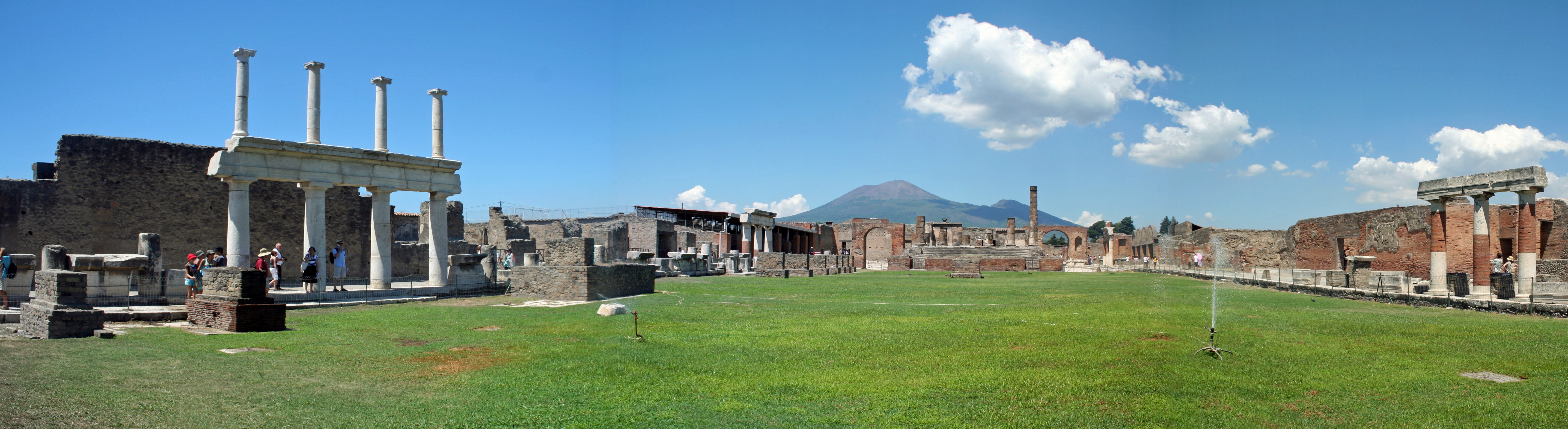
The Destruction of Pompeii: The Day Vesuvius Buried a City
On August 24, 79 AD (or possibly October 24, according to recent research), Mount Vesuvius erupted with catastrophic force, burying the prosperous Roman cities of Pompeii and Herculaneum under 20 feet of volcanic ash and pumice. An estimated 16,000 people died. The cities vanished from memory for nearly 1,700 years. When excavations began in the 18th century, archaeologists discovered something extraordinary: an entire Roman world frozen in time. Streets, shops, homes, brothels, graffiti - even the shapes of people caught in their final moments. Pompeii became a window into ancient life more vivid than any written history.
The City
Pompeii in 79 AD was a thriving Roman city of perhaps 11,000 people - a center of trade and pleasure on the Bay of Naples. Wealthy Romans maintained vacation villas there. The streets were lined with shops, taverns, and public baths. The city had an amphitheater, a forum, temples, and brothels.
Vesuvius loomed to the north, but no one remembered its last eruption. The Romans didn't know it was a volcano. They called the mountain covered in vineyards and forests simply 'the mountain.' The fertile volcanic soil made the region ideal for farming. The danger was invisible, buried under centuries of dormancy.
The Eruption
The eruption began around noon with a massive explosion that sent a column of ash and pumice 20 miles into the sky. Pliny the Younger, watching from across the bay, described a cloud shaped like an umbrella pine. His uncle, Pliny the Elder, sailed toward the disaster and died, becoming history's first volcanologist and first volcano victim.
For 18 hours, pumice rained on Pompeii, accumulating several feet deep. Buildings collapsed under the weight. Many residents fled, but others stayed, sheltering in homes or unable to escape. Then came the pyroclastic surges - superheated clouds of gas and rock traveling at 100 miles per hour.
The Death
The pyroclastic surges killed everyone who remained. At temperatures exceeding 300°C, death was instantaneous. Bodies were flash-heated, then buried under volcanic material that hardened around them. Over centuries, the bodies decomposed, leaving hollow cavities in the ash.
In the 1860s, archaeologist Giuseppe Fiorelli developed a technique to fill these cavities with plaster, creating casts of the victims in their final moments. The results were haunting: a mother sheltering her child, a dog straining at its chain, a man covering his face against the ash. Pompeii's dead were resurrected as permanent monuments to terror.
The Preservation
The ash that killed Pompeii also preserved it. Streets retained their ruts from cart wheels. Walls kept their frescoes and graffiti. Shops held their goods. A bakery still contained carbonized loaves of bread. Election notices remained painted on walls. Wine shops advertised their prices. Brothels displayed explicit frescoes above each room.
Even the mundane became extraordinary: the dice a gambler was throwing, the meal a family was eating, the surgical instruments a doctor was using. Pompeii offers an intimate portrait of Roman life that no literary source could provide. We know more about daily life in this small provincial city than about Rome itself.
The Legacy
Pompeii was rediscovered in 1748 and has been under excavation ever since. About two-thirds of the city has been unearthed, revealing thousands of artifacts and buildings. The site receives over 4 million visitors annually, making it one of Italy's most popular tourist destinations.
Vesuvius remains active - it last erupted in 1944. Three million people now live in the danger zone around the volcano. Scientists monitor seismic activity constantly. Pompeii stands as both an archaeological treasure and a warning: the mountain that buried one civilization remains fully capable of burying another.
From the Air
Pompeii (40.75N, 14.49E) lies at the foot of Mount Vesuvius near Naples, Italy. Naples International Airport (LIRN) is 25km northwest. The excavated city and the volcano are clearly visible from the air. The Bay of Naples curves to the west. Herculaneum lies closer to Vesuvius. The terrain is coastal with the Apennines visible inland.