Pompeii's Graffiti: The Bathroom Walls of Ancient Rome
When Vesuvius buried Pompeii in 79 AD, it preserved more than architecture. It preserved voices. Over 11,000 pieces of graffiti survive on Pompeii's walls - scratched into plaster by ordinary Romans going about their ordinary lives. They wrote about love ('I don't want to sell my husband'), sex ('Weep, you girls. My penis has given you up'), politics ('Vote for Lucius Popidius Sabinus'), and bathroom habits ('Apollinaris, doctor to the Emperor Titus, had a good crap here'). The graffiti reveals that Romans were exactly like us: bored, horny, petty, and desperate to be remembered.
The Messages
Roman graffiti covered every available surface: tavern walls, basilica columns, private homes, even tombs. Some were carefully painted signs. Most were scratched into wet plaster with a stylus. The subjects varied widely:
Love: 'Secundus says hello to his Prima, wherever she is.' Politics: 'All the late night drunks ask you to elect Marcus Cerrinius aedile.' Commerce: 'Successus the weaver loves a slave girl named Iris.' Profanity: 'Chie, I hope your hemorrhoids rub together so much that they hurt worse than they ever have before.'
The Voices
What makes Pompeian graffiti extraordinary is its ordinariness. These aren't official inscriptions or literary texts - they're the thoughts of people who never expected to be remembered. A gladiator brags about his conquests. A bartender complains about a customer who didn't pay. A woman curses her unfaithful lover. A philosopher scratches 'nothing lasts forever' without knowing Vesuvius would prove him right.
The humanity is startling. 'If anyone does not believe in Venus, they should gaze at my girlfriend.' 'I screwed a lot of girls here.' 'Atimetus got me pregnant.' The voices are so immediate that 2,000 years collapse.
The Places
Different locations inspired different graffiti. Brothel walls listed services and prices. Taverns collected reviews ('The finances officer of the emperor Nero says the food here is poison'). The basilica - Pompeii's courthouse - featured philosophical musings and legal jokes.
The most intimate graffiti appeared in private homes. 'Restitutus has deceived many girls.' 'On April 19th, I made bread.' One wall contained a detailed drawing of a ship labeled 'To Pompeii, welcome!' - perhaps by a homesick traveler. Another showed mathematical calculations, as if someone was working out a problem with charcoal.
The Studies
Archaeologists have cataloged over 11,000 Pompeian inscriptions in the Corpus Inscriptionum Latinarum. They provide invaluable data about Roman life: literacy rates, language evolution, social attitudes, commercial practices. The graffiti suggests that many ordinary Romans could read and write, at least basically.
Some inscriptions are in Greek, showing the cosmopolitan nature of the city. Some use slang that doesn't appear in formal Latin texts. A few contain spelling errors that reveal how Latin was actually pronounced. The graffiti is a linguistic treasure - the closest we can get to hearing ancient Romans speak.
The Mirror
Pompeii's graffiti forces us to see Romans as people, not marble statues. They had bad days ('I'm amazed, O wall, that you have not collapsed and fallen, since you must bear the tedious stupidities of so many scrawlers'). They fell in love ('Lovers, like bees, live a honeyed life'). They dealt with disappointment ('What's the point in having a Venus if she's made of marble?').
The urge to write on walls appears universal. Two thousand years from now, archaeologists may excavate our subway stations and find messages equally crude and tender. We like to think we've evolved beyond our ancestors. The graffiti of Pompeii suggests otherwise.
From the Air
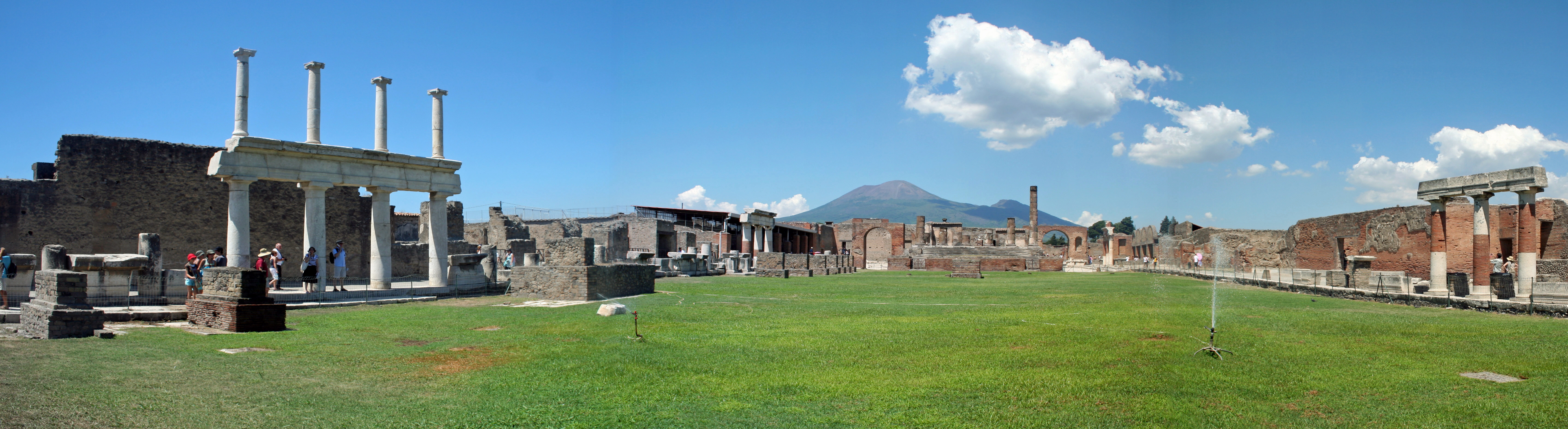
Pompeii (40.75N, 14.49E) lies southeast of Naples near Mount Vesuvius. Naples International (LIRN) is 25km northwest. The excavated city is visible from the air as a grid of streets and buildings beside the modern town. Vesuvius looms to the north. The site covers 66 hectares, of which about two-thirds has been excavated. Weather is Mediterranean - hot summers, mild winters.