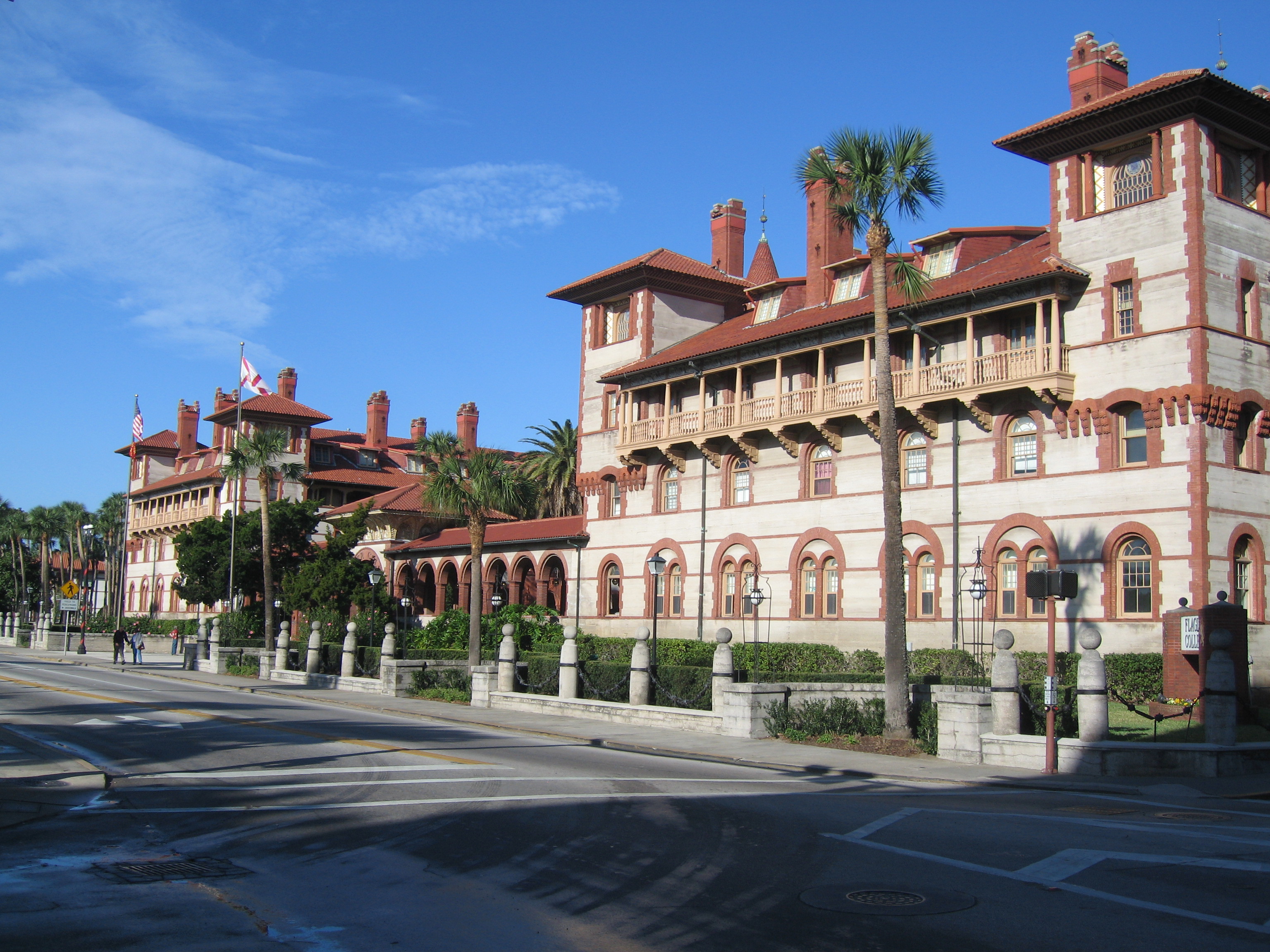
Ponce de Leon Hotel
When the Hotel Ponce de Leon opened on January 10, 1888, its guests refused to touch the electricity. Henry Flagler, the Standard Oil co-founder who built the 540-room palace, had to hire staff to walk the hallways turning lights on and off for residents terrified of the switches. Thomas Edison, a personal friend of Flagler, had personally overseen the installation of DC dynamos in the building, making it one of the first structures in the world wired for electricity from the ground up. The hotel's twin towers, which look purely decorative from the street, were actually water storage tanks holding 8,000 gallons each. Nothing about the Ponce de Leon is what it first appears to be.
Concrete, Canvas, and Ambition
The Hotel Ponce de Leon was the first major building constructed entirely of poured concrete, rising on land that had been an orange grove and salt marsh belonging to Dr. Andrew Anderson. Henry Flagler hired the New York architecture firm of John Carrere and Thomas Hastings for their first major commission -- a Spanish Colonial Revival hotel so ambitious that Flagler spent several times his original estimate. Architect Emmanuel Louis Masqueray, freshly arrived from Paris and later the supervisor of the 1904 World's Fair in St. Louis, created the watercolor elevation. Inside, Virgilio Tojetti painted canvases of angels that were stretched across the ceilings, while George W. Maynard completed murals in the rotunda and dining room -- the same artist who would later paint the Exploration series in the Library of Congress. The building's grandeur was no accident. Carrere and Hastings went on to design more than 600 projects, including the New York Public Library.
From Ballroom to Barracks
During World War II, the federal government commandeered the Ponce de Leon as a Coast Guard Training Center. St. Augustine became the birthplace of the Coast Guard Reserve; one of the first Reserve officer classes graduated there in May 1941. From 1942 until 1945, up to 2,500 young recruits lived in the building at any given time, sleeping where Gilded Age socialites once danced. A small room east of the central dome served as a brig. Among those trainees was Jacob Lawrence, already a celebrated artist. Drafted in October 1943 into a still-segregated military, Lawrence was automatically assigned as a steward's mate. His commanding officer, Captain J.S. Rosenthal, recognized his talent and encouraged him to keep painting. Lawrence later became the first African-American artist to have his work hung in both the Vatican and the White House.
The Long Decline and the College
After the war, crowds returned briefly, but the hotel's glory days were over. Visitor numbers declined steadily, and in 1967 the Ponce de Leon permanently closed. A year later, in 1968, the building was reborn as the centerpiece of the newly established Flagler College. The transformation was not merely functional -- it was restorative. Beginning in 1976, during the nation's bicentennial, Flagler College embarked on an ambitious campaign to return the hotel and surrounding Flagler-era campus buildings to their original grandeur. Maynard's rotunda murals were cleaned and preserved. Tojetti's angel canvases received conservation treatment. In 1988, the college celebrated the centennial of the hotel's opening. Students later created the Flagler's Legacy program, offering guided tours of the former hotel to thousands of visitors each year.
Landmarks Within Landmarks
The building was added to the National Register of Historic Places in 1975 and designated a U.S. National Historic Landmark on February 21, 2006. But the Ponce de Leon's legacy extends beyond preservation awards. Ring Lardner wrote about visiting the hotel's murals. Rudolph Valentino filmed scenes for the 1920 silent film Stolen Moments in the hotel courtyard. During the Great Depression, St. Augustine attracted a colony of literary figures -- Ernest Hemingway, Zora Neale Hurston, Robert Frost, John Dos Passos, and Marjorie Kinnan Rawlings all visited or lived in the area, drawn partly by the same quality of light and architecture that had attracted Flagler's winter tourists decades earlier. Today, college students walk through the same lobbies where Edison tested his dynamos and Lawrence sketched between drills, a building that has never stopped collecting stories.
From the Air
The Ponce de Leon Hotel (now Flagler College) is located at approximately 29.892N, 81.315W in downtown St. Augustine. From the air, its Spanish Colonial Revival towers, terracotta roofline, and central dome are unmistakable landmarks in the historic district. The building sits directly across King Street from the Lightner Museum (former Hotel Alcazar) and one block from the Casa Monica Hotel. The Matanzas River is visible to the east, with the Bridge of Lions connecting to Anastasia Island. Nearest airport: St. Augustine Airport (KSGJ), approximately 4nm northwest. The Castillo de San Marcos is visible to the northeast along the bayfront. Best viewed at 1,500-3,000 feet in clear conditions.