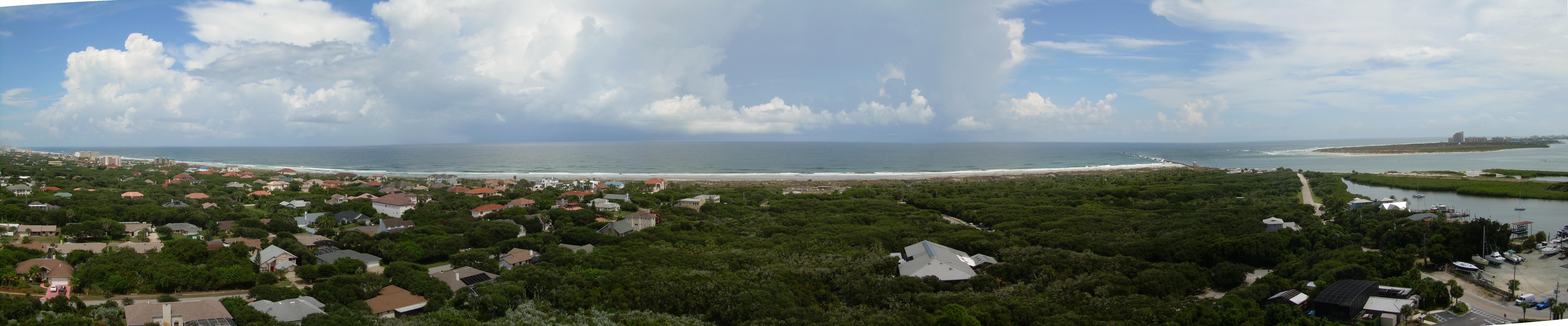
Ponce de Leon Inlet Light
Stephen Crane was convinced he was going to die. It was January 1897, and the journalist-turned-war-correspondent was clinging to a ten-foot dinghy in the Atlantic swells off the Florida coast, the steamship SS Commodore sinking behind him. Then, through the spray and gray horizon, he and his crewmates spotted it: the Mosquito Inlet Light, a 175-foot brick tower that had been guiding ships past this treacherous stretch of coast for a decade. Crane survived, steered toward the light, and turned the ordeal into "The Open Boat," one of the most celebrated short stories in American literature. The lighthouse he aimed for still stands today at Ponce de Leon Inlet, the tallest in Florida and a National Historic Landmark since 1998.
A Tower That Fell Before It Ever Shone
The first attempt to light this inlet ended in failure. In 1835, a lighthouse was erected on the south side of what was then called Mosquito Inlet, but the oil for its lamp was never delivered. Before the oversight could be corrected, a storm scoured the sand from around the base, weakening the structure. Then the Second Seminole War erupted, and in December 1835, Seminole warriors attacked the tower, smashing the lantern room glass and setting fire to the wooden stairs. The area was abandoned, and without anyone to repair it, the lighthouse collapsed the following year. For nearly fifty years afterward, ships navigated this coastline in darkness, and wrecks piled up along the shore.
The Engineer Who Never Saw It Finished
It was not until 1883 that construction began on a replacement lighthouse, this time on the north side of the inlet. The project followed Light-House Board standard plans, modified for the local conditions, and was supervised by Chief Engineer Orville E. Babcock. Babcock never saw his work completed. In 1884, he drowned in the waters of Mosquito Inlet itself, the very channel his lighthouse was meant to protect. Other engineers carried the project forward, and in 1887 the tower was finished and its kerosene lamp lit for the first time. The beam could be seen for miles across the open Atlantic, finally giving mariners a reliable mark along Florida's central coast.
From Kerosene to Electricity
The lighthouse evolved with the technology of its era. The original kerosene lamp gave way to an incandescent oil vapor lamp in 1909. In 1924, a generator replaced the old windmill pump, bringing electricity to the keepers' dwellings and water system. The beacon itself was electrified in 1933 with a 500-watt lamp, and the original first order Fresnel lens was swapped for a smaller third order rotating Fresnel lens. In 1927, the inlet was officially renamed from Mosquito Inlet to Ponce de Leon Inlet, and in 1939 the lighthouse transferred from the abolished Lighthouse Service to the United States Coast Guard. The Coast Guard operated the station for three decades before abandoning it in 1970 in favor of a new beacon at New Smyrna Beach.
Rescued from Ruin
Abandonment might have been the end of the story, but concerned citizens of the Town of Ponce Inlet had other plans. In 1972, the town accepted the light station property from the Coast Guard, and the Ponce de Leon Inlet Lighthouse Preservation Association was formed to manage the site as a museum. That same year, the lighthouse was listed on the National Register of Historic Places. The tower and three keepers' dwellings have been fully restored and are open to the public seven days a week. Visitors can climb the 203 steps to the top. The museum displays the original 1867 Barbier et Fenestre first order fixed lens installed in 1887, an 1860 Henry Lepaute rotating first order Fresnel lens from the Cape Canaveral Light Station, and a 1904 Barbier, Benard, et Turenne third order lens that has been restored to active service in the tower as a private aid to navigation. It is one of only eleven lighthouses in the country designated a National Historic Landmark.
From the Air
The Ponce de Leon Inlet Light stands at 29.08N, 80.93W on the north side of Ponce de Leon Inlet, just south of Daytona Beach. At 175 feet, the red-brick tower is a prominent visual landmark from the air, easily spotted along the narrow barrier island separating the Halifax River from the Atlantic Ocean. The inlet itself is a clear break in the barrier island. Look for the lighthouse on the southern tip of the Daytona Beach peninsula, where the inlet opens to the sea. Nearest airports: Daytona Beach International Airport (KDAB) approximately 10nm north, New Smyrna Beach Municipal Airport (KEVB) approximately 7nm south, Spruce Creek Fly-In (7FL6) approximately 4nm west.