Pondicherry
Pondicherry - now officially Puducherry - was a French colony until India absorbed it in 1954. Today this coastal city of 250,000 keeps baguettes and boulevards alive alongside Tamil temples and traditions. Yellow colonial buildings still line streets with French names. Auroville's utopian commune attracts seekers from around the world. Along the beach promenade, statues of colonial governors share space with Indian monuments. Outside Goa, no city in India looks more European. Three hundred years of French rule made sure of that.
The French Quarter
Walk into the French Quarter and Pondicherry changes. Streets follow a neat grid, their names still French. Colonial buildings stand in yellows and whites, and cafes serve croissants alongside espresso. France maintained this quarter until 1954, and careful preservation has kept it intact through decades of Indian administration. It feels unlike anywhere else in the country.
Tourists concentrate here. Boutique hotels occupy colonial buildings, restaurants serve both French and Indian cuisines, and shops stock what visitors want. In many ways the French Quarter is a performance of difference - but an effective one.
The Ashram
Spiritual seekers have come to Pondicherry since the philosopher Sri Aurobindo and his spiritual partner the Mother established their ashram here. It still operates today. Devotees wear white, and at the samadhi where both are buried, visitors gather in quiet reverence. Long before beaches became a draw, the ashram was the reason certain travelers sought out this city.
The ashram represents one side of Pondicherry - spiritual seeking, communal living, a philosophy that attracted followers from around the world. Its influence shapes the city's character, promoting vegetarianism and sobriety in the surrounding neighborhoods.
Auroville
In 1968 the Mother founded Auroville, a township designed for human unity. Residents from dozens of countries now live and work here. At its center stands the Matrimandir, a golden sphere devoted to meditation and a symbol of humanity transcending divisions. More than fifty years on, the experiment continues.
Controversy follows Auroville closely. Believers defend its idealism; critics point to contradictions and the persistent gap between vision and reality. What happens when utopian ideals meet human nature? Something interesting, if incomplete.
The Beach
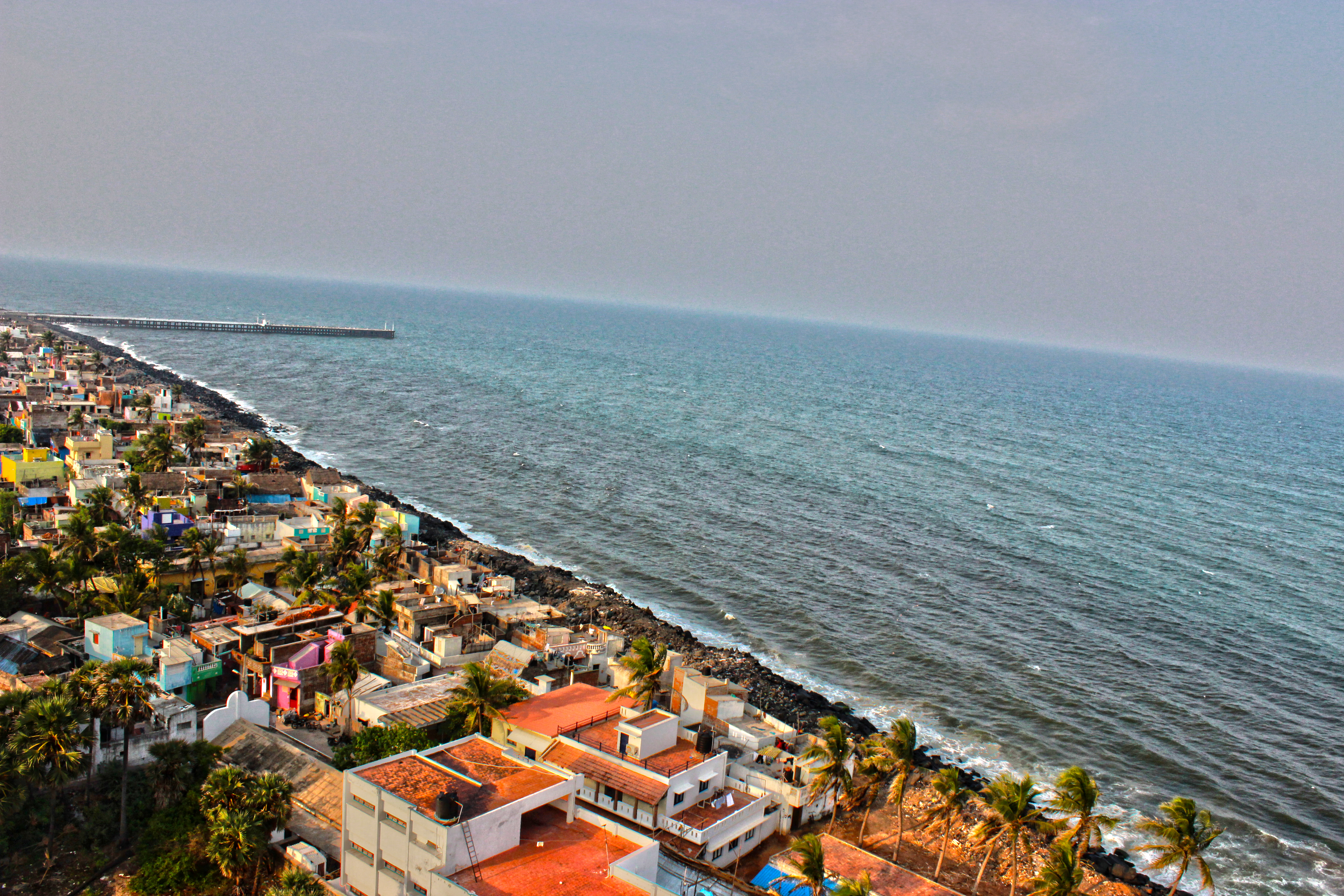
Every morning joggers claim the Promenade beach. By evening, strollers take over, moving beneath statues and street lights France installed decades ago. Swimming is out - rocks and dangerous currents forbid it. But this stretch of public space, shaped by colonial planning, serves a different purpose: gathering.
Here French and Indian Pondicherry converge. The Gandhi statue and the French war memorial share the same promenade, facing the same sea. Pondicherry displays itself along this waterfront, performing for residents and visitors alike.
The Tamil Quarter
Cross the canal and you enter a different Pondicherry. In the Tamil Quarter, temples replace churches on the skyline. Tamil is spoken everywhere; French is foreign. Most Pondicherrians live here, in neighborhoods that colonial planning once deliberately separated from the European settlement. Independence hasn't fully erased that old divide.
Beyond the colonial facade lies the authenticity visitors rarely see. This is what makes Pondicherry Indian, even as tourism promotes the French vocabulary. The real city lives on the other side of the canal.
From the Air
Pondicherry (11.93N, 79.83E) lies on the Coromandel Coast of Tamil Nadu in southeastern India. Chennai (VOMM/MAA), 150km to the north, is the nearest major airport. A small local airstrip exists but offers limited commercial service. From the air, the French Quarter's grid pattern stands out against the Bay of Bengal coastline. The Promenade runs along the beach, and Auroville sits 10km north. Expect tropical heat year-round, with the northeast monsoon bringing heavy rain from October through December. Cyclones are possible. French-style streets contrast sharply with typical Indian urban development.