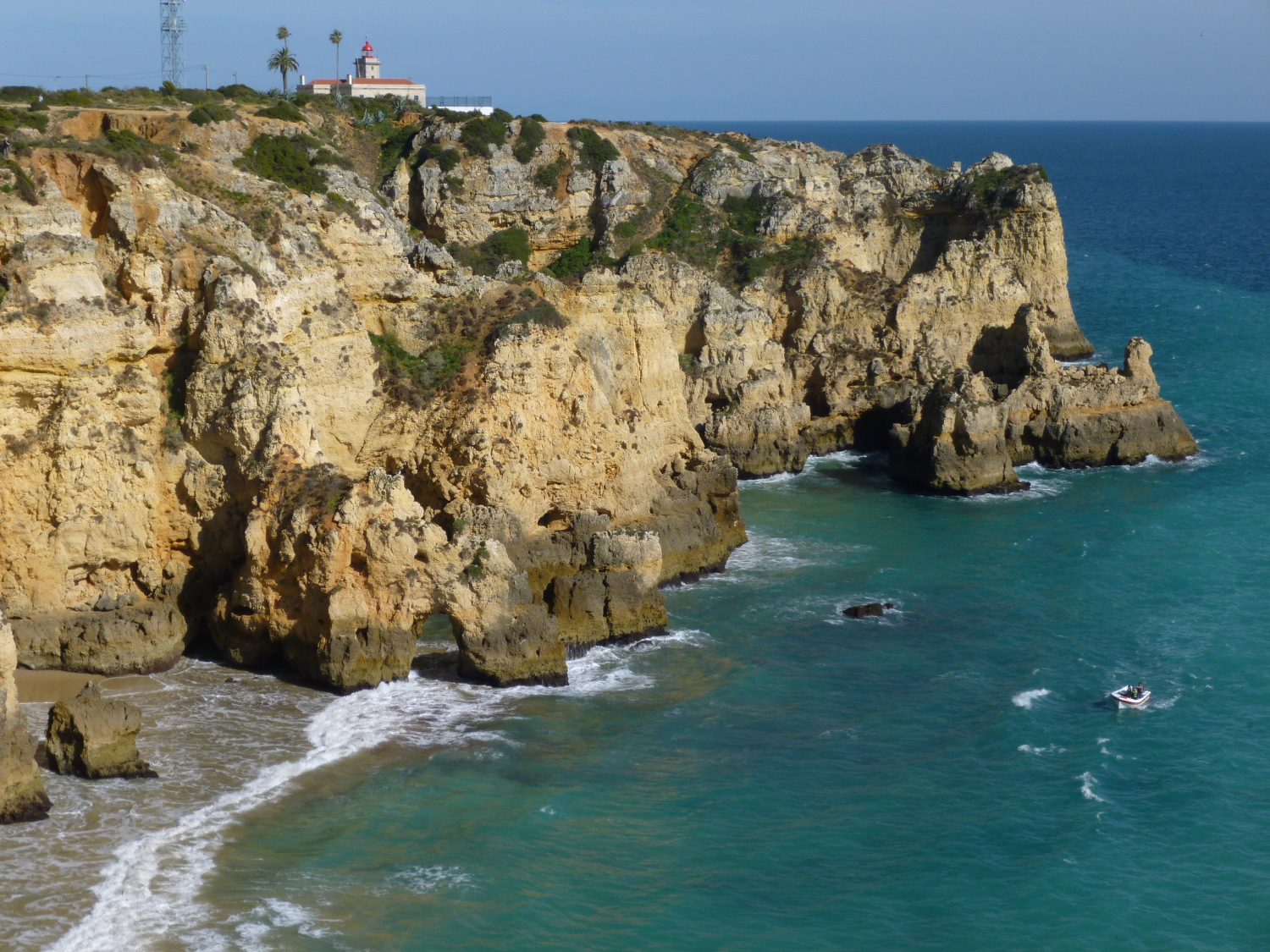
Ponta da Piedade Lighthouse
For thirty years, the people of Lagos said no. Plans for a lighthouse at Ponta da Piedade were drawn up as early as 1883, but the local parish council refused to allow construction because it would require demolishing the ruins of the Nossa Senhora da Piedade hermitage -- a small chapel dedicated to Our Lady of Piety that had crumbled but remained sacred in local memory. Three decades of bureaucratic standoff followed, the needs of maritime safety weighed against the reverence for a ruin. The lighthouse finally went up in 1912-13, built on the hermitage's foundations, its red flash replacing the prayers that had once been offered from the same clifftop.
Light on the Cliffs
The Ponta da Piedade Lighthouse is a stone tower of masonry standing fifty-one meters above sea level, with an attached keeper's house, on one of the most dramatic stretches of the Algarve coastline near Lagos, Portugal. When it first began operations in mid-1913, it carried a fourth-order Fresnel lens that emitted five grouped flashes every ten seconds, its oil lamp visible for eighteen nautical miles. The technology evolved over the decades. In 1923, the original lens was temporarily replaced by a smaller sixth-order unit with a fixed white light. Electrification came in 1952, when the oil lamp gave way to an electric bulb powered by the public grid. The range initially dropped to fifteen nautical miles before being increased back to eighteen. In 1983, the lighthouse was fully automated using equipment from the Gisman company, its rhythm changing to one white flash every seven seconds -- a steady, solitary pulse above the golden cliffs.
A Coastline Carved by Time
Below the lighthouse, the sea has spent millennia sculpting the Algarve's soft sandstone and limestone into something extraordinary. Towering arches, sea stacks, grottoes, and tunnels line the coast at Ponta da Piedade, their surfaces glowing amber and ochre in the southern Portuguese sun. The rock formations have made this one of the most photographed locations in the Algarve -- a place where the geometry of erosion produces shapes that seem designed rather than accidental. Small boats carry visitors from the base of the cliffs through sea caves and beneath natural bridges, the water shifting from turquoise to emerald depending on the depth and the angle of light. The lighthouse sits above it all, functional and unadorned, a working beacon on a headland that draws tourists for reasons its builders never anticipated.
Between the Sacred and the Practical
The tension between the hermitage and the lighthouse captures something essential about the Algarve coast. This is a landscape layered with devotion and pragmatism, where fishermen named headlands after saints and mariners needed fixed lights to avoid the reefs below. The hermitage of Nossa Senhora da Piedade had served its own kind of navigation -- spiritual rather than nautical -- before time and weather reduced it to foundations. Building the lighthouse on those same foundations was less an act of replacement than of continuation: one form of guidance succeeding another on the same promontory, both oriented toward the sea. The keeper's house still stands attached to the tower, though no keeper has lived there since automation in 1983. The red flashlight that distinguishes this beacon from its neighbors along the coast continues its seven-second rhythm, marking the headland for vessels rounding the southwestern corner of Portugal on their way between the Atlantic and the Mediterranean.
From the Air
Located at 37.08N, 8.67W on the dramatic Ponta da Piedade headland near Lagos, Portugal. The lighthouse and its white tower are visible from the air against the golden sandstone cliffs. The spectacular rock formations -- arches, sea stacks, and grottoes -- are best seen from low altitude (1,000-2,000 feet). Nearest airport: Faro (LPFR), approximately 35 nm east. Lagos aerodrome (LPLG) is about 3 nm north. The coast here faces south, with generally good visibility except in summer morning fog.