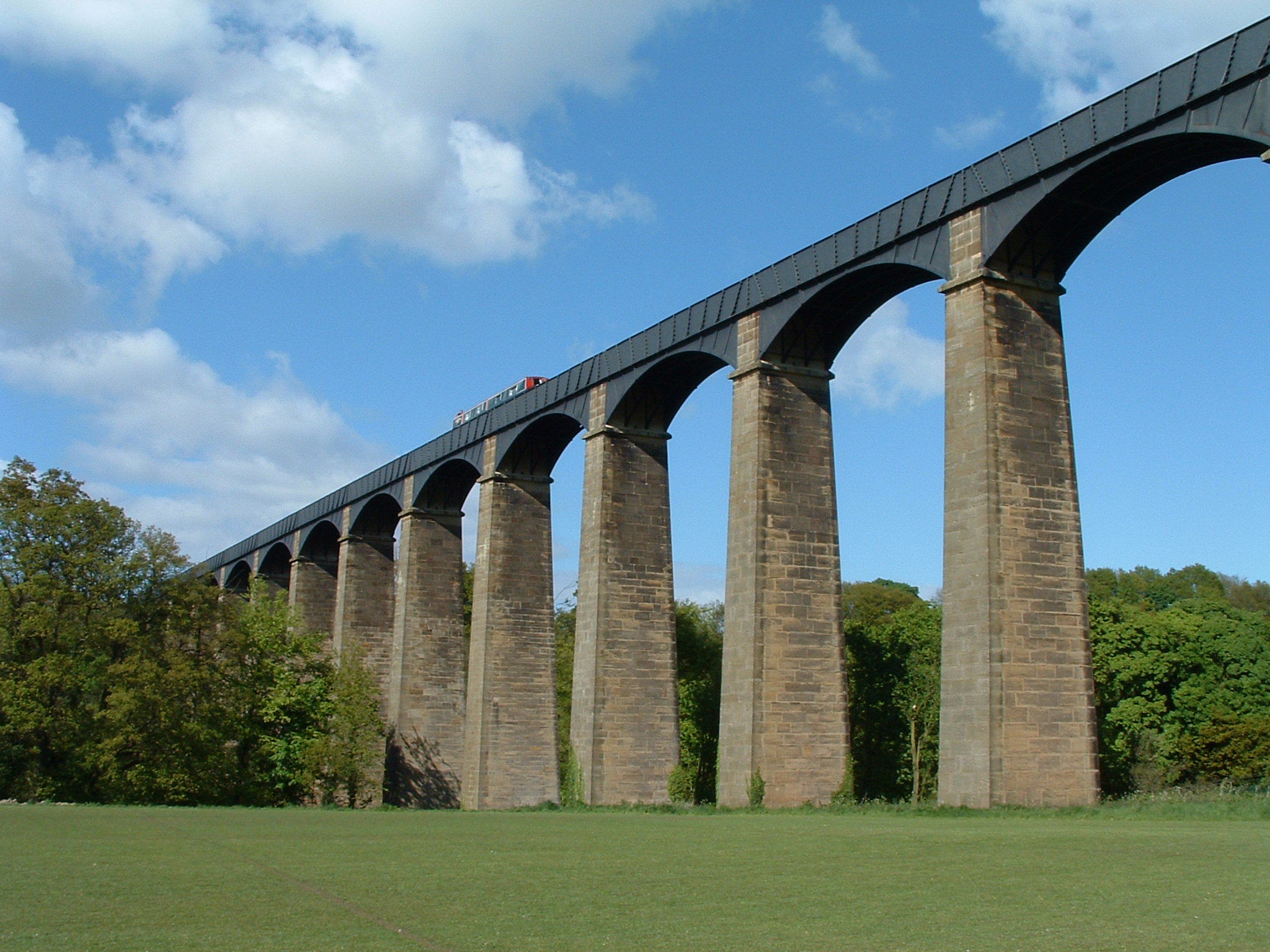
Pontcysyllte Aqueduct
The helmsman of a narrowboat crossing the Pontcysyllte Aqueduct has no railings on the canal side. The cast-iron trough rises barely six inches above the waterline, and the River Dee flows 126 feet below. There is nothing between the boat and the abyss but a thin lip of metal and the steadiness of one's nerve. This is Thomas Telford's masterpiece, completed in 1805, the highest navigable aqueduct in the world and a structure so audacious that the public considered it impossible right up until the moment it worked.
Blood, Iron, and Flannel
The aqueduct's construction reads like an inventory of Georgian ingenuity. The mortar binding its eighteen hollow masonry piers uses lime, water, and ox blood, a technique dating to antiquity that strengthens the mixture against freeze-thaw cycles. The cast-iron trough plates were produced at William Hazledine's Plas Kynaston Foundry in nearby Cefn Mawr, each one shaped not as a simple rectangle but as a voussoir, mimicking the form of a stone arch for decorative effect. The joints between plates were sealed with Welsh flannel bedded in a mixture of white lead and iron filings from boring waste. Telford had tested this approach on a smaller scale at the Longdon-on-Tern Aqueduct on the Shrewsbury Canal, and his confidence in the method proved justified. The structure is 336 yards long, 11 feet wide, and took ten years from design to completion, at a cost of forty-seven thousand pounds.
The Canal That Never Was
Pontcysyllte was meant to be the centerpiece of something far grander. The Ellesmere Canal would have linked the River Severn at Shrewsbury to the Port of Liverpool on the River Mersey, creating a commercial corridor across the Welsh-English borderlands. The westerly route through the Vale of Llangollen was chosen over a cheaper eastern path because it would pass through the mineral-rich coalfields of northeast Wales. But the revenues never materialized. Most major work ceased after Pontcysyllte opened in 1805, and Trevor Basin, just beyond the aqueduct's northern end, became the canal's unceremonious terminus. In 1808, a feeder channel from the River Dee near Llangollen was completed, and Telford built the Horseshoe Falls weir at Llantysilio to maintain the water supply. The canal survived not because of the commerce it was built for, but because it supplied drinking water to a reservoir at Hurleston.
The Physics of Floating
A canal aqueduct obeys a principle that seems counterintuitive until you think it through. Thanks to Archimedes, the weight on the bridge remains virtually constant whether a narrowboat is crossing or not. A boat displaces exactly its own weight in water, pushing that water off the bridge as it enters. The towpath is mounted above the waterline on cast-iron pillars set within the trough, allowing displaced water to flow freely beneath it and around the vessel. This elegant arrangement has kept the aqueduct functional for over two centuries. Every five years, the Canal and River Trust closes both ends and pulls a plug in one of the highest spans, draining the water into the Dee below for inspection and maintenance, a spectacle that draws crowds to watch a river appear where a canal had been.
From Industry to Wonder
By the 1980s, the former Ellesmere Canal had been rebranded as the Llangollen Canal, and leisure boats had replaced coal barges. The canal became one of the most popular holiday waterways in Britain, largely because of the aqueduct and the dramatic scenery of the Dee Valley. In 2009, UNESCO inscribed Pontcysyllte and a stretch of canal running from Rhoswiel to the Horseshoe Falls as a World Heritage Site, recognizing it as a masterpiece of creative genius from the early Industrial Revolution. The designation covers not just the main aqueduct but also the older Chirk Aqueduct nearby. Today the aqueduct is maintained by the Canal and River Trust, and narrowboats still cross it daily, their passengers gripping the tiller a little tighter as the valley opens beneath them and the iron lip of Telford's trough becomes the only boundary between the everyday and the extraordinary.
From the Air
Located at 52.970N, 3.088W in the Dee Valley near Llangollen, northeast Wales. The aqueduct is spectacularly visible from the air as a thin line crossing high above the River Dee on tall masonry piers. Best viewed from lower altitudes where the height of the structure above the valley floor is apparent. Nearby airports include Hawarden (EGNR) and Welshpool (EGCW). The Chirk Aqueduct and Chirk Castle are visible just to the south.