Pontevedra Museum
The most important gold treasure on the Iberian Peninsula sits in a security room in a former Jesuit college in the Galician city of Pontevedra. The treasure of Caldas de Reis, dating from the Bronze Age, was discovered buried in a vineyard on December 20, 1940, and its weight makes it one of the most significant gold finds in all of Europe. It is just one piece of a collection so large it takes six buildings to house it. The Pontevedra Museum, founded by the Provincial Council on December 30, 1927, has grown from a single manor house into a complex that sprawls across the old quarter, occupying Gothic ruins, baroque colleges, 18th-century manor houses, and a modern 10,000-square-meter exhibition hall.
Six Buildings, Six Centuries
The museum's oldest building is also its most atmospheric. The ruins of the San Domingo convent, built in the 14th and 15th centuries, were abandoned after the Ecclesiastical Confiscations of Mendizabal in 1834. Only the main chapel and side chapels of the chevet survive, but among the standing walls visitors find a collection of coats of arms, tombstones, Visigothic and Romanesque capitals, and carved statuary. The first purpose-built museum space was the Castro Monteagudo building, dating to 1760, originally constructed by the province's first auditor. The Garcia Florez building, an 18th-century manor house, joined the museum in 1943, bringing navigation equipment, religious sculptures, and Sargadelos earthenware. The Fernandez Lopez building, completed in 1965 and later expanded, houses romantic and historical paintings with rooms dedicated to Goya and Joaquin Sorolla, as well as a library of over 150,000 bibliographic records.
Gold and Stone from the Castro Culture
The Sarmiento building, a baroque former Jesuit college begun in 1695 and completed in 1714, was incorporated into the museum in 1979 and thoroughly remodeled before reopening in 2013. Its galleries hold the archaeological collection and medieval Galician art from the 13th century onward. The torcs and jewelry of the Castro culture, the pre-Roman Celtic civilization that built the hilltop settlements across Galicia, are a particular highlight. Pieces from the treasures of Caldas de Reis and Agolada represent a goldsmithing tradition that flourished centuries before the Romans arrived. The silverware collection in the Castro Monteagudo building ranges even further, encompassing pieces from Russia, China, Turkey, and Latin America. One of its most curious objects is a box from 1600 that belonged to the New England preacher Thomas Hooker, an artifact that somehow traveled from colonial America to a Galician museum.
Castelao and the Art of Galicia
The sixth and newest building, the Castelao Building, was designed by architects Eduardo Pesquera and Jesus Ulargui and inaugurated on January 4, 2013. Its 23 rooms across four floors trace Galician art from the Gothic period to the present. The first floor covers the Gothic through the 19th century, including an altarpiece from the Dominican convent in Santiago de Compostela and works by Goya and Gregorio Fernandez. The second floor is dedicated to the turn of the 20th century, with works by Ovidio Murguia and the instruments of violinist Manuel Quiroga Losada. Two rooms honor Alfonso Daniel Rodriguez Castelao, the artist, writer, and political figure who became a symbol of Galician identity. The museum houses Castelao's most emblematic work, including the original album Nos, acquired by the museum for 650,000 euros. The third floor brings the story to the present with contemporary Galician artists.
A Museum Still Growing
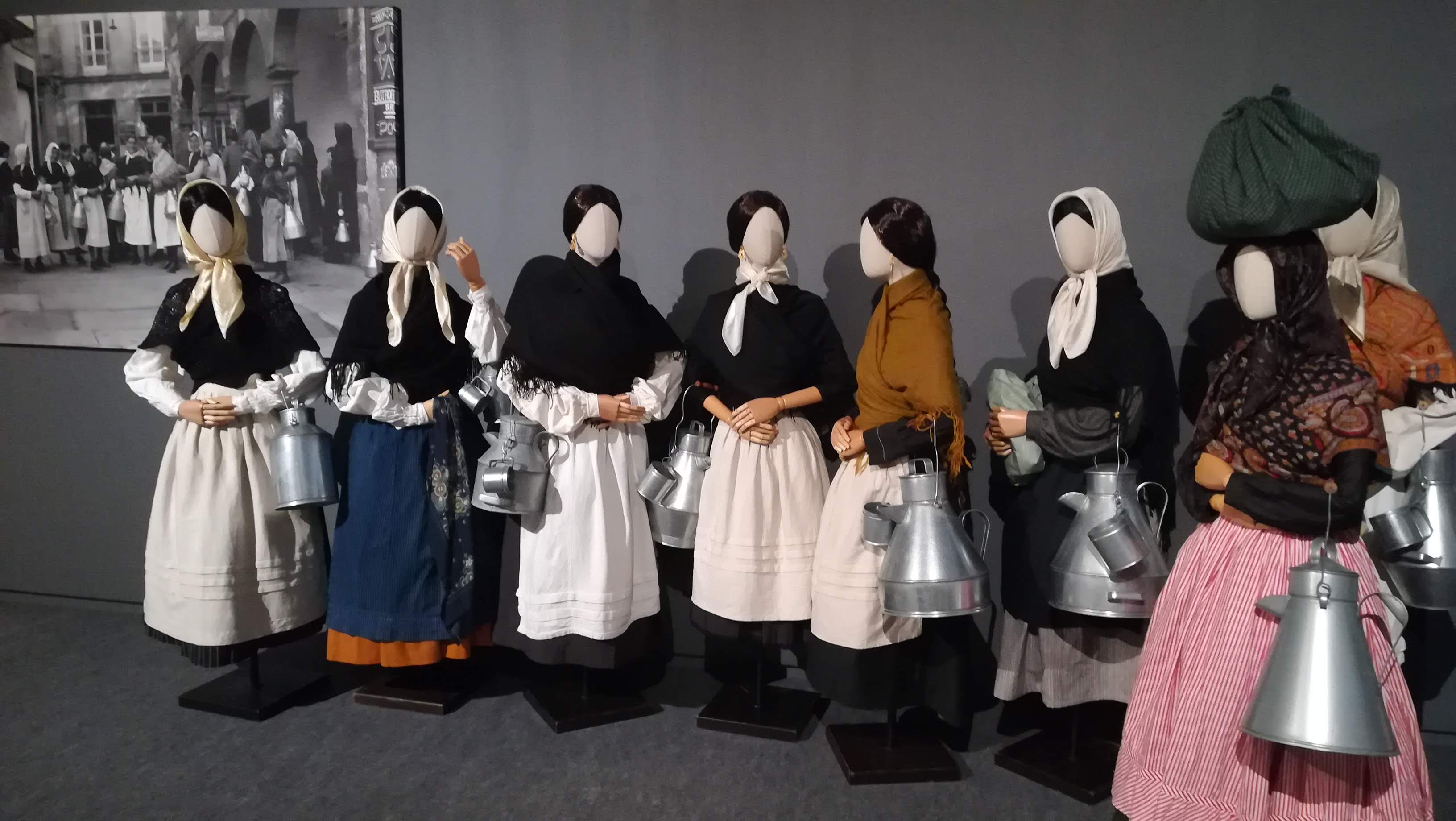
In December 2021, the City Council of Pontevedra purchased the Saint Clare's Convent from the Order of Poor Clares for 3.2 million euros, and in January 2023 transferred it to the Provincial Deputation for integration as the museum's seventh building. The museum's reach extends beyond its permanent collection: a 2022 exhibition of 75 traditional Galician folk costumes, paired with photographs taken by American photographer Ruth Matilda Anderson between 1924 and 1926, drew over 14,000 visitors and became the most successful event in five years. By the end of 2022, the museum recorded nearly 175,000 visitors. For a provincial museum in a city of 80,000, those numbers speak to something beyond tourism. They speak to a region that has invested in knowing itself.
From the Air
Located at 42.43N, 8.64W in the old quarter of Pontevedra, Galicia, northwest Spain. The city sits at the head of the Ria de Pontevedra, one of the Rias Baixas inlets of the Atlantic coast. The museum complex is distributed across the old town and is not visible as a single structure from altitude. Nearest airport is LEVX (Vigo-Peinador) approximately 25 km south. The Rande Bridge and Vigo Bay are visible to the southwest. Best viewed at low altitude in clear conditions.