Pontianak Sultanate
On a Wednesday in October 1771, a flotilla led by a man of Hadrami Arab descent reached the point where three rivers converge on the western coast of Borneo. Syarif Abdurrahman Alkadrie had come to build a kingdom, and the triple junction of the Landak, Kapuas Kecil, and Kapuas Besar rivers offered exactly what he needed: a natural trading crossroads deep enough for ocean-going vessels, surrounded by forest dense enough to supply timber for palaces and mosques. Within seven years, the Dutch East India Company had recognized him as sultan. The Pontianak Kadriyah Sultanate would endure for nearly 180 years, through colonial entanglements, wartime atrocity, and the birth of a nation, before its formal dissolution in 1950.
Marriage, Ambition, and Three Rivers
Alkadrie's path to power was paved with strategic alliances. His father, a Hadrami cleric, had traveled from Semarang to West Kalimantan and married into the Matan royal family. Alkadrie himself made two political marriages: the first to Utin Chandramidi, princess of the Mempawah Kingdom, and the second in 1768 to Ratu Syahranum of the Banjar Sultanate, which earned him the title Pangeran Nur Alam. These unions connected him to the most powerful Malay courts on the island. When he arrived at the river confluence in 1771, he was not an outsider carving a kingdom from nothing -- he was a man who had woven himself into Borneo's political fabric and now claimed his own thread. He cleared the forest, built a hall and residence, and established the Jami Mosque and Kadriyah Palace as the twin pillars of his new capital.
The Dutch Bargain
The Dutch arrived in Pontianak in 1778, led by Willem Ardinpalm from Batavia. Alkadrie initially refused foreign cooperation, but after a second diplomatic mission he accepted the Dutch as partners. On July 5, 1779, an agreement granted the Dutch use of land across the river from the sultan's palace -- an area called Tanah Seribu -- which became the seat of Dutch colonial administration in West Borneo. It was a relationship of mutual convenience: the sultanate gained a powerful trading partner and military ally, while the Dutch gained a foothold on Borneo's western coast. Successive sultans deepened this partnership. Syarif Kasim (1808-1819) strengthened ties with both the Dutch and the British. Syarif Usman (1819-1855) expanded the Kadriyah Palace and continued construction of the Jami Mosque. The sultanate even maintained friendly relations with the Lanfang Republic, a remarkable Chinese-governed state in the same region.
Modernizers and Traditionalists
The longest-reigning sultan, Syarif Muhammad Alkadrie (1895-1944), transformed Pontianak into something his predecessors might not have recognized. He was the first Malay sultan in West Kalimantan to wear European regalia alongside the traditional Teluk Belanga, signaling an embrace of modernization that went beyond fashion. He championed education and public health, encouraged European and Chinese investment, and supported the development of rubber, coconut, and copra plantations. His predecessor Syarif Yusuf (1872-1895) had been the sultanate's most religiously devoted ruler, a man who largely stayed out of politics to focus on spreading Islam. The contrast between these two consecutive reigns captures a tension that ran through the sultanate's history: how much to engage with the outside world, and on whose terms.
The Mandor Tragedy
When the Imperial Japanese army reached Pontianak in 1942, the era of Sultan Syarif Muhammad came to a violent end. Suspecting plots among scholars, nobles, sultans, and community leaders across West Kalimantan, the Japanese launched a wave of arrests between September 1943 and early 1944. The repression went far beyond detention. Thousands of residents of Pontianak and the surrounding area were tortured and killed. On June 28, 1944, Japanese forces executed Sultan Syarif Muhammad along with family members, traditional leaders, scholars, and community figures. Two of his sons were beheaded. The same fate befell sultans and leaders across West Kalimantan in what became known as the Mandor Incident -- a massacre that devastated the region's traditional leadership and contributed to the outbreak of the Dayak Desa War.
From Sultan to Nation-Builder
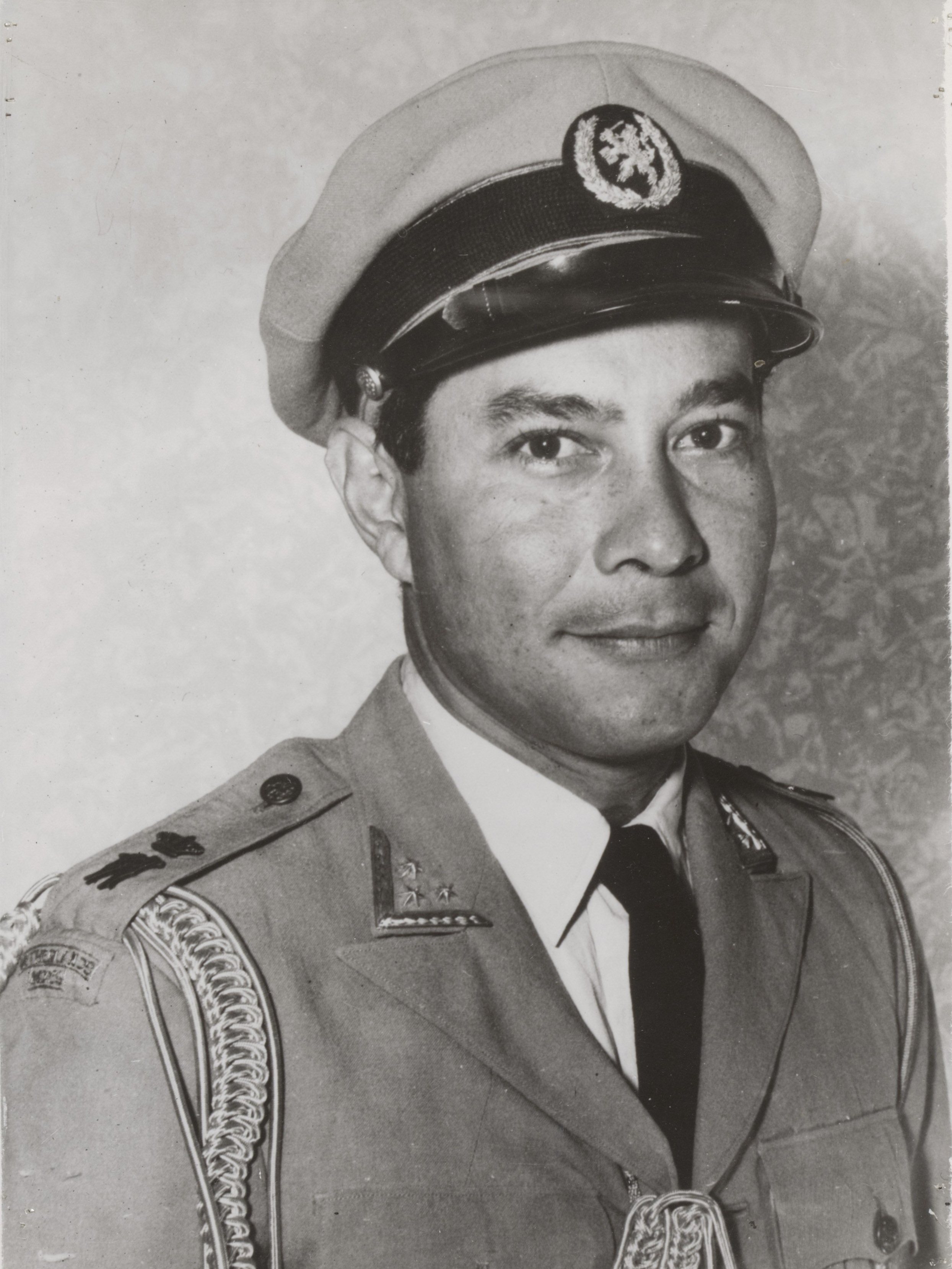
Sultan Syarif Muhammad's son, Syarif Hamid, survived only because he had been a Japanese prisoner of war in Batavia since 1942. Released in 1945, he returned to Pontianak and was crowned Sultan Hamid II on October 29, 1945. What followed was extraordinary: Hamid II led the Pontianak Sultanate and the Malay sultanates of West Kalimantan into the newly independent Republic of Indonesia. He served as President of the State of West Kalimantan from 1947 to 1950 and designed Indonesia's national emblem, the Garuda Pancasila. But his career ended in disgrace when he was implicated in a coup attempt by Raymond Westerling's APRA forces. After Hamid II's death in 1978, the sultan's seat sat empty for a quarter century until 2004, when the Kadriyah Palace nobles appointed Syarif Abubakar Alkadrie as the eighth Sultan of Pontianak -- a ceremonial title, but one that preserves the memory of a dynasty that shaped western Borneo.
From the Air
Located at 0.021S, 109.341E at the confluence of the Kapuas River system in Pontianak, West Kalimantan, Indonesia. The Kadriyah Palace and adjacent Jami Mosque are visible from low altitude along the riverbank in East Pontianak. The city straddles the equator -- the Equator Monument is a notable landmark. Nearest airport is Supadio International Airport (WIOO), approximately 17 km south of the city center. The Kapuas River, Indonesia's longest river in Kalimantan, dominates the landscape below. Tropical climate with year-round humidity and frequent afternoon thunderstorms.