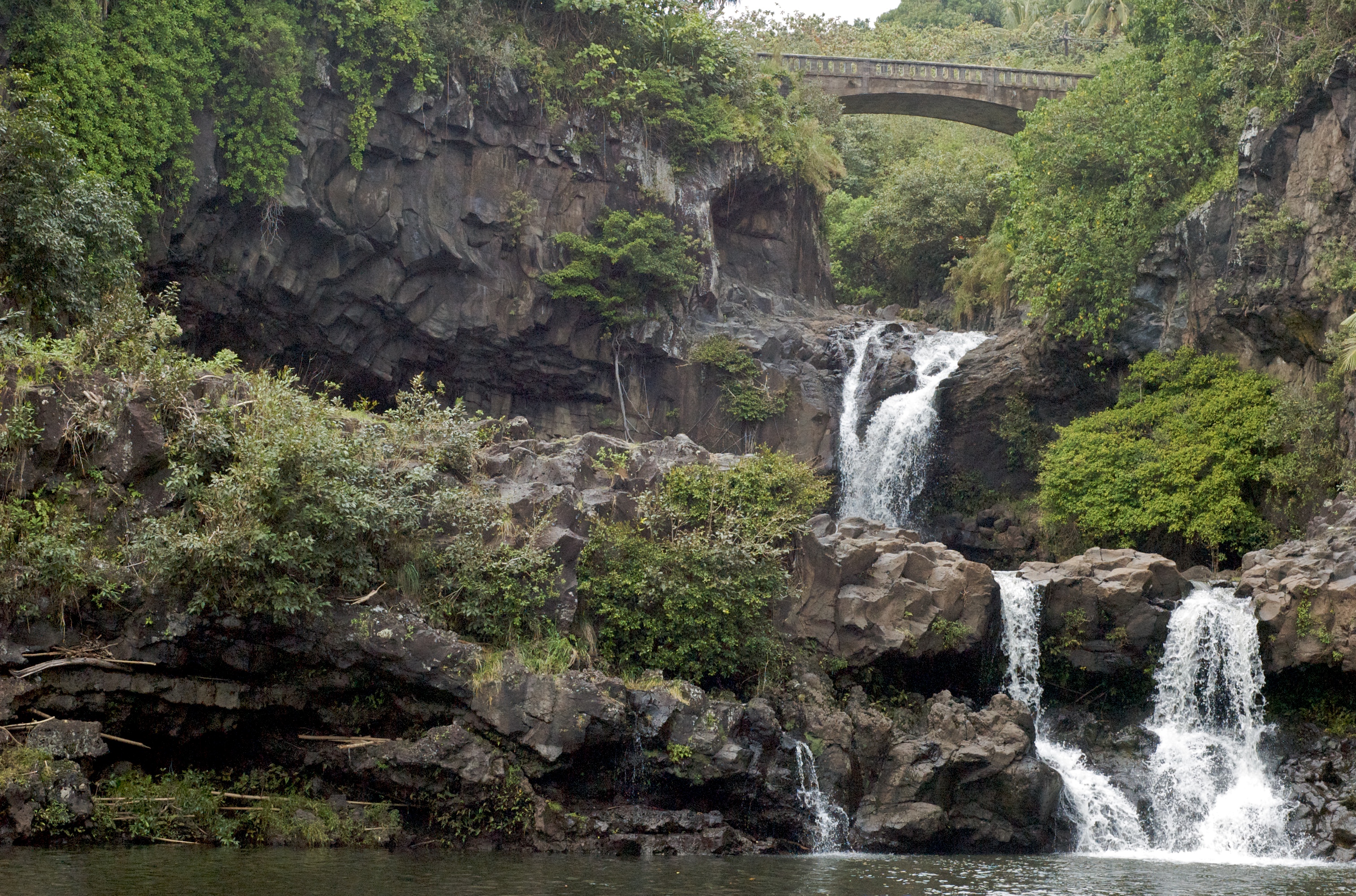
Pools of ʻOheʻo
The name is a lie, and a profitable one. In the 1940s, the owner of the Travaasa Hana hotel looked at the chain of freshwater pools cascading through a volcanic gulch on Maui's remote eastern coast and saw a marketing problem: nobody was coming. So he christened them the "Seven Sacred Pools," a name exotic enough to lure tourists down the winding road to Hana. There are not seven pools -- there are far more, tumbling in tiers from the upper slopes of Haleakala down through the 'Ohe'o Gulch to the sea. And they were never sacred to Hawaiian culture. But the name stuck, and the visitors came, and the pools' real story -- one of conservation, friendship, and the tension between preservation and access -- got buried under the branding.
Something Special in the Gulch
The Hawaiian word 'Ohe'o translates to "something special," and the pools earn the description without needing a hotel owner's embellishment. They sit in the Kipahulu section of Haleakala National Park, where Pipiwai Stream tumbles through a series of natural basalt ledges, pooling at each step before spilling over the next. The effect is a staircase of water carved into volcanic rock, each pool a different size and depth, surrounded by dense tropical vegetation that closes in from both sides of the gulch. Above, the stream descends from the cloud forests on Haleakala's slopes. Below, it empties into the Pacific. Between those two points, the pools occupy a middle zone -- neither mountain nor coast, neither river nor ocean -- that feels suspended from the landscape around it.
The Rockefeller Rescue
By 1960, the pools' growing popularity had locals worried. Among them was Sam Pryor, a retired Pan Am executive who had settled near Hana and recognized that uncontrolled tourism could destroy the very thing tourists came to see. Pryor had a powerful friend: Laurance Rockefeller, the philanthropist and conservationist who had already helped establish national parks in the Virgin Islands and Wyoming. Pryor asked Rockefeller to buy a portion of the Kipahulu area to protect it from development. Rockefeller agreed, acquiring the land and eventually selling it to the National Park Service in 1969. The Kipahulu District was folded into Haleakala National Park, placing the pools under federal protection. It was a transaction that depended on personal relationships -- a retired airline executive who knew a Rockefeller, a Rockefeller who believed in preservation -- and it saved the gulch from the resort development that consumed so much of Hawaii's coastline in the decades that followed.
Beauty with Teeth
The pools are not as gentle as they look. Swimming is officially prohibited because the cliff walls above are unstable, and rocks regularly tumble into the water below. Flash floods are a constant threat in the narrow gulch -- rain on Haleakala's upper slopes can send a wall of brown water surging down Pipiwai Stream with little warning, turning the tranquil pools into churning torrents within minutes. Despite posted signs and ranger warnings, visitors have been killed and seriously injured jumping into the pools from the surrounding rocks. The same volcanic geology that carved these beautiful basins also made them dangerous: the ledges are slippery, the depths unpredictable, the currents deceptive. The park service walks a line between welcoming visitors to one of Maui's most iconic landscapes and keeping them alive once they arrive.
The Road That Delivers You
Reaching the pools requires driving the Hana Highway, one of the most famous and demanding roads in Hawaii. The route winds along Maui's northern coast through 620 curves and across 59 bridges before arriving at Hana, and the pools lie another ten miles beyond the town in the Kipahulu District. The isolation is part of the experience and part of the protection. Most visitors who make the journey are committed enough to treat the place with care, though the sheer volume of traffic on the Hana Highway has become a management challenge in itself. The pools sit at the end of a long geographic funnel: the volcano's slope above, the narrow gulch around them, the ocean below. Everything -- water, stone, vegetation, visitors -- moves through this channel toward the sea. The Hawaiian name for the place, 'Ohe'o, promises something special, and the landscape delivers without exaggeration or branding.
From the Air
The Pools of 'Ohe'o are at 20.663°N, 156.042°W in the Kipahulu District of Haleakala National Park on Maui's southeastern coast. From the air, look for the 'Ohe'o Gulch cutting through dense green vegetation from Haleakala's slopes to the ocean -- the tiered pools may be visible as a chain of light-colored water features in the dark gulch. The Kipahulu Visitor Center and parking area are identifiable near the coast. Best viewed below 2,000 feet AGL. Nearest airport: Hana Airport (PHHN), approximately 10 nm to the north-northeast. Kahului Airport (PHOG) is about 40 nm to the west-northwest. Watch for orographic cloud buildup along Haleakala's slopes, especially in afternoon.