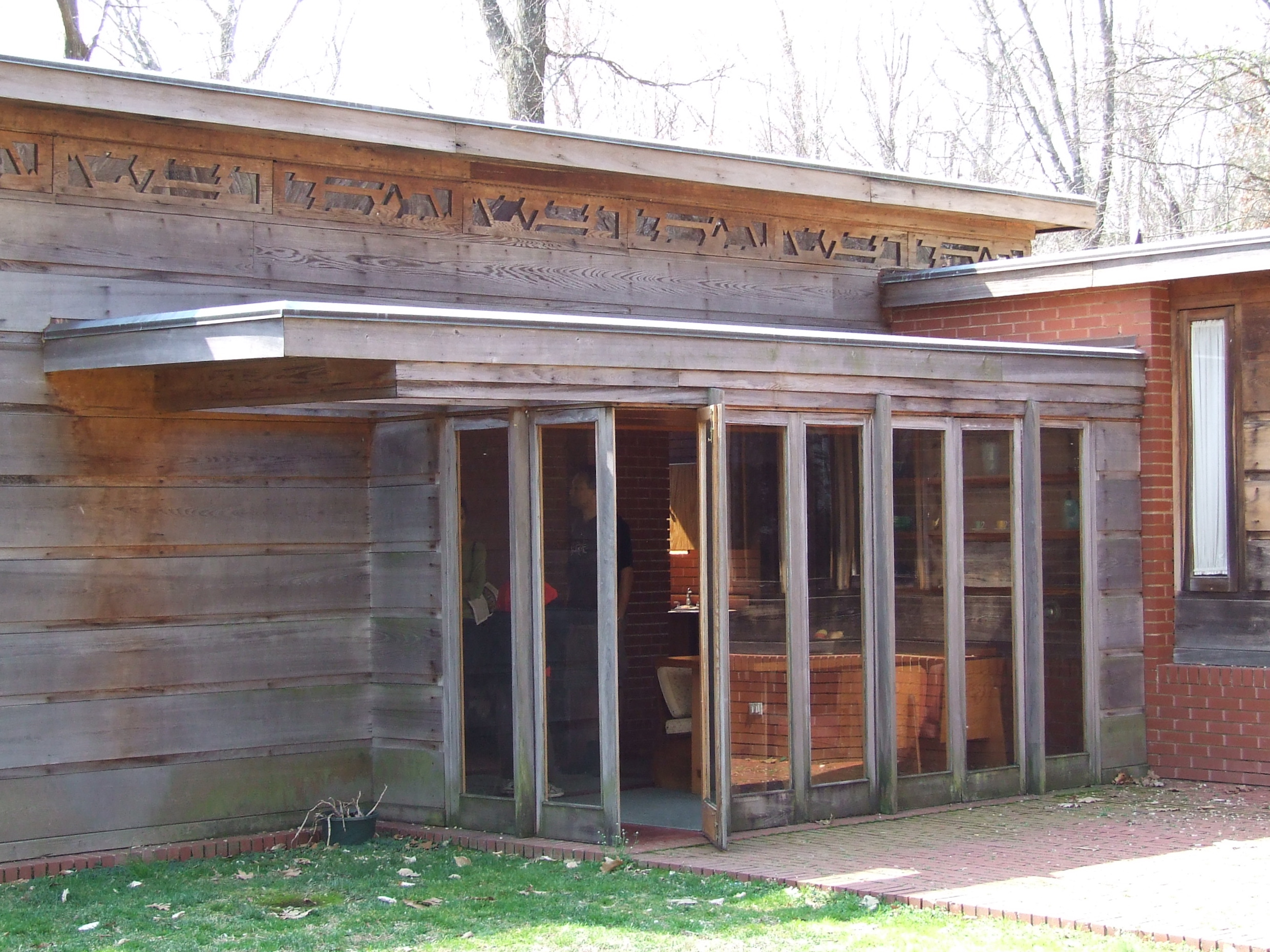
Pope-Leighey House
In 1939, a journalist named Loren Pope sat down and wrote a letter to the most famous architect in America. Pope had just seen Frank Lloyd Wright on the cover of Time Magazine, read the accompanying profile about Fallingwater, and noticed Wright's stated desire to build homes for ordinary middle-class families rather than the wealthy. Pope was exactly that -- a newspaperman with a modest budget and a plot of land on Locust Street in Falls Church, Virginia. Wright wrote back. He said he only built houses for "people who deserved them," and middle-class families qualified. The result, completed in 1941, was a house Wright considered among his best work. He even toyed with naming it "Touchstone." It became instead the Pope-Leighey House, one of the earliest and finest examples of Wright's Usonian architecture -- his vision of beautiful, affordable American living.
Architecture as Democracy
Wright developed Usonian architecture as a direct response to what he saw as a fundamental injustice: that good design was reserved for the rich. As American cities expanded through the early twentieth century on waves of commercial growth and working-class migration, architects debated how to shape the nation's built future. Wright's answer was Usonianism -- homes designed specifically for middle-class families, built with modular construction and natural materials to keep costs within reach. The Pope-Leighey House embodies this philosophy in every detail. Wright controlled not just the structure but the furniture, the appliances, and the decor, believing that a house should nurture the lives of the people inside it. He rejected the idea that form should merely follow function, arguing instead that form and function are one -- that a home should feel both open and protective, both beautiful and practical. His mentor, Louis Sullivan, had championed functionalism. Wright took that principle and made it personal.
The House That Wouldn't Stay Put
The Pope-Leighey House has been moved twice, each time to save it from demolition. Its original location at 1005 Locust Street in Falls Church stood directly in the path of a proposed Virginia highway expansion. In 1964, The New York Times ran the headline "HOUSE BY WRIGHT FACES DEMOLITION; Udall Tries to Save Building From Virginia Highway." The National Trust for Historic Preservation, with help from Secretary of the Interior Stewart Udall, lobbied the governor to reroute the highway. When that effort failed, the Trust arranged to have the house physically relocated to the grounds of Woodlawn Plantation near Mount Vernon in Alexandria, Virginia. The house was disassembled, transported, and reassembled on its new site. A second move followed years later when the house was shifted again within the Woodlawn grounds to address soil and drainage problems. Through both relocations, the Trust preserved the house as Wright intended it to be lived in -- complete with the original furniture, built-in shelving, and custom decor.
Living Inside a Philosophy
Step through the front door and the Wright philosophy becomes tangible. The ceilings are low at the entrance, compressing the space before releasing it into the open living room -- a classic Wright technique for creating a sense of arrival and expansion. Exposed wood and brick ground the interior in natural materials. Built-in furniture eliminates clutter and enforces the clean horizontal lines Wright favored. The house is one of only three Wright-designed homes in Virginia, alongside the Andrew B. Cooke House in Virginia Beach and the Luis Marden House in McLean. But the Pope-Leighey House holds a special place in the Wright catalog because it was built to prove a point -- that beauty and affordability were not opposites. The National Trust has preserved the interior exactly as it was meant to be inhabited. Visitors walk through rooms where every object, from the kitchen bench to the bedroom shelving, was placed with Wright's intention that architecture should shape daily life, not merely contain it.
A Letter's Long Legacy
Loren Pope lived in his Wright house for only a few years before selling it to Robert and Marjorie Leighey, whose name became permanently attached to the structure. But Pope never lost his admiration for what Wright had built. In interviews decades later, he described the experience of commissioning the house as transformative. The Pope-Leighey House today sits on the grounds of Woodlawn Plantation, a historic site that also preserves an 1805 Georgian mansion built for Nelly Custis Lewis, George Washington's step-granddaughter. The contrast between the two buildings -- one rooted in eighteenth-century formality, the other in twentieth-century democratic idealism -- makes the shared site feel like a conversation across two centuries of American architecture. The house is open for public tours and remains one of the most accessible examples of Wright's Usonian vision. It started with a fan letter from a journalist who believed good architecture should be for everyone. Wright agreed.
From the Air
The Pope-Leighey House sits at 38.719N, 77.136W on the grounds of Woodlawn Plantation near Mount Vernon, Virginia, approximately 10nm south-southwest of the National Mall. From the air, Woodlawn is identifiable as a large estate with formal grounds and tree-lined approaches just west of Route 1 (Richmond Highway) and south of Fort Belvoir. The Wright house is small and flat-roofed, difficult to distinguish from altitude, but the Woodlawn mansion's white columned facade is visible at lower altitudes. Nearest airport is Ronald Reagan Washington National (KDCA), approximately 8nm north-northeast. Davison Army Airfield (KDAA) at Fort Belvoir is closer at roughly 2nm north but is restricted military. Caution: this area is within the Washington D.C. SFRA. Best appreciated at 2,000 feet AGL or on the ground via a tour.