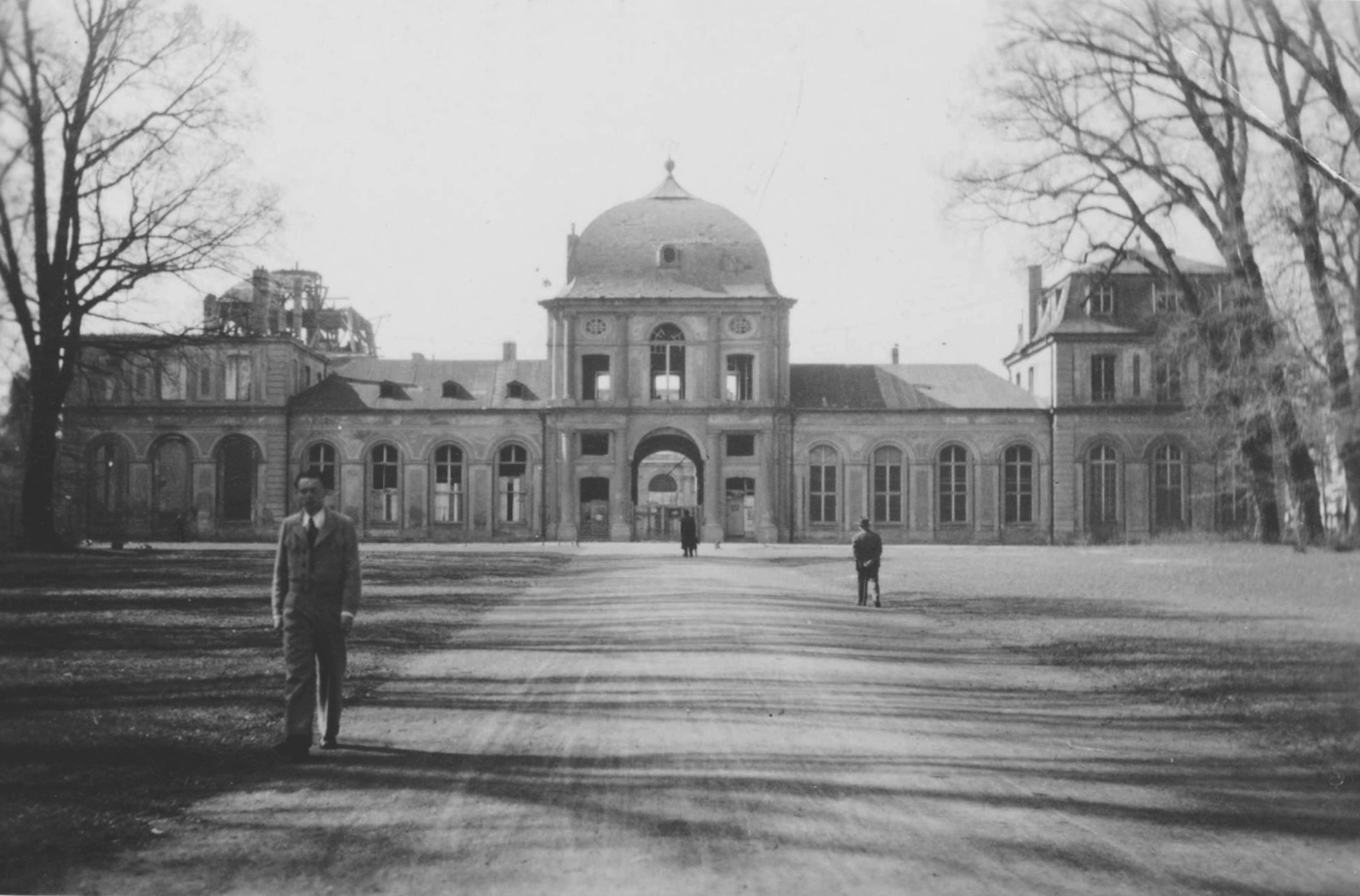
Poppelsdorf Palace
Robert de Cotte never came to Bonn. In May 1715 he was First Architect to Louis XIV in Paris, and the new patron writing him letters was Joseph Clemens of Bavaria — Archbishop-Elector of Cologne and a Wittelsbach prince with imperial taste. Clemens wanted a maison de plaisance close to his big city palace, a pleasure-house at the end of a long axial avenue, in conscious imitation of how Versailles related to the Trianon. De Cotte sent him drawings. Clemens wrote back, charmed but cautious: 'I received your project for my Maison de Poppelsdorf, which pleased me infinitely, and I know nothing more beautiful or better conceived, but we are now obliged to consider the site.' What got built between 1715 and 1746, on a mostly modest budget, became one of the strangest and most likeable baroque palaces in the Rhineland — a square building with a perfect circle hidden inside.
An Architect Who Stayed in Paris
De Cotte was running the most powerful architectural office in Europe and had no plans to make the journey upriver. He worked from descriptions, sketches sent home by his on-site deputy Benoît de Fortier, and his own imagination of what a Rhineland prince needed. The first scheme was four two-storey wings around the courtyard. Clemens read it and balked. 'I realized that it would be quite useless to erect so large a building on that site, which is but a cannon shot from town,' he wrote. 'For the most part my retinue returns to the city at night.' De Cotte revised: three of the wings shrank to a single storey, the garden wing kept its second floor, and the circular gallery — Poppelsdorf's signature idea — stayed.
The Square With a Circle Inside
The plan is one of those drawings architects love to show students. From the outside, a strict square with avant-corps at the corners. Step into the entrance vestibule and sixteen columns frame your view through to an arcaded ring open to the sky — a circular court inside a square building, an idea borrowed from Renaissance models like the Villa Madama in Rome (begun around 1516) and the Villa Farnese at Caprarola (begun 1559). To the left of the central domed salon ran the elector's apartment: grande salle, audience chamber, bedroom, cabinet, arranged in an enfilade in the French manner. To the right, the dining room. Chapel in the right wing, kitchens and stables tucked into the entrance-side quadrants. Clemens died in 1723 with the work unfinished. His nephew, Clemens August — another Wittelsbach archbishop with a building habit — picked up the campaign in 1745 and finished it in 1746.
From Pleasure-House to University
The Electorate of Cologne did not survive the French Revolutionary Wars. By 1794 revolutionary French troops were on the Rhine, the prince-electors were finished as ruling sovereigns, and Poppelsdorf — like its bigger sister, the Electoral Palace in town — eventually passed to the Prussian crown. In 1818 King Frederick William III gave the building to the brand-new Rhenish Friedrich Wilhelm University of Bonn, the same year and same gesture as the city palace at the other end of the long Poppelsdorfer Allee. The surrounding park was converted that year into the Botanical Garden of Bonn, which is still here, now spread over about half a hectare of greenhouse and home to roughly 8,000 different plants. The pleasure-house had been promoted to a research institute.
Bombed, Rebuilt, and Still Quiet
In 1944 Allied bombing badly damaged the palace, as it did almost everything else of architectural value in central Bonn. The reconstruction, completed from 1955 onward, is honest about itself — much of what you see today is the post-war rebuild, with surfaces simpler than the original baroque interiors. The mineralogy and palaeontology collections of the University of Bonn moved into the building's east wing, and the natural-history museums remain in residence. The circular courtyard still works as architecture: a sheltered ring of arcade open to the sky, with the gardens visible through the arch at the far end. Walk the long straight path of the Poppelsdorfer Allee from here to the Electoral Palace and you trace one of the most legible baroque axes in Germany — a town palace at one end, a country house at the other, the two buildings still aligned across 1.5 kilometres of city even though their princes have been gone for more than two centuries.
From the Air
50.7250 N, 7.0921 E in Bonn's Poppelsdorf district, about 1.5 km southwest of the Electoral Palace. Cologne-Bonn (EDDK / CGN) is about 19 km north; Bonn-Hangelar (EDKB) lies roughly 6 km northeast. From 2,500 feet the building reads as a stocky pale-yellow square with a perceptible circular shadow inside its courtyard; the dead-straight Poppelsdorfer Allee runs northeast from the entrance toward the Electoral Palace, with the botanical garden's glass greenhouses clustered behind.