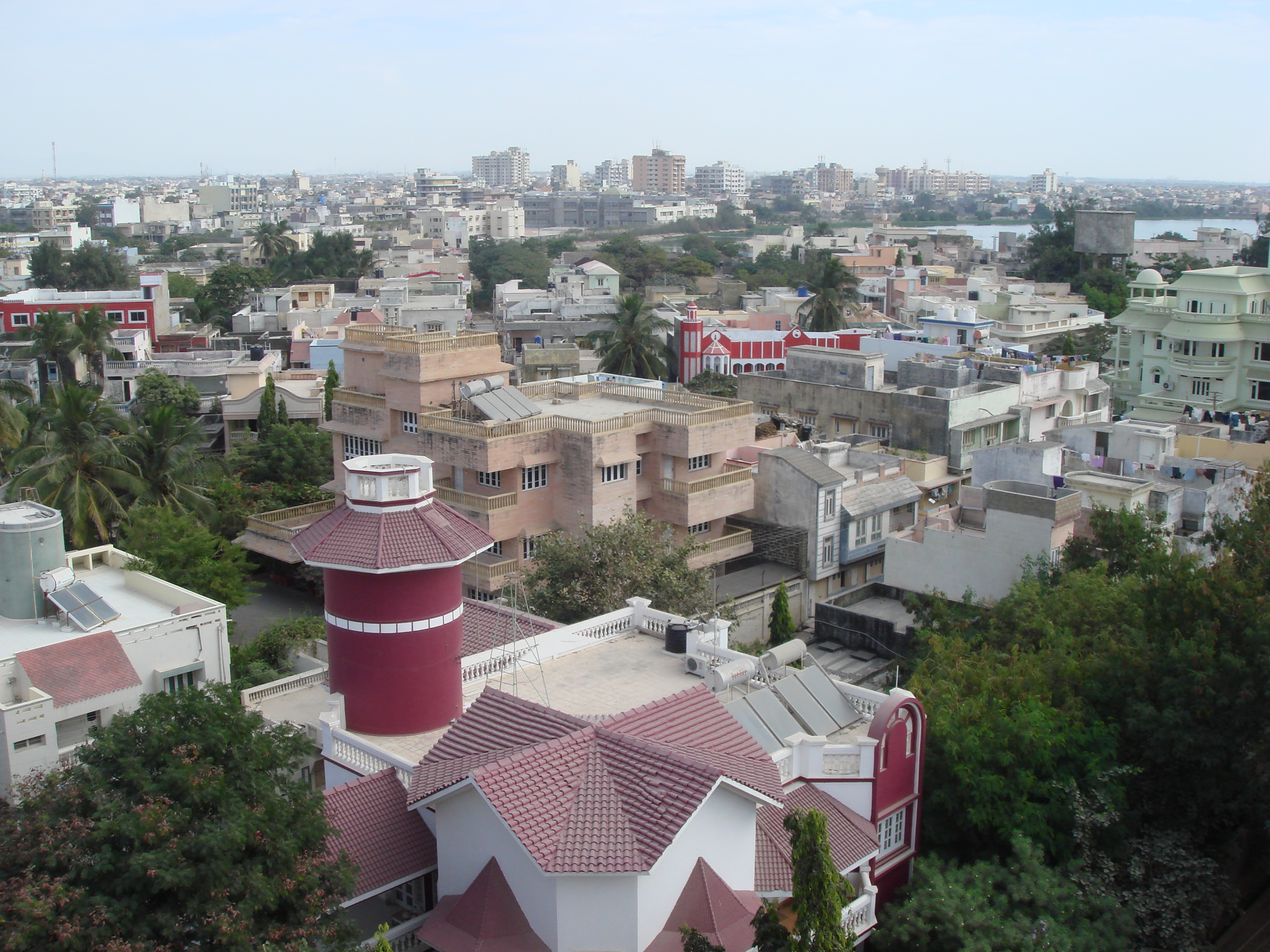
Porbandar
In 1899, Porbandar received 83 millimeters of rain. The following year, the skies opened and dropped 1,185 millimeters. Then 1901 brought 99 millimeters again. Seven consecutive years of such whiplash -- from near-drought to deluge and back -- gave this coastal Gujarat city one of the most variable rainfall patterns on Earth, comparable only to northern Australia, the Brazilian sertão, and the Kiribatese Line Islands. It is an apt metaphor for a place whose history swings between extremes: an ancient port that birthed the man who would free a nation through stillness.
Where Gandhi Drew His First Breath
On 2 October 1869, in a house at Manek Chowk in Porbandar's main bazaar, Mohandas Karamchand Gandhi was born. That house is now Kirti Mandir, a memorial open daily from 7:30 AM to 7:00 PM. But Porbandar's connection to Gandhi extends beyond a birthplace. His wife Kasturba was also from here, and the values that shaped his philosophy -- simplicity, community, the sea's rhythms -- were woven into the city's character. Porbandar was then the capital of its own princely state, ruled by the Jethwa clan of Rajputs who had governed the region since at least the mid-16th century. The state had been subordinate first to the Mughal governor of Gujarat, then overrun by the Marathas, and eventually absorbed into the authority of the Gaekwad court at Baroda. Gandhi grew up in a town accustomed to shifting power, a place that understood resistance was sometimes the only constant.
An Ancient Port on the Arabian Sea
Porbandar has been a port city since antiquity, and the sea continues to define it. Today it operates an all-weather, medium-sized deep water port with direct berthing facilities for ships up to 50,000 deadweight tonnage. INS Sardar Patel, a naval base of the Indian Navy, provides logistic support for units deployed across the northern Arabian Sea. The Coast Guard maintains its District Headquarters here as well. But the maritime heritage runs deeper than military installations. Porbandar sits at an average elevation of just one meter above sea level, barely above the waves that have shaped its economy for millennia. The city's position on Gujarat's western coast made it a natural trading hub, connecting the subcontinent with the Persian Gulf and East African shores. That exposure to the open ocean also makes it the least hot of all major Gujarati cities -- sea breezes keep average high temperatures below 35 degrees Celsius year-round.
Temples, Planets, and Palaces
Porbandar wears its layers openly. The Sudama Temple is one of the few in all of India dedicated to Sudama, the humble friend of Krishna whose story of poverty and divine friendship resonates across Hindu tradition. Bharat Mandir, established by the philanthropist Nanjibhai Kalidas Mehta, houses a permanent exhibition on Indian culture, history, and geometry. Tara Mandir is one of India's oldest planetariums -- an unexpected institution for a small coastal city, but fitting for a place that has long looked outward. The Huzoor Palace, Daria Raj Mahal Palace, and Darbargadh speak to Porbandar's centuries as a princely capital, their architecture reflecting the wealth that flowed through the port. The last king of Porbandar, Natwarsinhji Bhavsinhji, presided until the state was merged into the United State of Kathiawar on 15 February 1948, just months after Indian independence.
Where Flamingos Wade and Dugongs Drift
Beyond its human history, Porbandar is a place of remarkable ecological importance. The Porbandar Bird Sanctuary draws teals, fowls, flamingos, ibises, and curlews, while the city's numerous wetlands make it one of Gujarat's premier birdwatching destinations. But the most significant wildlife here swims offshore. Porbandar is one of the last coasts in India where the dugong -- a threatened marine mammal sometimes called the sea cow -- can still be found. These gentle, slow-moving creatures graze on seagrass beds in the shallow coastal waters, their presence a barometer of marine ecosystem health. The juxtaposition is striking: a naval base and a deep water port share the same coastline with one of the rarest marine mammals on Earth, a reminder that even heavily used waters can harbor life that most of the world has forgotten.
Monsoons and Resilience
Porbandar's climate defines its character. The hot semi-arid conditions bring three distinct seasons: a cool period from October to March, scorching heat from April to early June, and the monsoonal wet from mid-June to September. Almost no rain falls outside the monsoon window, except from the occasional late-season tropical cyclone -- the most powerful on record struck on 22 October 1975, producing a four-meter storm surge. During monsoon season, rainfall is staggeringly erratic: annual totals have ranged from a mere 32 millimeters in 1918 to 1,850 millimeters in 1983, when a single cyclone dumped over 1,100 millimeters in four days. With a coefficient of variation exceeding fifty percent, Porbandar's rainfall variability ranks among the most extreme anywhere on the planet. The city endures. Its population of roughly 153,000 maintains a literacy rate of 86 percent, well above the national average. The trains run to Rajkot, Ahmedabad, and Mumbai. The fishing boats go out. Gandhi's birthplace keeps its doors open, seven days a week.
From the Air
Located at 21.64°N, 69.60°E on the western coast of Gujarat's Saurashtra peninsula, facing the Arabian Sea. The city sits at approximately 1 meter elevation with its port and coastline clearly visible from the air. Porbandar Airport (VABP) serves the city with limited commercial flights. Nearest major airport is Rajkot (VARK), approximately 190 km to the east. From altitude, look for the port facilities, the urban area along the coast, and the wetland areas that attract flamingos. Best viewed at 3,000-5,000 ft.