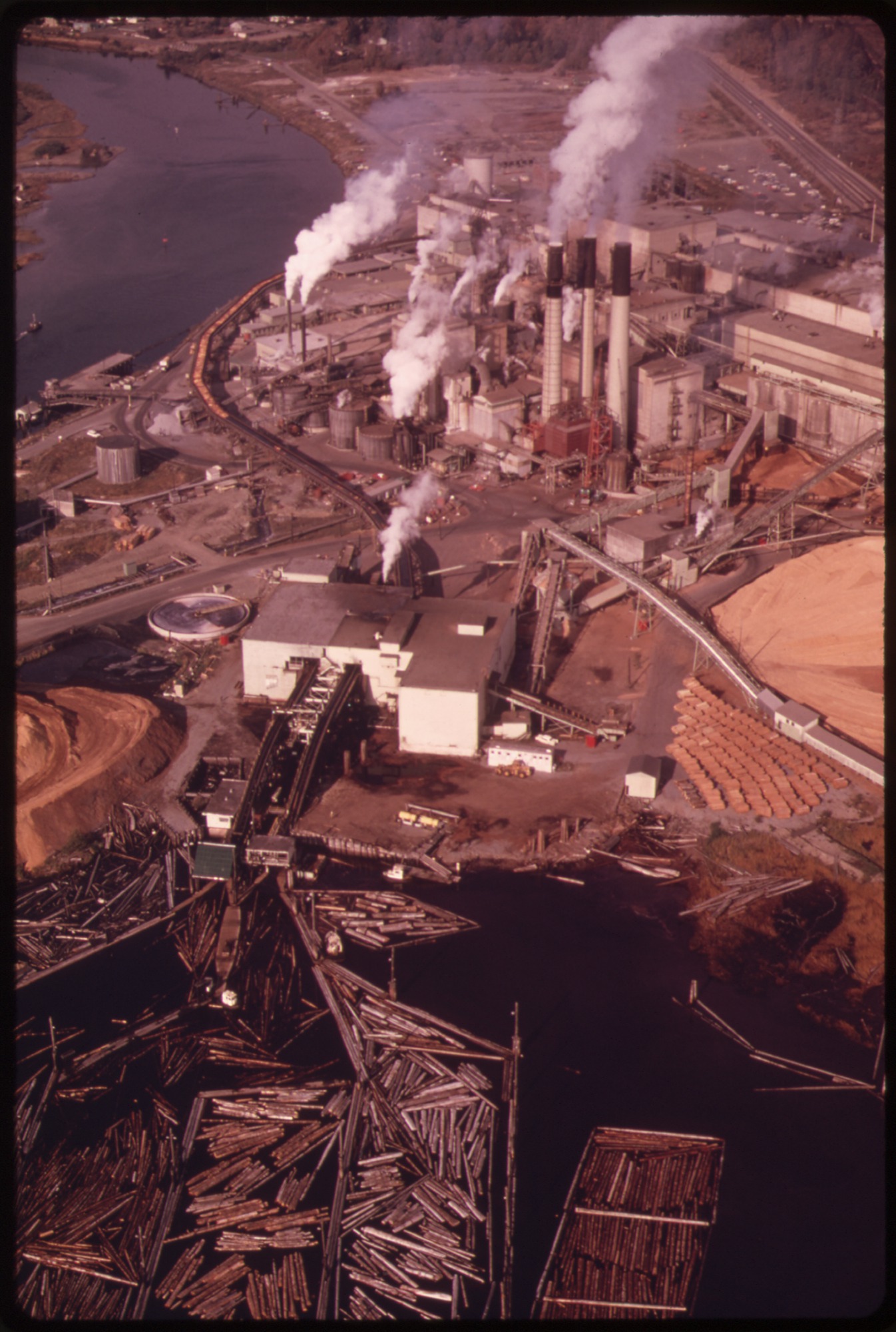
Port Alberni Mill
On a clear day, you can smell it before you see it -- the distinctive sulfur tang of a working pulp mill, drifting down Alberni Inlet on the same Pacific breezes that have carried the scent of cedar and salmon for millennia. The Port Alberni Mill has stood on the inlet's edge since 1946, producing paper through an era when telephone directories were essential household items and catalogues were how rural Canada shopped. It has outlasted multiple owners, shifting markets, and the near-collapse of the North American paper industry.
Born from a Ban
The mill's origin story involves a regulatory twist. Bloedel, Stewart and Welch established the facility in 1946, intending to produce kraft pulp -- but only because Fisheries and Oceans Canada had prohibited the use of the sulfite process, which was more polluting to the waterways that salmon depended on. The kraft process, while still industrial, was the lesser environmental evil. This constraint made the Port Alberni Mill significant in two ways: it was the first major new pulp mill in British Columbia in decades, and it was the first in the province to integrate residuals from sawmills, turning waste wood into usable pulp. In an industry defined by brute extraction, that efficiency was notable.
The Paper Machine Era
In 1951, ownership passed to MacMillan Bloedel through a merger, and in 1957 two paper machines were installed. The mill began producing newsprint -- the cheap, rough paper that fed the presses of daily newspapers across the Pacific Northwest. At peak capacity, the operation would grow to produce 336,000 tonnes of paper annually, employing 310 people. The product line expanded beyond newsprint to include directory paper, lightweight coated stock, and specialty grades used in telephone books, catalogues, magazines, brochures, and food-grade packaging. For decades, when you flipped through a phone book or a Sears catalogue in western Canada, there was a reasonable chance the paper came from this inlet on Vancouver Island.
A Parade of Owners
The mill's ownership history reads like a timeline of the Canadian paper industry's consolidation and reinvention. MacMillan Bloedel held it for nearly five decades before selling to Pacifica Papers in 1998. Three years later, Norske Skog Canada took over, followed by Catalyst Paper in 2005. Eventually the mill became part of Paper Excellence. Each transition reflected broader market pressures: the decline of newsprint as newspapers shrank, the shift to digital directories, the global oversupply of commodity paper. Through it all, the mill adapted -- pivoting from newsprint to specialty papers, finding niches where physical paper still mattered.
Industrial Anchor
From the air, the Port Alberni Mill is unmistakable: a cluster of industrial buildings, steam plumes, and log booms along the inlet's edge, dwarfed by the forested mountains rising on every side. The contrast is the story of Port Alberni itself -- a working industrial town set in some of the most dramatic landscape on Vancouver Island. The mill remains one of the city's largest employers and a reminder that the Alberni Valley's economy was built not just on cutting trees but on transforming them. Logs became lumber at the sawmills, pulp at the kraft mill, and paper on the machines -- a chain of value that kept the valley's paychecks among the highest in British Columbia for decades.
From the Air
Located at 49.25N, 124.81W on the edge of Alberni Inlet in Port Alberni, Vancouver Island. The mill complex is visible as a large industrial site with steam plumes at the head of the inlet. Nearest airport is Port Alberni Airport (CBS8). Alberni Inlet extends south to Barkley Sound. The Somass River enters the inlet just north of the mill.