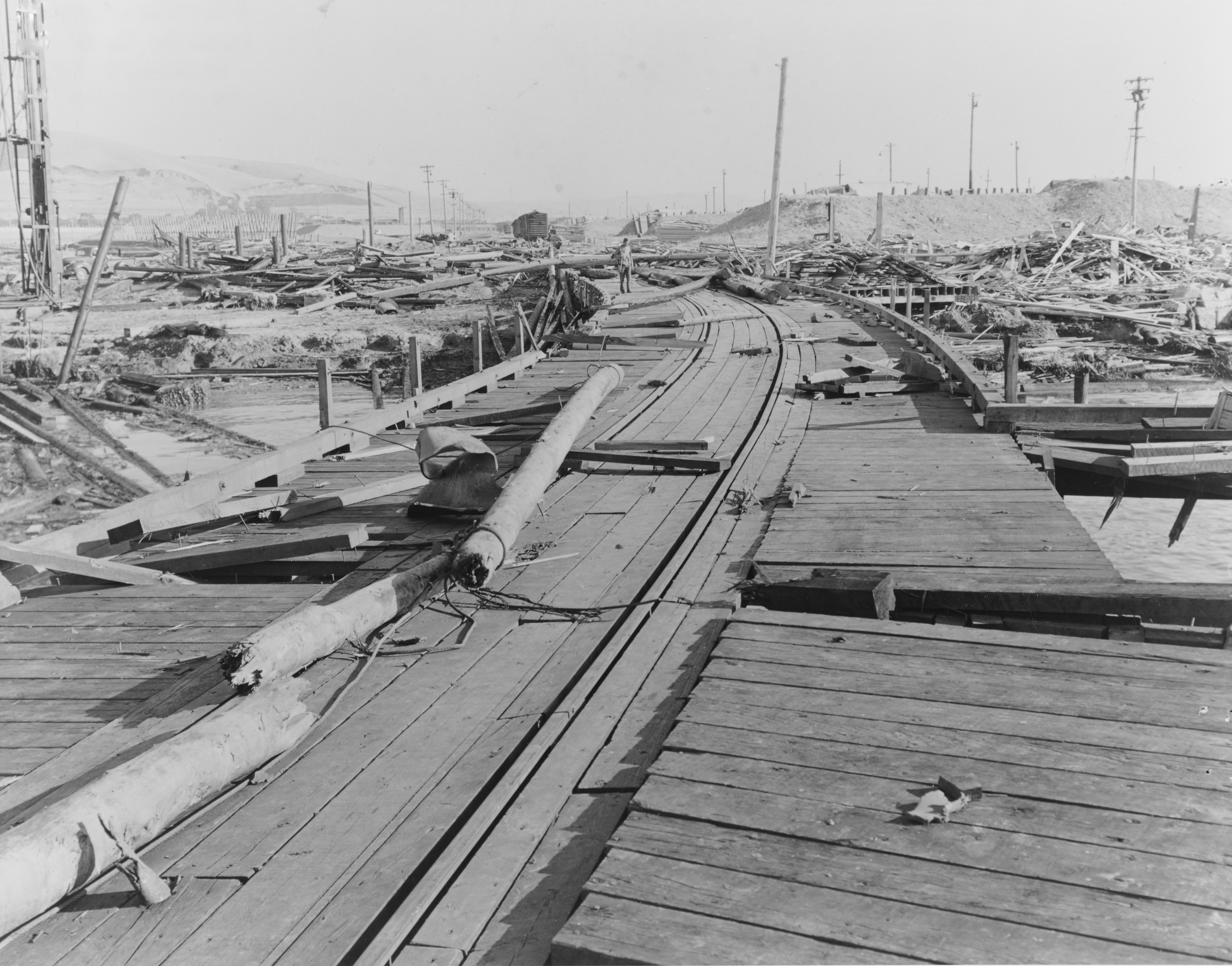
Port Chicago Disaster
At 10:18 p.m. on July 17, 1944, the night sky over Suisun Bay erupted in a fireball three miles wide. An Army Air Forces pilot flying nearby reported that the explosion lit up the heavens like a second sun. In an instant, 320 men ceased to exist, two cargo ships vanished, and a pier holding thousands of tons of munitions became a crater. The blast registered 3.4 on the Richter scale at UC Berkeley, 35 miles away. This was the Port Chicago disaster, the deadliest home-front accident of World War II. But what happened afterward would prove just as consequential: the explosion ignited a fight against military segregation that would reshape the United States Navy.
The Loading Pier
The Port Chicago Naval Magazine sat on Suisun Bay, roughly 40 miles from the Golden Gate. Here, munitions flowed toward the Pacific Theater: bombs, shells, torpedoes, and naval mines, each piece loaded by hand onto cargo ships bound for war. The men doing this dangerous work were almost entirely African American. They had enlisted expecting to serve at sea, trained for naval ratings at Great Lakes, but found themselves instead assigned as stevedores, handling explosives without formal training. Their white officers placed bets on which division could load the most tonnage, turning deadly work into a competition. A Coast Guard commander warned the Navy that conditions were unsafe and ripe for disaster. The Navy leadership declined offers from the International Longshore and Warehouse Union to train the men, citing cost concerns and fears of slower work.
The Night Everything Changed
The Liberty ship SS E. A. Bryan had been loading since July 13. By that final evening, it held 4,600 tons of explosives. The Quinault Victory, freshly arrived, was taking on its own deadly cargo. At 10:18 p.m., a smaller explosion flashed from the pier. Eight seconds later, the Bryan detonated. The blast obliterated both ships, the pier, and everyone on them. Of the 320 dead, only 51 bodies could be identified. The others had simply ceased to exist. African American casualties totaled 202 dead and 233 injured, accounting for fifteen percent of all Black military deaths during the entire war. Survivors spent weeks retrieving body parts from the bay, cleaning up wreckage while their white officers received 30-day survivor's leave. The enlisted men received nothing.
The Refusal
Three weeks after the explosion, surviving sailors were ordered back to loading munitions under the same conditions at nearby Mare Island. Many were still in shock, having witnessed friends vaporized. On August 9, 1944, 258 men refused to work. They were not deserting, not abandoning the war effort. They simply would not load ammunition without proper safety measures. The Navy charged them with mutiny, a crime punishable by death. Thurgood Marshall, then chief counsel of the NAACP, traveled to California to observe the trial, calling it the worst case of mass injustice he had ever witnessed. Fifty men, dubbed the Port Chicago 50, received sentences of 15 years hard labor and dishonorable discharge. Over 200 others were convicted of lesser charges.
The Long Road to Justice
The convictions stood for eighty years. Sailors who survived the blast and prison emerged to lives marked by the stigma of mutiny. Many refused pardons, reasoning that pardons are for guilty people seeking forgiveness, and they had done nothing wrong. Freddie Meeks, one of the last survivors, pushed for a pardon simply to bring the story to light, saying the injustice had been in the closet for too long. On July 17, 2024, exactly eighty years after the explosion, the Navy finally exonerated all 256 men. The investigation found multiple errors in the original courts-martial, including that the sailors had been denied meaningful right to counsel. Every dishonorable discharge was vacated.
A Memorial and Its Meaning
The Port Chicago Naval Magazine National Memorial was dedicated in 1994, fifty years after the blast. It sits within an active military base, requiring advance reservation to visit. A new regional park honoring Thurgood Marshall and the Port Chicago 50 is planned nearby, offering easier public access. The explosion and subsequent mutiny are credited with accelerating the desegregation of the United States Navy, which began integrating its forces in February 1946. Today, the memorial stands as witness not only to the 320 who died that July night, but to the hundreds who risked everything by simply refusing to die the same way.
From the Air
Located at 38.06N, 122.03W on Suisun Bay, approximately 35 miles northeast of San Francisco. The memorial is visible along the waterfront near the town of Port Chicago (now part of Concord). Approach from the west offers views of the Sacramento-San Joaquin Delta meeting the bay. Nearby airports include Buchanan Field (KCCR) 4nm south and Oakland International (KOAK) 25nm southwest. The site is on an active military installation with restricted airspace; maintain altitude and distance.