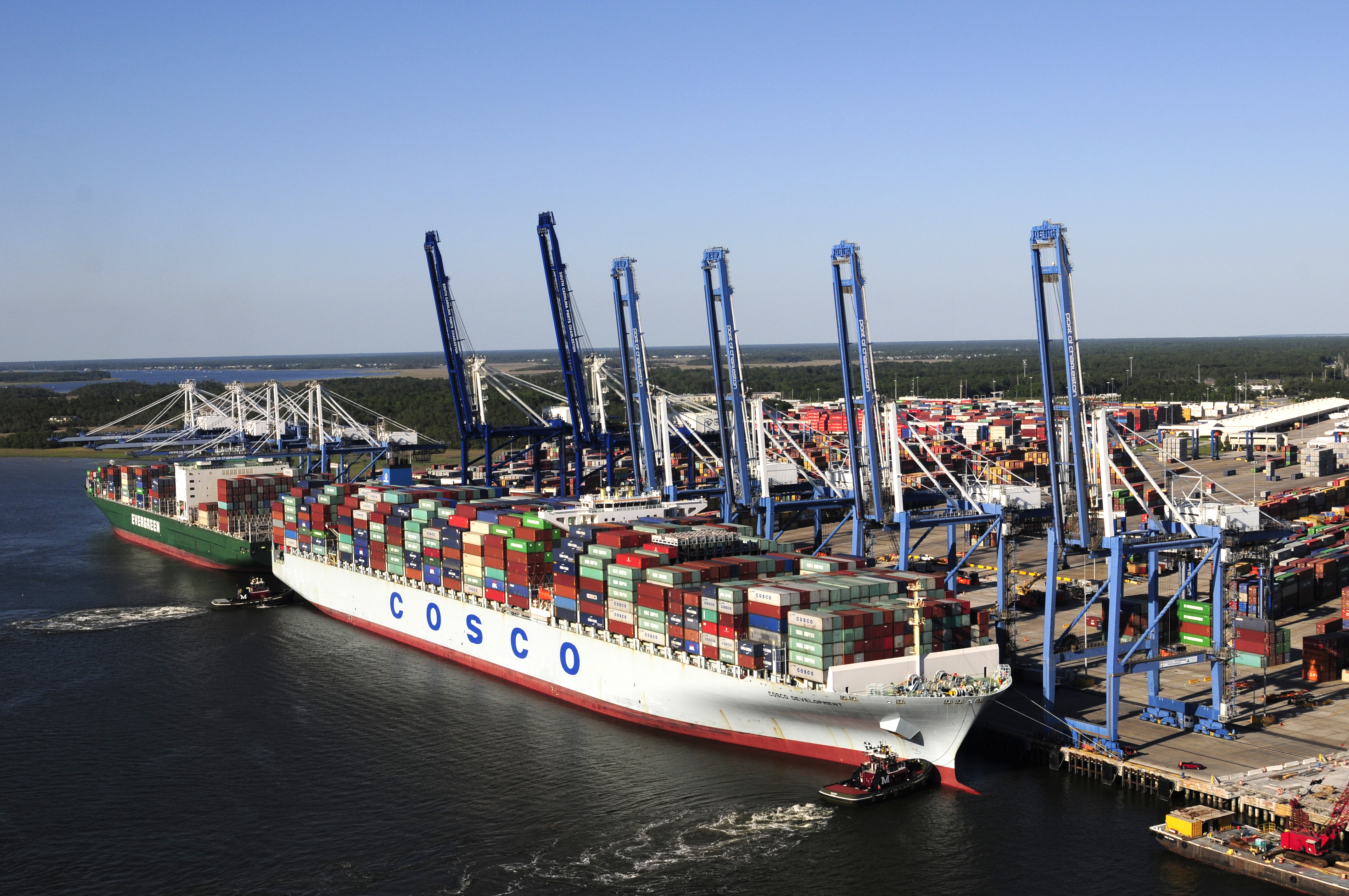
Port of Charleston
In 1670, English settlers established Charles Towne along the banks of the Ashley River and immediately understood what the geography was telling them: this natural harbor, where the Ashley and Cooper Rivers converge before emptying into the Atlantic, was made for trade. By 1682, Charles Towne was the official port of entry for the entire colony. Three and a half centuries later, the Port of Charleston ranks sixth in the nation by cargo value, moving over $72 billion in goods annually through six terminals spread across Charleston, North Charleston, and Mount Pleasant. The harbor has been deepened to 52 feet -- the deepest on the East Coast -- and container ships the size of small cities glide through waters that once carried indigo and rice.
The Colony's Lifeline
From its founding through the start of the Civil War, Charleston's port was the economic engine of the Carolina colony. Lumber, naval stores, furs, and animal skins moved outward first. Then came the plantation crops that would define the Lowcountry: rice, indigo, cotton, and tobacco. The port also received the colony's darkest import -- enslaved Africans, who arrived in vast numbers until the late 1700s. This commerce made Charleston one of the wealthiest cities in colonial America. The natural harbor, sheltered and deep, gave the port advantages that geography alone could not guarantee elsewhere. By the time the first shots of the Civil War echoed across the harbor in 1861, Charleston had been a major trading center for nearly two centuries.
Ruins and Revival
The Civil War devastated the port. Mines and the wrecks of sunken Confederate and Union ships choked the harbor. The Southern economy had virtually nothing to export, and Charleston's network of private wharves fell into ruin. Recovery came slowly, and from an unexpected direction: the establishment of major federal military bases in the early twentieth century. The federal presence meant the harbor was well maintained and steadily improved. In the 1920s, Mayor John P. Grace pushed to revive commercial shipping by creating the Port Utilities Commission. In 1922, the city purchased the Charleston Terminal Company -- which controlled the majority of the peninsula's commercial waterfront -- for $1.5 million. Two decades later, in 1942, the South Carolina Legislature created the South Carolina Ports Authority to manage and grow the state's maritime commerce.
Deep Water, Big Ships
Modern Charleston has bet heavily on infrastructure. Between 2016 and 2020, the South Carolina Ports Authority invested $1.05 billion in new and existing facilities. The Hugh K. Leatherman Terminal, which opened in March 2021, was the first new container terminal built in the United States in twelve years, capable of handling ships carrying up to 20,000 twenty-foot equivalent container units. At full buildout, it will increase the port's capacity by fifty percent. A massive harbor deepening project brought the channel to 52 feet at mean low tide, making Charleston the deepest harbor on the East Coast -- deep enough to handle the post-Panamax vessels now passing through the expanded Panama Canal. In fiscal year 2021, the port moved 2.85 million TEUs across its docks.
Six Terminals, One Harbor
The port's operations stretch across six distinct terminals, each with its own specialty. Union Pier, in the heart of historic Charleston, handles break-bulk cargo and doubles as the cruise ship terminal -- vessels have called there since 1913. Columbus Street Terminal manages project cargo and roll-on/roll-off operations. Wando Welch Terminal in Mount Pleasant handles container vessels of all sizes. The Veterans Terminal and North Charleston Terminal serve bulk, break-bulk, and smaller container ships. And the new Leatherman Terminal in North Charleston represents the port's future, purpose-built for the massive container ships that now dominate global trade. Together, they form a system that handles everything from forest products and steel to the BMWs that roll off ships from the automaker's South Carolina plant.
The Next Horizon
Charleston is not finished growing. In response to surging traffic at both Charleston and the neighboring Port of Savannah, the Jasper Ocean Terminal is planned for construction on the Savannah River by 2035 -- a joint venture that would add yet more capacity to the Southeast's port network. Cruise operations continue to expand from Union Pier, where the Carnival Sunshine currently home-ports. The port's story is one of constant reinvention: colonial wharf to Civil War ruin to military harbor to modern container hub. From the air, the geometry of it all becomes clear -- the stacked containers in their colorful rows, the gantry cranes reaching over ship decks, the channel markers tracing a path from the open Atlantic into the heart of a city that has always understood the value of a good harbor.
From the Air
Located at 32.7846°N, 79.924°W on the Charleston peninsula and surrounding waterfront. The port's six terminals are spread across the harbor -- look for the massive container cranes at the Wando Welch Terminal on the Mount Pleasant side and the new Leatherman Terminal along the Cooper River in North Charleston. Container ships and cruise vessels are often visible in the channel. Best viewed at 3,000-8,000 feet for full scope of operations. Nearest airports: Charleston AFB / International (KCHS) approximately 8 nm northwest; Charleston Executive Airport (KJZI) about 8 nm northwest.