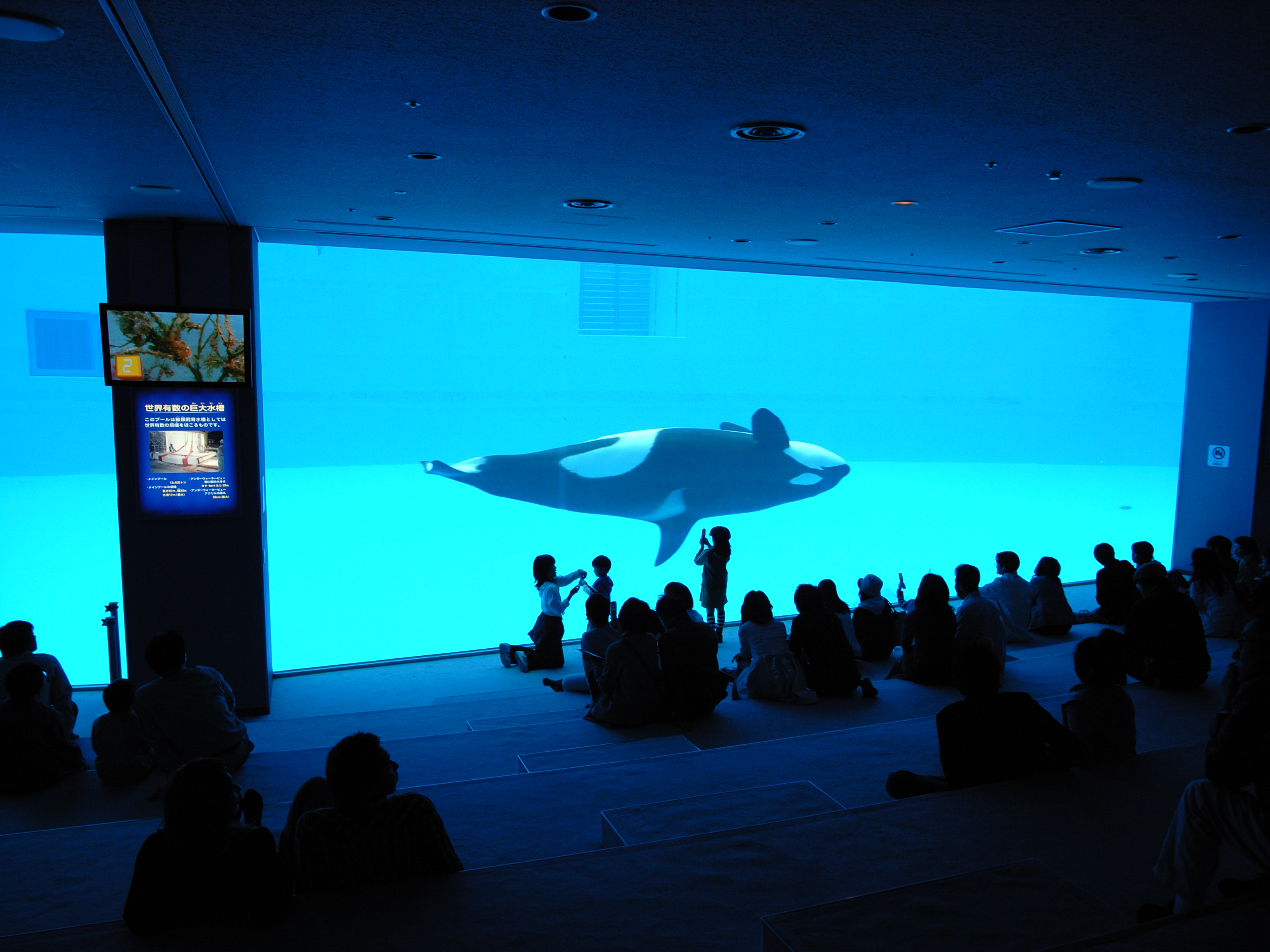
The Largest Tank in Japan: Port of Nagoya Public Aquarium
Ninety-nine percent of the seawater inside the Port of Nagoya Public Aquarium is pumped directly from the harbor just outside its walls. That connection to the actual ocean is fitting for a facility that holds the largest tank capacity and total area of any public aquarium in Japan -- a place where killer whales, beluga whales, dolphins, emperor penguins, and loggerhead sea turtles share space across two enormous buildings on the Nagoya waterfront. Opened in 1992, the aquarium was ambitious from the start, but it was the completion of the North Building in 2001 that transformed it into something extraordinary: a 60-meter-wide, 30-meter-long show pool holding 13.5 million liters of water, at the time the largest dolphin performance tank in the world. Docked just outside, the bright orange hull of the retired Antarctic research vessel Fuji serves as both neighbor and thematic anchor for an aquarium that asks visitors to follow the ocean's currents from Nagoya Harbor all the way to the bottom of the Earth.
Two Buildings, Two Journeys
The aquarium is divided into distinct halves with very different stories to tell. The North Building, opened in 2001, follows the theme 'A 3.5-Billion-Year Journey: Animals That Returned to the Sea.' Its exhibits focus on marine mammals -- creatures whose ancestors left the ocean for land millions of years ago, only to return. Here visitors encounter killer whales, beluga whales, bottlenose dolphins, and California sea lions, along with the massive main performance pool where dolphin shows play to packed audiences. The South Building, the original 1992 structure, takes visitors on 'A Journey to Antarctica,' tracing marine life through five ocean regions inspired by the routes of Antarctic research expeditions. Penguins waddle through carefully maintained habitats, deep-sea creatures hover in darkened tanks, loggerhead sea turtles glide through warm water, and coral reef fish flash color across illuminated displays. Together, the two buildings house approximately 500 species.
The Orca Family
The aquarium's most dramatic residents have always been its killer whales. In 2011, a male named Bingo and a female named Stella arrived on a five-year loan from Kamogawa Sea World in Chiba Prefecture, transported by ship across Japanese waters. Their daughter Ran 2 arrived by truck the day before. On November 13, 2012, Stella gave birth to a female calf named Lynn -- the first orca ever born at the Port of Nagoya Public Aquarium. Bingo, the largest killer whale ever kept in captivity in Japan, died on August 2, 2014 after an illness. Since then, the aquarium's orca family has consisted entirely of Stella's descendants. Stella herself eventually moved to Kobe Suma Sea World in March 2024. Her grandson Earth, born at the aquarium on October 13, 2008, became one of the facility's most popular residents, but died of gastric torsion on August 3, 2025 at age 16. As of late 2025, only Lynn remains at Nagoya -- the sole killer whale at the facility. The aquarium weighs its orcas four times a month and adjusts their diet accordingly -- a detail that speaks to the intensive care these animals require.
Breeding Firsts
The Port of Nagoya Public Aquarium has earned multiple breeding awards and Koga awards from the Japanese Association of Zoos and Aquariums for its work with species that are notoriously difficult to raise in captivity. In 1995, the aquarium achieved the first successful artificial hatching of loggerhead sea turtles from an indoor spawning ground anywhere in Japan -- and then went further, breeding loggerheads successfully for two consecutive generations. The penguin breeding research facility has produced its own string of successes, including the hatching of emperor penguins, among the most challenging penguin species to breed outside Antarctica. In total, the aquarium has received breeding and conservation awards for 18 different Antarctic and marine species, establishing Nagoya as one of the most productive aquarium research programs in the country.
A Waterfront Renewed
The aquarium sits in the Minato-ku port district of Nagoya, a short walk from Nagoyako Station on the Meiko Line subway. The surrounding area, known as the Garden Pier, was reimagined around the aquarium's presence, turning a working port into an attraction that draws visitors year-round. Beside the aquarium, the retired icebreaker Fuji -- the orange-hulled research vessel that made 18 voyages to Antarctica between 1965 and 1983 -- is permanently moored and open as a museum ship. The pairing is deliberate: the Fuji's Antarctic expeditions inspired the South Building's thematic journey through the five oceans. For the aquarium itself, accredited as a museum-equivalent facility under Japan's Museum Act, the waterfront location is more than scenic. That direct pipeline to Nagoya Harbor's seawater gives its tanks a living connection to the Pacific, a reminder that the creatures inside these walls have relatives swimming in the currents just beyond the breakwater.
From the Air
Located at 35.09°N, 136.88°E on the Nagoya Port waterfront in Minato-ku. From altitude, the aquarium complex is visible as a cluster of large, modern buildings on the southern edge of the port area, adjacent to the bright orange hull of the retired icebreaker Fuji. The Garden Pier area and the distinctive curved roof of the North Building are identifiable landmarks. Chubu Centrair International Airport (RJGG) lies approximately 18 nautical miles to the south across Ise Bay. Nagoya Airfield / Komaki (RJNA) is roughly 12 nautical miles to the north. Best viewed at 2,000-4,000 feet AGL approaching from over the bay for the full waterfront perspective.