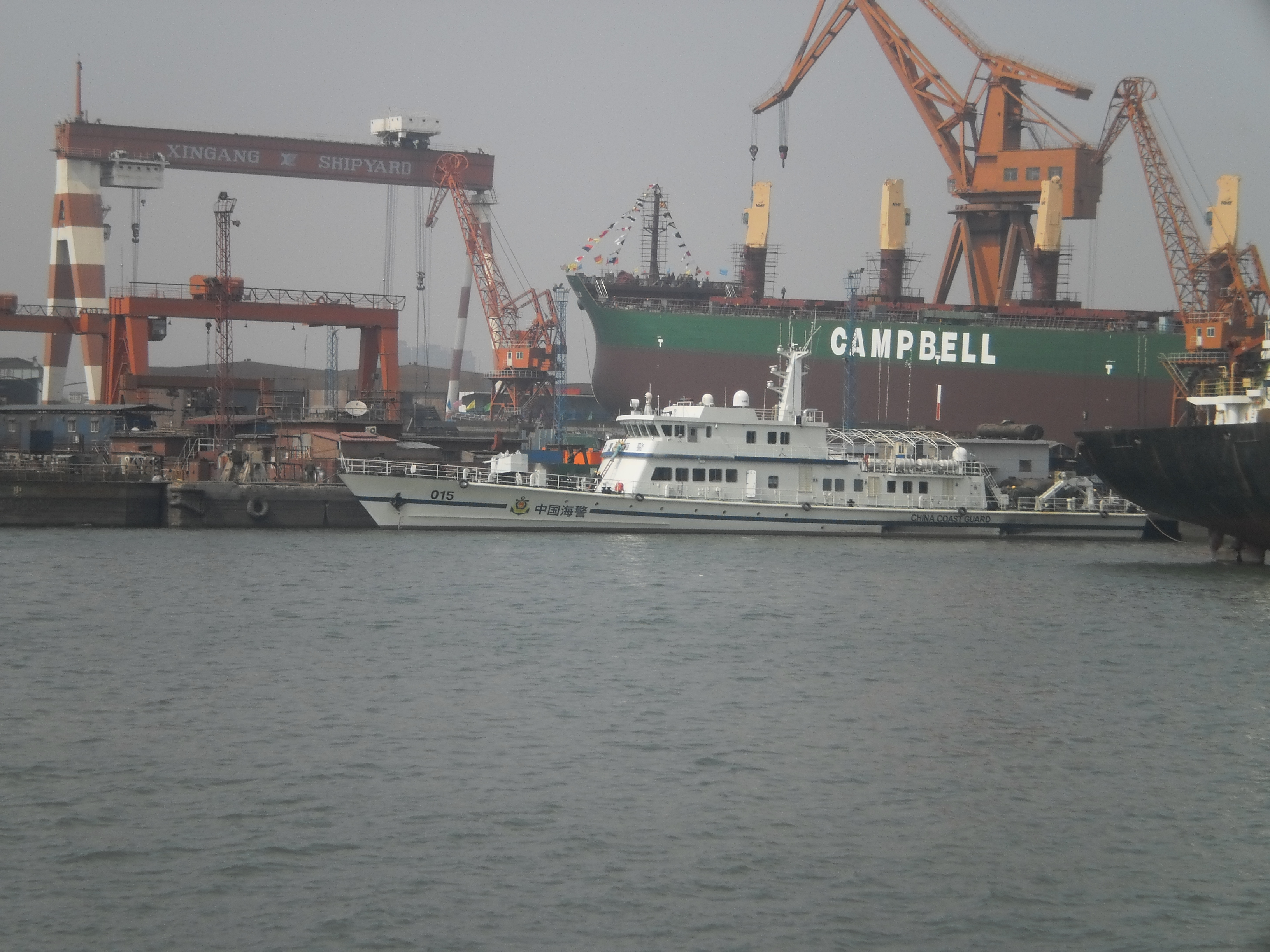
Port of Tianjin
On August 12, 2015, at 11:34 p.m., the first explosion lit the sky over Tianjin's Binhai New Area. Thirty seconds later, a second blast followed, equivalent to 800 metric tonnes of ammonium nitrate, registering as a magnitude 2.9 earthquake. A warehouse owned by Ruihai Logistics, a firm handling hazardous materials at the Port of Tianjin, had detonated. One hundred and seventy-three people died. Nearly 800 were injured. Eight more were never found. The disaster exposed the tensions at the heart of China's largest northern port: a facility processing over 500 million tonnes of cargo annually, expanding at breakneck speed, storing chemicals in quantities that even its own regulators could not fully track.
Built from Mud
The Port of Tianjin is, by necessity, largely man-made. The coastal terrain is dominated by mudflats and salt marshes that slope so gently that the five-meter depth line extends 14 to 18 kilometers from shore. Deep-water navigation requires extensive dredging, and land reclamation is the only cost-effective way to build new terminals. The result is the largest man-made port in mainland China, covering 121 square kilometers of land surface with over 31.9 kilometers of quay and 151 production berths. Located on the western shore of the Bohai Bay, 170 kilometers southeast of Beijing and 60 kilometers east of Tianjin city, the port traded with more than 600 ports in 180 countries by 2013. It handled 13 million container units that year, making it the world's ninth-largest container port and fourth-largest by total cargo tonnage.
From Ancient Estuary to Global Hub
Major ports have operated at the Hai River estuary since at least the Eastern Han Dynasty. Since 1153, the site has served as the critical supply hub for what is now Beijing. But the modern port traces its origins to the aftermath of the Second Opium War, when the 1860 treaties opened Tanggu as a transshipment center. After the Boxer Rebellion, foreign powers occupied Tanggu entirely and built an extensive network of riverside quays. Japanese occupation forces began constructing the Xingang seaport in 1940, but war damage left it unusable by 1949. The Communist government reopened it on October 17, 1952, with a dredged channel of just six meters, handling ships of 7,000 deadweight tonnes and an annual throughput of 800,000 tonnes. Growth from there was explosive: 20 million tonnes by 1988, 100 million by 2001, 200 million by 2004, 300 million by 2007, and 400 million by 2010.
A City Within a City
The port's scale is nearly urban. Nine distinct port areas spread across the coast, from the Haihe river wharves to the core Xingang facilities at Beijiang, Nanjiang, and Dongjiang, plus developing areas at Hanggu, Gaoshaling, and Nangang. The Tianjin Port Group operates 26 harbor tugs, five pilot ships, seven auxiliary craft, and two floating cranes. An 88-meter control tower at the eastern end of the East Pier houses the Vessel Traffic Service Center, monitoring every ship within 20 nautical miles. The port operates 365 days a year, 24 hours a day on three shifts. Its hinterland reaches across 52 percent of China's land area, from Beijing and Tianjin through Hebei, Henan, Shanxi, Shaanxi, Ningxia, Gansu, Qinghai, Tibet, and Xinjiang. Fifteen scheduled container train routes dispatch 50-car trains to cities as distant as Urumqi and the border crossings at Erenhot, Alashankou, and Manzhouli.
The Oldest Dockyard, the Newest Explosions
The still-functioning Taku Dockyard, founded in 1880, is the oldest modern dockyard in northern China, a reminder of the port's deep roots. But the 2015 disaster is the event that marked the port in global consciousness. The explosions ripped through a container storage station, sending a shockwave across the Binhai district and devastating nearby residential areas. The blast demonstrated the risks of a port that had grown faster than its safety infrastructure could match: hazardous materials stored in uncertain quantities, regulatory oversight stretched thin by the sheer volume of commerce. The port rebuilt and continued to grow. It is part of the Maritime Silk Road connecting China to Europe via the Indian Ocean and Suez Canal, and it maintains friendship-port relationships with cities from Amsterdam to Philadelphia to Melbourne. But the names of 173 people who died on that August night remain inseparable from its story.
From the Air
The Port of Tianjin sprawls along the Bohai Bay coast at approximately 38.97N, 117.71E, centered on the Hai River estuary. It is visible from cruising altitude as an enormous industrial complex extending along the coast. Tianjin Binhai International Airport (ZBTJ) is located just to the west. The port's nine distinct areas, extensive quays, and container yards create a distinctive coastal landscape. Best viewed at 10,000-20,000 feet for the full scope of the facility.