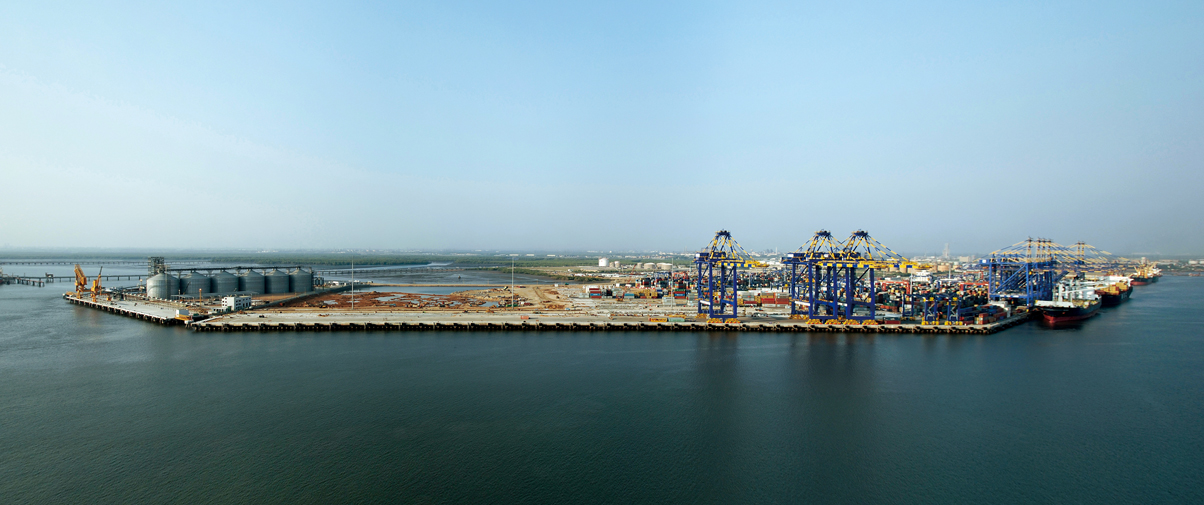
Port Qasim
Forty-five kilometres of navigable channel separate the open Arabian Sea from a port that handles roughly 35 percent of Pakistan's cargo. Port Qasim does not announce itself with the skyline drama of nearby Karachi. Instead, it sprawls across 12,000 acres of industrial waterfront wedged between the creeks and mud flats of the Indus Delta, a place where container cranes and mangrove roots compete for territory along the same silted shoreline.
A Port Born of Steel
Port Qasim owes its existence to a single commodity: steel. In the 1970s, Prime Minister Zulfiqar Ali Bhutto launched Pakistan's first steel mill in southern Karachi, and the massive imports of raw material demanded a dedicated deep-water facility. The country's only existing seaport, Karachi Port, was already congested. So a new harbor was carved from an old channel of the Indus River, 35 kilometres east of the city center, and named after Muhammad bin Qasim, the Arab commander who conquered the coastal areas of Sindh around 712 CE. What began as a steel-supply dock evolved into an industrial complex that today hosts roughly 80 percent of Pakistan's automotive industry, along with power plants and export processing zones.
The Mangrove Frontier
Port Qasim sits on the northwest edge of the Indus Delta, one of the largest mangrove ecosystems found in an arid climate. The Korangi-Phitti Creek system threads through mud flats where reptiles, shorebirds, and terrestrial mammals find habitat among the tangled roots. Yet this green fringe is under constant pressure. Shipping traffic churns sediment, industrial runoff clouds the water, and the port's expansion steadily encroaches on wetland. WWF Pakistan has responded with conservation projects that enlist local communities, schoolchildren, and government agencies, including Port Qasim Authority itself, in restoring degraded mangrove patches. The tension between commerce and ecology is visible from the air: on satellite imagery, the green corridors of mangrove forest run parallel to the grey rectangles of container yards.
When the Tasman Spirit Ran Aground
In July 2003, the Malta-registered, Greek-owned tanker Tasman Spirit ran aground at the entrance to Karachi's harbor channel, spilling crude oil across the Karachi coastline. Dead fish and turtles washed ashore. Mangrove forests turned black. Dozens of nearby residents suffered nausea from the fumes. Fears ran high that the spill would devastate the Phitti Creek waterway leading into Port Qasim, but the creek itself escaped major contamination. The incident underscored both the vulnerability of the delta ecosystem and the sheer volume of maritime traffic passing through these narrow channels every day.
Gateway and Lifeline
Together with Karachi Port, Port Qasim handles nearly 90 percent of Pakistan's external trade. The remaining maritime cargo flows through the newer Gwadar Port far to the west. Port Qasim's connectivity is part of its appeal: the national highway lies just 15 kilometres away, six railway tracks link the terminal to the national rail network, and Jinnah International Airport sits only 22 kilometres distant. Night navigation facilities allow vessels up to 202 meters in length to enter after dark. Expansion plans worth approximately US$1.22 billion in foreign direct investment aim to add new terminals, including the country's first Integrated Cargo Container Control facility, a joint Pakistani-American screening system designed to expedite US-bound shipments. For a nation whose economy depends on the sea, Port Qasim is both gateway and lifeline.
From the Air
Port Qasim is located at 24.78N, 67.34E on the southern coast of Sindh province. From cruising altitude, the port's industrial facilities are visible along the Phitti Creek waterway amid the dark green mangrove forests of the Indus Delta. The nearest major airport is Jinnah International Airport (ICAO: OPKC), approximately 22 km to the northwest. Best viewed at 5,000-10,000 feet for detail of the channel-and-mangrove landscape.