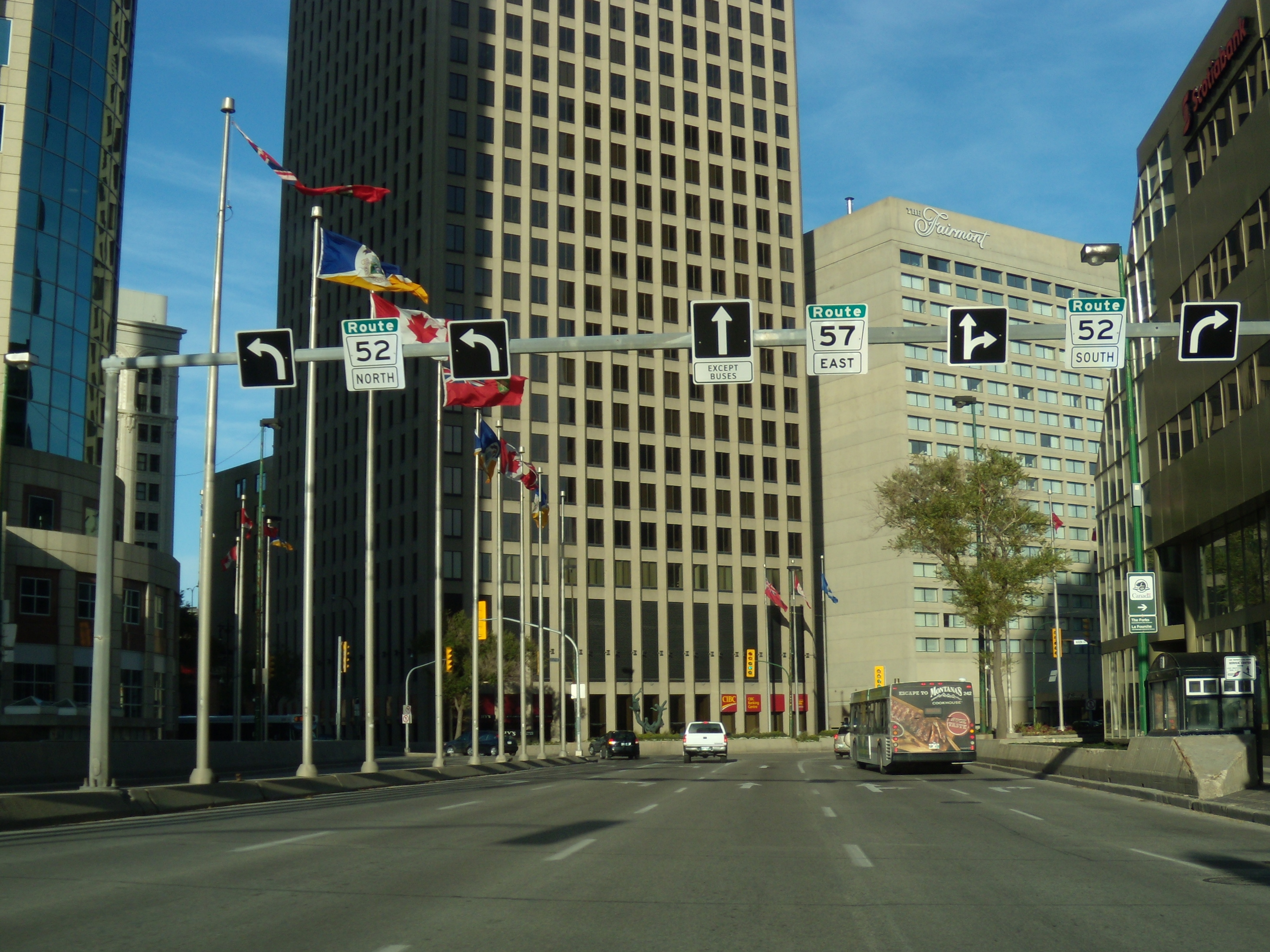
Portage and Main
"Portage and Main, fifty below." Randy Bachman and Neil Young planted those words in a 1992 song called "Prairie Town," and the phrase stuck because it confirmed what everyone already suspected: this intersection is cold. The legend that Portage and Main is the coldest, windiest corner in Canada has never been proven -- there are no official temperature measurements at any street corner in the country -- but it hardly matters. The myth became the identity. When Canadians say "Portage and Main," they mean Winnipeg itself, the way "Broadway" means New York theatre or "Wall Street" means finance. This is a crossroads that transcended its traffic function to become a national shorthand for an entire prairie city.
An Ox Cart Merchant's Gamble
On June 2, 1862, Henry McKenney purchased the land where Winnipeg's north-south and east-west ox cart paths crossed. His plan was straightforward: build a general store at the busiest intersection in the territory, with his half-brother John Christian Schultz. That decision, rooted in the simple logic of frontier commerce, established the geographic center of what would become one of Western Canada's major cities. Portage Avenue stretched westward toward the prairie. Main Street ran north-south along the Red River. As Winnipeg grew, the intersection grew with it, becoming the hub of the city's banking industry. National banks established branches accessible from underground passages beneath the corner. The 1919 Winnipeg General Strike -- one of the most significant labor actions in Canadian history -- used Portage and Main as a gathering point. By the mid-twentieth century, the intersection had achieved something rare for a mere street corner: a reputation that extended well beyond its city limits.
The Great Pedestrian Lockout
In 1976, the City of Winnipeg made a deal that would define the intersection for nearly fifty years. Private developers agreed to build an underground concourse linking shopping malls beneath all four corner properties. In exchange, the city closed the street-level pedestrian crossings. By 1978, barriers were in place, and anyone wanting to cross Portage and Main on foot had to descend into the underground network connected through the Winnipeg Skywalk. The concourse featured a large concrete sculptural wall by Winnipeg artist Bruce Head, but the underground experience felt disconnected from the energy of the street above. As the original deal neared expiration in 2016, the debate erupted. Should pedestrians be allowed to walk across Canada's most famous intersection? A 2018 plebiscite answered decisively: 65 percent voted to keep the crossings closed, citing traffic congestion concerns. The mayor accepted the result.
Seventy-Three Million Reasons to Change
The plebiscite settled the question politically, but infrastructure had the final word. A 2024 city report estimated that repairing the aging underground concourse would cost more than $73 million and require four to five years of disruptive construction. Faced with those numbers, Winnipeg city council voted 11 to 3 in March 2024 to reopen the intersection to pedestrians. On June 27, 2025, the barriers came down and street-level crossings reopened for the first time in nearly half a century. Pedestrians could once again walk across the crossroads of Canada in the open air -- wind and all. The intersection today anchors occasional street festivals and serves as the starting point for the annual Winnipeg Santa Claus Parade, which proceeds west along Portage Avenue. The tradition of coordinated Christmas lights along Main Street and Portage Avenue dates back to 1929.
A Corner in the Culture
Portage and Main has embedded itself in Canadian culture with a persistence that no urban planner could have predicted. Beyond the Bachman-Young anthem, the British band Blurt named a song after the intersection. Stompin' Tom Connors used it as the setting for "Red River Jane." Stan Rogers referenced it in "Free in the Harbour" as a waypoint for Newfoundland fishermen heading west to Alberta's oil fields. In 1974, Canada Post featured the intersection on an 8-cent stamp commemorating Winnipeg's centennial. It occupies a square on the Canadian Monopoly board. Fort Garry Brewing Company named an India Pale Ale after it. Even hockey has its Portage and Main moment: on August 13, 1981, Dale Hawerchuk signed his contract with the Winnipeg Jets at the intersection, and in 1995 and 1996, "Save the Jets" rallies filled the corner with passionate fans. This is a street corner that generates stories the way other cities generate from entire neighborhoods.
From the Air
Located at 49.895°N, 97.138°W in the heart of downtown Winnipeg, Manitoba. The intersection of Portage Avenue and Main Street is identifiable from altitude by the cluster of prominent buildings at the corner: 201 Portage, the Richardson Building, 360 Main, Winnipeg Square, and the Fairmont Hotel. The confluence of the Red River and Assiniboine River is visible approximately 600 meters to the south. Winnipeg James Armstrong Richardson International Airport (CYWG) lies roughly 7 km to the west-northwest. The downtown grid is oriented roughly north-south/east-west, making the intersection easy to identify from standard approach patterns. Best viewed from 2,000-4,000 feet.