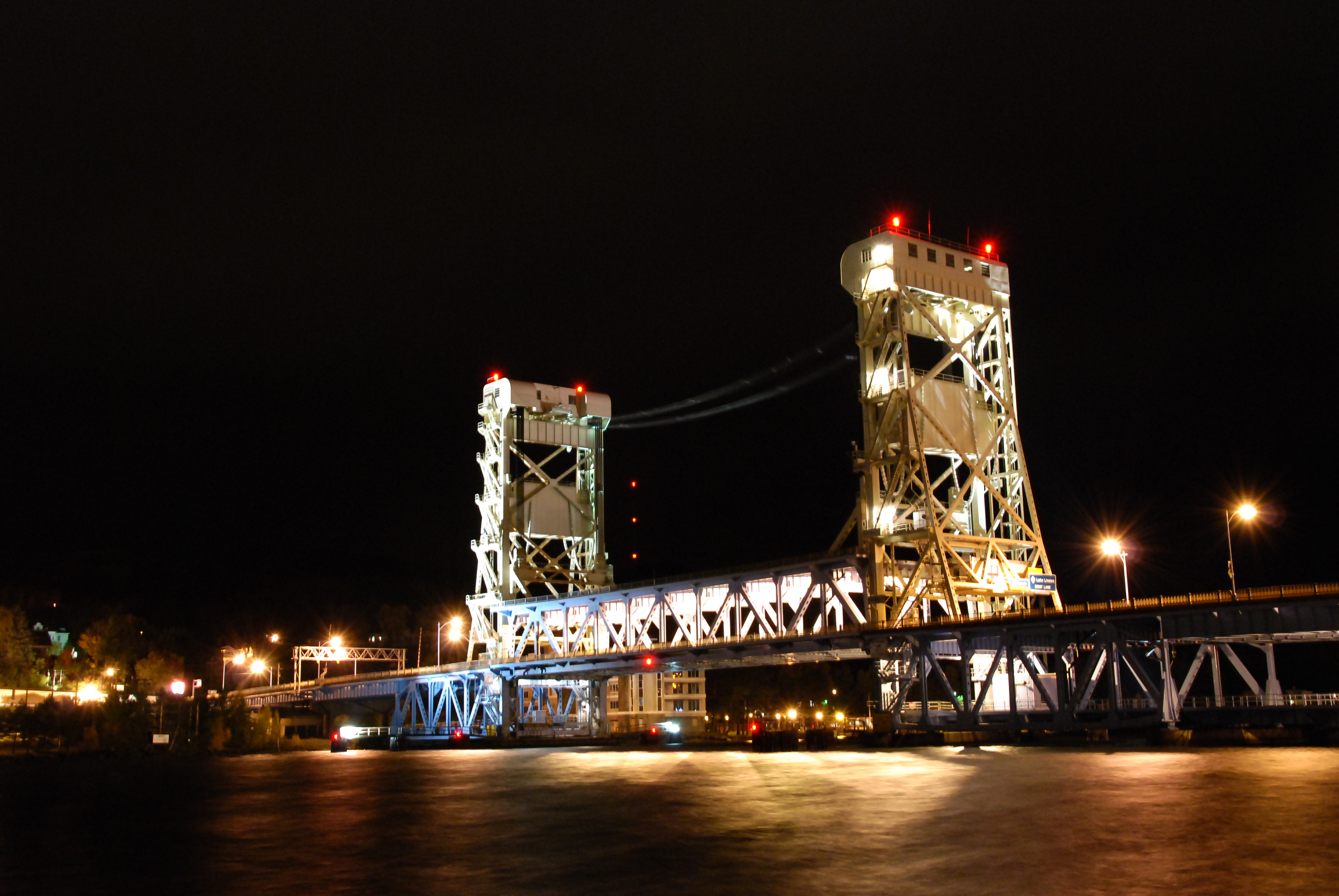
Portage Lake Lift Bridge
In winter, when Portage Lake freezes solid and the Keweenaw Waterway becomes a white corridor between snow-buried towns, the Portage Lake Lift Bridge drops to its lowest position. Not for cars -- they cross on the upper deck year-round -- but for snowmobiles, which stream across the exposed lower deck in an improvised transit system that would baffle any traffic engineer south of the 45th parallel. This is life on the Keweenaw Peninsula, where the world's heaviest and widest double-decked vertical-lift bridge serves double duty as a highway and a snowmobile corridor, and where the structure officially known as the Houghton-Hancock Bridge has been the only land-based link between Copper Island to the north and the rest of Michigan to the south since 1959.
Three Bridges, One Crossing
The current bridge is the third attempt to span the waterway at this site. The first was a wooden swing bridge, completed in the spring of 1876 after three local men raised $47,000 in stock to build it as a toll crossing. That structure served for nearly two decades before being replaced in 1895 by a steel swing bridge built by the King Bridge Company. The steel swing bridge had its own troubles: in 1905, a ship called the Northern Wave collided with it and damaged the center swinging section. The section was replaced, and in 1920 another ship nearly repeated the disaster, only stopping in time by dropping its anchor, which snagged on the canal bottom. By the 1950s, the 54-year-old swing bridge had been declared a menace to navigation on the busy Keweenaw Waterway, and the decision was made to replace it entirely.
An Engineering Monument in Steel and Concrete
The bridge that replaced it was a feat of mid-century engineering. More than 35,000 tons of concrete and 7,000 tons of steel went into the structure, designed by the Chicago firm Hazelet and Erdal. The American Bridge Company built the superstructure and Bethlehem Steel provided the structural steel, with the Al Johnson Construction Company serving as general contractor. The cost ran between $11 and $13 million, depending on the source. When it opened in 1959, the bridge carried U.S. Highway 41 and M-26 across the waterway on an ingenious double-decked liftspan. The lower deck had rails embedded in the road surface for trains, while the upper deck served vehicles. The span could be partially raised to a middle position, letting small and medium boat traffic pass while cars continued across above. For large ships, the full lift cleared the waterway entirely. For trains, the span dropped to its lowest setting.
The Yooper Loop
Rail service ended in 1982, and with it the need for the lowest bridge position during the boating season. Since then, the bridge stays at its middle or raised position through the summer months, descending to the bottom only for maintenance, repair, or the annual freeze-up that opens the lower deck to snowmobile traffic. The intersection where US 41 and M-26 approach the bridge from the south has earned the nickname the Yooper Loop -- a nod to the colloquial term for residents of Michigan's Upper Peninsula. Hancock and Houghton, the twin cities the bridge connects, hold an annual celebration called Bridgefest to commemorate the opening that united their communities. In June 2022, the bridge received designation as a National Historic Civil Engineering Landmark, placing it among a select group of structures recognized for their contribution to engineering history.
The Thread That Holds Copper Country Together
For all its tonnage and engineering distinction, the Portage Lake Lift Bridge matters most for what it makes possible. Without it, the northern half of the Keweenaw Peninsula -- the towns of Calumet, Laurium, Copper Harbor, Eagle Harbor, and dozens of former mining communities -- would be accessible only by water or by a long detour around the waterway's eastern end. The bridge is not just a crossing; it is the lifeline of a region. Michigan Technological University students in Houghton cross it to reach restaurants in Hancock. Miners once crossed earlier versions to reach the shafts on Quincy Hill. Today, tourists cross it on their way to the Keweenaw National Historical Park, and every winter, snowmobilers cross its lower deck in a tradition as practical as it is peculiar. From the air, the bridge is a thin silver bar across the dark water of the waterway, the hinge point of a peninsula that copper built.
From the Air
The Portage Lake Lift Bridge at 47.124N, 88.575W spans the Keweenaw Waterway between Houghton (south) and Hancock (north). The bridge is a distinctive silver structure clearly visible from the air, bisecting the waterway that separates Copper Island from the rest of the peninsula. Look for the twin towns flanking the crossing and the Michigan Tech campus on the Houghton side. Nearest airport: Houghton County Memorial Airport (KCMX) approximately 5nm northeast. Best viewed at 2,000-3,000 ft to see the double-decked liftspan and its relationship to the waterway. The Keweenaw Waterway itself is visible as a canal cutting east-west across the peninsula.