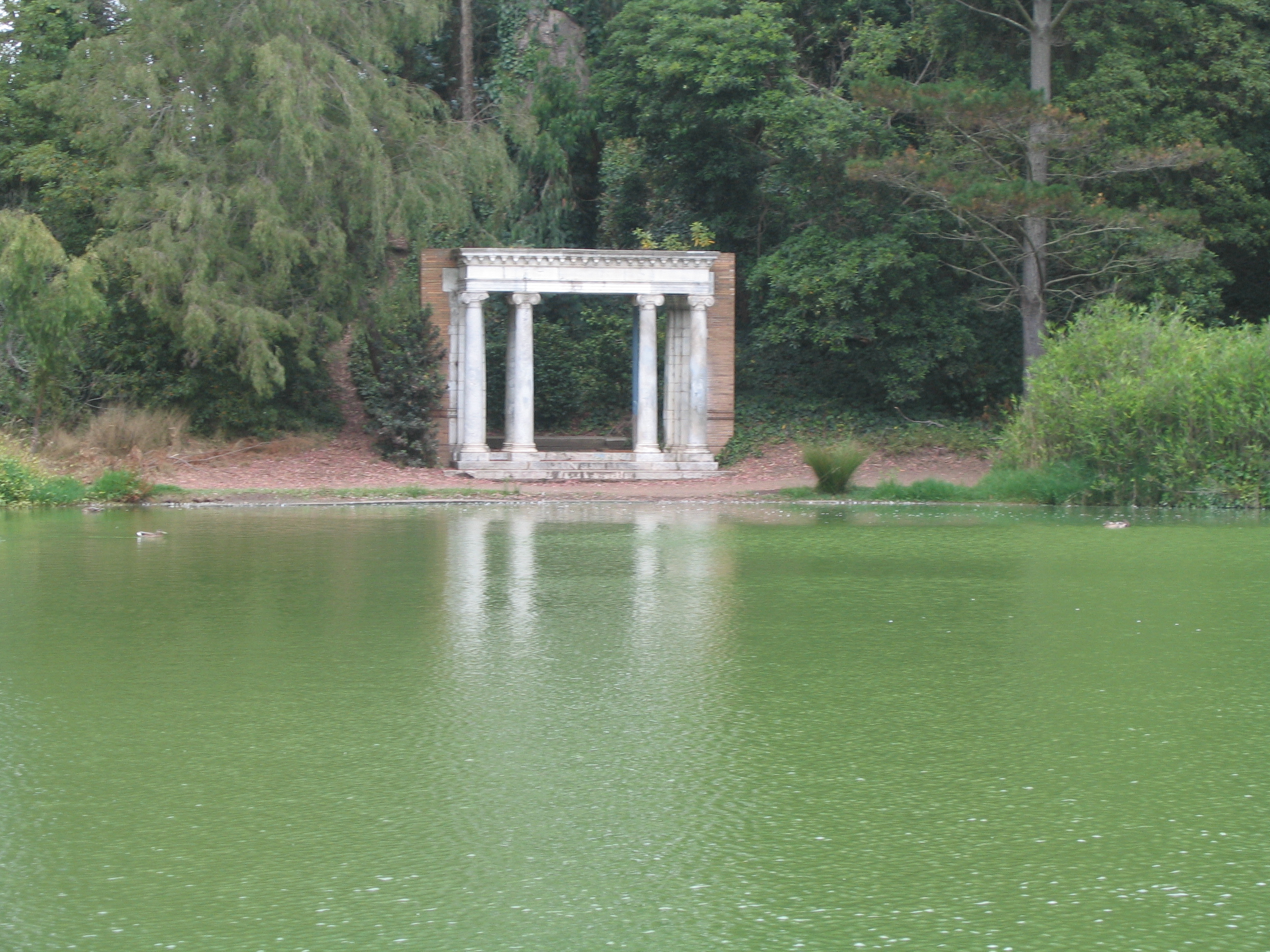
Portals of the Past
At the edge of Lloyd Lake in Golden Gate Park stands a classical marble portal that leads nowhere. Six Ionic columns support an entablature, framing a view of water and trees. This is all that remains of the A.N. Towne mansion on Nob Hill, destroyed in the fire following the 1906 earthquake. The doorway was salvaged from the ruins and moved to the park, where it was placed at the lakeside with deliberate artfulness. The portal frames the view as if the lake were a room you are about to enter. It is called Portals of the Past, and it is the most beautiful piece of architecture in San Francisco that serves no architectural purpose at all.
From Nob Hill to the Lake
The Towne mansion stood on Nob Hill, part of the cluster of railroad-baron estates that defined the hilltop before the earthquake. When the 1906 fire swept through, the mansion was destroyed along with nearly everything else on Nob Hill. The marble entry portal survived because stone does not burn. It was photographed amid the ruins, framing a view of the devastated city beyond, an image that became one of the iconic photographs of the earthquake's aftermath. The portal was later moved to Golden Gate Park and installed at the edge of Lloyd Lake, where its classical proportions and the accident of its survival transformed it from rubble into art.
Memory in Marble
The portal's placement at the lakeshore was no accident. Positioned so that visitors approach it from the park's paths, it creates the illusion of a doorway opening onto the water. The effect is startling: a formal architectural element, designed to welcome guests into a mansion, now welcomes them into nothing, or into everything. The absence behind the portal is the point. The mansion it belonged to is gone. The neighborhood it stood in was rebuilt. The people who walked through it are dead. What remains is the gesture of entrance, preserved in marble, a permanent threshold leading to the past.
A Landmark of Loss
Portals of the Past has become one of Golden Gate Park's most recognized landmarks, though many visitors pass it without knowing its story. It is listed as a San Francisco Designated Landmark. The columns are weathered now, their marble softened by more than a century of fog and rain. Lloyd Lake reflects them in the early morning, doubling the image. Photographers come for the light. Joggers pass without pausing. The portal asks nothing of anyone. It simply stands, as it has stood since a fire burned away everything around it except the part designed to be walked through.
From the Air
Located at 37.77°N, 122.47°W at Lloyd Lake in Golden Gate Park's western section. The portal is not individually visible from altitude but sits within the park's recognizable green expanse. Nearest airports: SFO (KSFO, 12 nm south), Oakland (KOAK, 14 nm east).