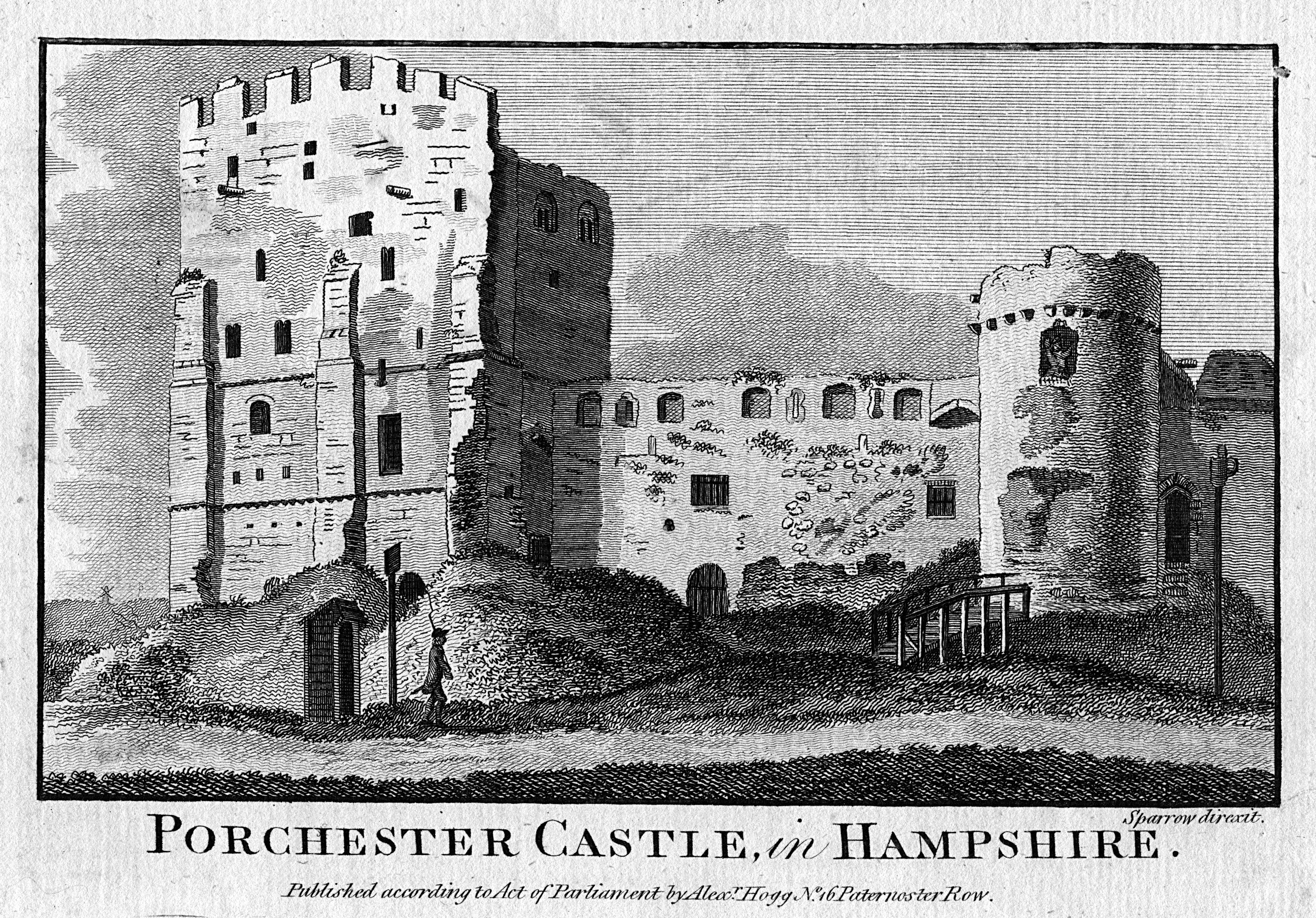
Portchester Castle
When Elizabeth I arrived at Portchester Castle on 30 August 1591, the floors of the state chambers were so rotten she had to eat dinner in the keeper's bedchamber, freshened not with her customary perfumes but with rue and hyssop. The indignity was fitting for a fortress that had already endured 1,300 years of use and abuse -- from Roman fleet base to Norman stronghold, from royal embarkation port to Napoleonic prison. Portchester's walls have held more of England's story than almost any other single structure.
Roman Walls, Saxon Kings
The outer walls of Portchester Castle are Roman. Built between 285 and 290 AD, probably by Marcus Aurelius Carausius on the orders of Emperor Diocletian, the fort was one of several Saxon Shore installations designed to combat pirate raids along the British coast. It likely served as a base for the Classis Britannica, the Roman fleet defending Britain. Those walls still stand -- making Portchester the best-preserved Roman fort north of the Alps. The Roman army withdrew from Britain in the early 5th century, but the site was never fully abandoned. A 10th-century hall and tower discovered within the fort suggest a high-status Saxon residence. In 904, King Edward the Elder made Portchester a burh, a fortified town to defend against Vikings, as recorded in the Burghal Hidage.
The Shakespeare Connection
After the Norman Conquest, a medieval castle was built within the Roman walls, eventually passing to royal control under Henry II in 1154. King John favored Portchester as a hunting lodge, and the French captured it briefly in 1216 during their intervention in the First Barons' War. But the castle's most dramatic moment came in July 1415, when Henry V was assembling his forces at Portchester for the campaign that would end at Agincourt. While preparing for the invasion of France, the king uncovered the Southampton Plot -- a conspiracy to overthrow him. Henry arrested the three conspirators at the castle: the Earl of Cambridge, Baron Scrope of Masham, and Sir Thomas Grey. All three were executed in early August. Shakespeare dramatized the scene in his play Henry V, giving Portchester a permanent place in English literature.
Prison and Decline
By the 15th century, nearby Portsmouth had eclipsed Portchester as a port and military center. A survey from 1441 described the castle as "right ruinous and feeble." It lingered through centuries of sporadic repair and neglect, used variously as a military hospital during conflicts with France and readied for defense against the Spanish Armada under Elizabeth I. Its final military purpose was grimmer: during the Napoleonic Wars, Portchester held over 7,000 French prisoners of war. A prison hospital stood along what was then called Seagates Lane, surviving today as a private residence. Those prisoners who died in captivity were often buried in the tidal mudflats south of the castle, where storms still occasionally disturb their remains.
Seventeen Centuries and Counting
Today Portchester Castle is managed by English Heritage, its Norman church of St Mary still standing in the southeast corner of the Roman walls -- an active place of worship within the Anglican Diocese of Portsmouth. The inner castle accommodates displays and exhibits, while the Roman sea wall draws anglers at high tide, fishing for flounder and bass in the same waters where the Classis Britannica once anchored. Local legend -- unverified but persistent -- holds that Pontius Pilate himself was brought to Portchester by galley late in his life as a final refuge. It is the kind of story a place this old attracts: when your walls have stood for seventeen centuries, almost anything seems plausible.
From the Air
Located at 50.84N, 1.12W at the head of Portsmouth Harbour, Hampshire. The rectangular Roman walls are clearly visible from the air, with the Norman keep in one corner. Portsmouth (the city) is approximately 6nm south. Nearest airports include Solent Airport (EGHF) and Portsmouth City heliport. Best viewed at 1,500-3,000 ft AGL on approaches over the harbour.