Portmeirion
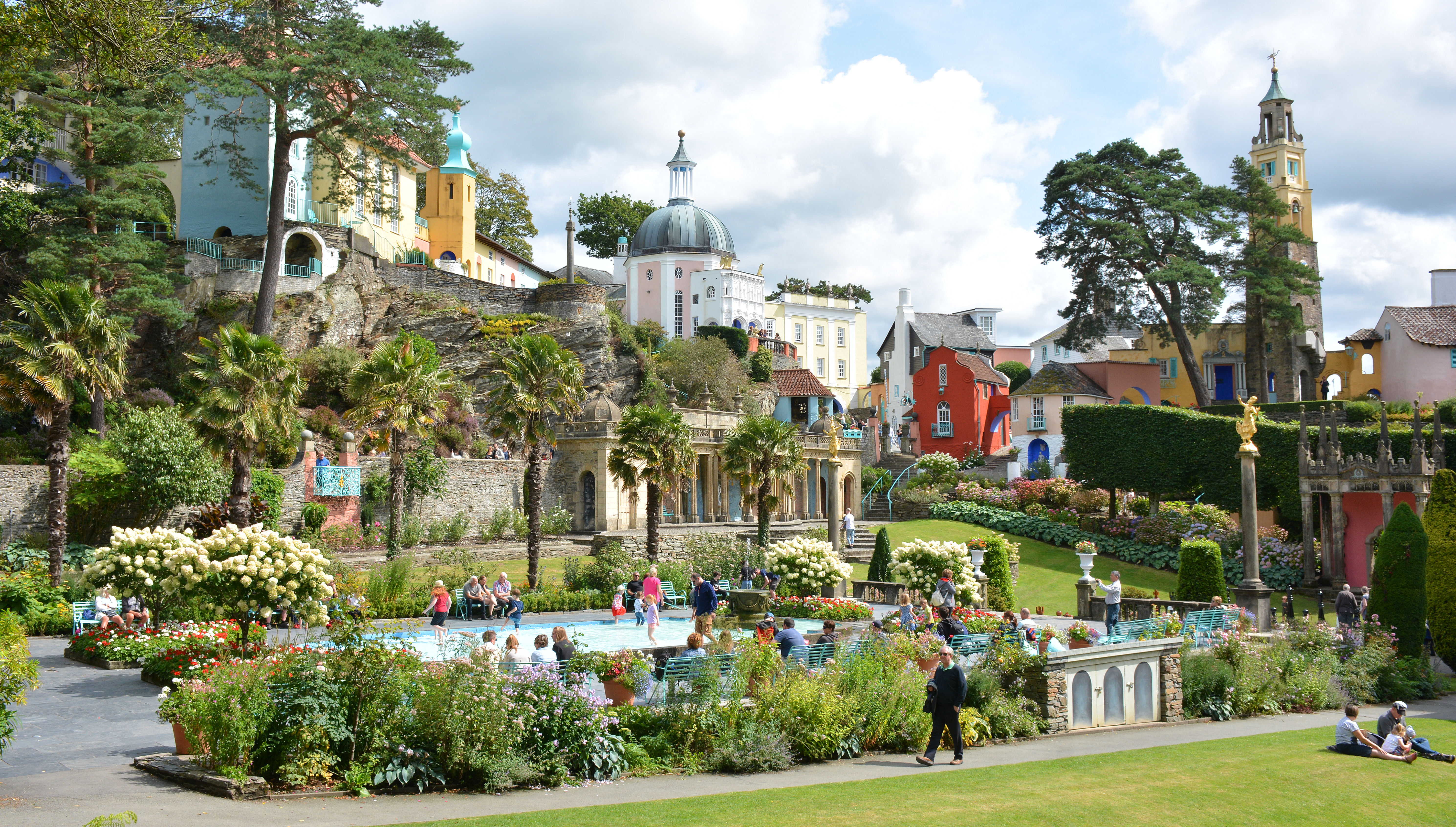
"I am not a number. I am a free man." Patrick McGoohan shouted those words against the backdrop of a place that should not exist: a pastel-colored Italian piazza, complete with campanile, colonnades, and a porthole-windowed lighthouse, nestled among rhododendrons on the coast of North Wales. Portmeirion is the life's work of Sir Clough Williams-Ellis, who spent half a century -- from 1925 to 1975 -- constructing an entire village to prove that developing a beautiful site need not destroy its beauty. The result is part folly, part manifesto, and entirely unforgettable.
Not Portofino, But Not Not Portofino
Williams-Ellis denied that Portmeirion was modeled on the Italian fishing village of Portofino, though he admitted the influence freely enough: "How should I not have fallen for Portofino? Indeed, its image remained with me as an almost perfect example of the man-made adornment and use of an exquisite site." He wanted to pay tribute to the atmosphere of the Mediterranean, not copy a specific place. The name itself is a compound: "Port-" from the coastal location, "-meirion" from the old county of Merioneth. The site had previously been a private estate called Aber Ia -- Welsh for "frozen mouth" -- built on a late 18th-century foundry and boatyard. Williams-Ellis incorporated fragments of demolished buildings from across Britain, creating what architecture critics have called a bricolage, a deliberate collage recognized as an early influence on postmodern architecture.
Noel Coward's Ghost and George Harrison's Birthday
The village drew creative minds from the start. Noel Coward wrote Blithe Spirit while staying at Portmeirion, George Bernard Shaw and H. G. Wells were early visitors, and Frank Lloyd Wright came in 1956. The Beatles had deep connections to the place: their manager Brian Epstein visited frequently, Paul McCartney stayed, and George Harrison celebrated his 50th birthday there in 1993, filming interviews for The Beatles Anthology documentary during his visit. Jools Holland was so taken with Portmeirion while filming for the music show The Tube that he later had buildings at his home in Blackheath designed in its style. Gregory Peck and Ingrid Bergman passed through. The village has always attracted people whose business is making imaginary worlds feel real.
Number 6 Was Here
In 1966 and 1967, Patrick McGoohan returned to Portmeirion to film The Prisoner, a surreal spy drama in which the village played "The Village" -- a beautiful, sinister prison where a retired intelligence agent known only as Number 6 is held and interrogated. At Williams-Ellis's request, Portmeirion was not identified on screen until the final episode's credits. The show became a cult classic, and its influence has never left the village. A large outdoor chessboard was installed in 2016 in homage to the series. The building used as Number 6's residence became a Prisoner-themed souvenir shop. Iron Maiden recorded a song called "The Prisoner" for their 1982 album The Number of the Beast, with lead singer Bruce Dickinson later wandering the village's avenues for a documentary. Many filming locations remain virtually unchanged after more than 50 years.
Architecture as Play
The critic Lewis Mumford devoted much of a chapter in his 1963 book The Highway and the City to Portmeirion, calling it "a fantastic collection of architectural relics and impish modern fantasies." He saw it as a necessary corrective to the rigid functionalism of mid-century modernism, a place where architecture reclaimed "the freedom of invention and the possibility of pleasurable fantasy." Mumford described the total effect as "relaxing and often enchanting" with "playful absurdities" that were "delicate and human in touch." Many of the buildings are listed by Cadw for their architectural importance, and the gardens are listed at Grade II star on the Register of Parks and Gardens of Special Historic Interest in Wales. What began as one architect's eccentric vision has become a recognized landmark in the history of British architecture.
The Wild Place
Beyond the Italianate stage set, Portmeirion's grounds -- Y Gwyllt, meaning "The Wild Place" -- contain a remarkable collection of rhododendrons and exotic plants in a wild-garden setting on the peninsula stretching north toward the Dwyryd estuary. The frost-free coastal microclimate allows camellias and rare subtropical species to thrive. The gardens were begun before Williams-Ellis's time by the previous owner, George Henry Caton Haigh, and have been continuously developed since. The village itself is now owned by a charitable trust and operates as a hotel, with most buildings serving as rooms or self-catering cottages. Castell Deudraeth, a Victorian mansion on the estate, was opened as an 11-bedroom hotel in 2001 by the Welsh opera singer Bryn Terfel, 23 years after Williams-Ellis's death. The architect's half-century experiment has outlived him, a permanent argument that buildings should delight as much as they shelter.
From the Air
Located at 52.91N, 4.10W on a small peninsula on the Dwyryd estuary, Gwynedd. From the air, the Italianate buildings with their distinctive pastel colors are unmistakable against the green Welsh landscape. The campanile (bell tower) is a key visual landmark. Nearby Porthmadog is 2 miles to the northeast. Nearest airport: Caernarfon (EGCK) approximately 15nm north. Recommended altitude: 1,500-2,500 ft for clear views of the village layout and estuary setting.