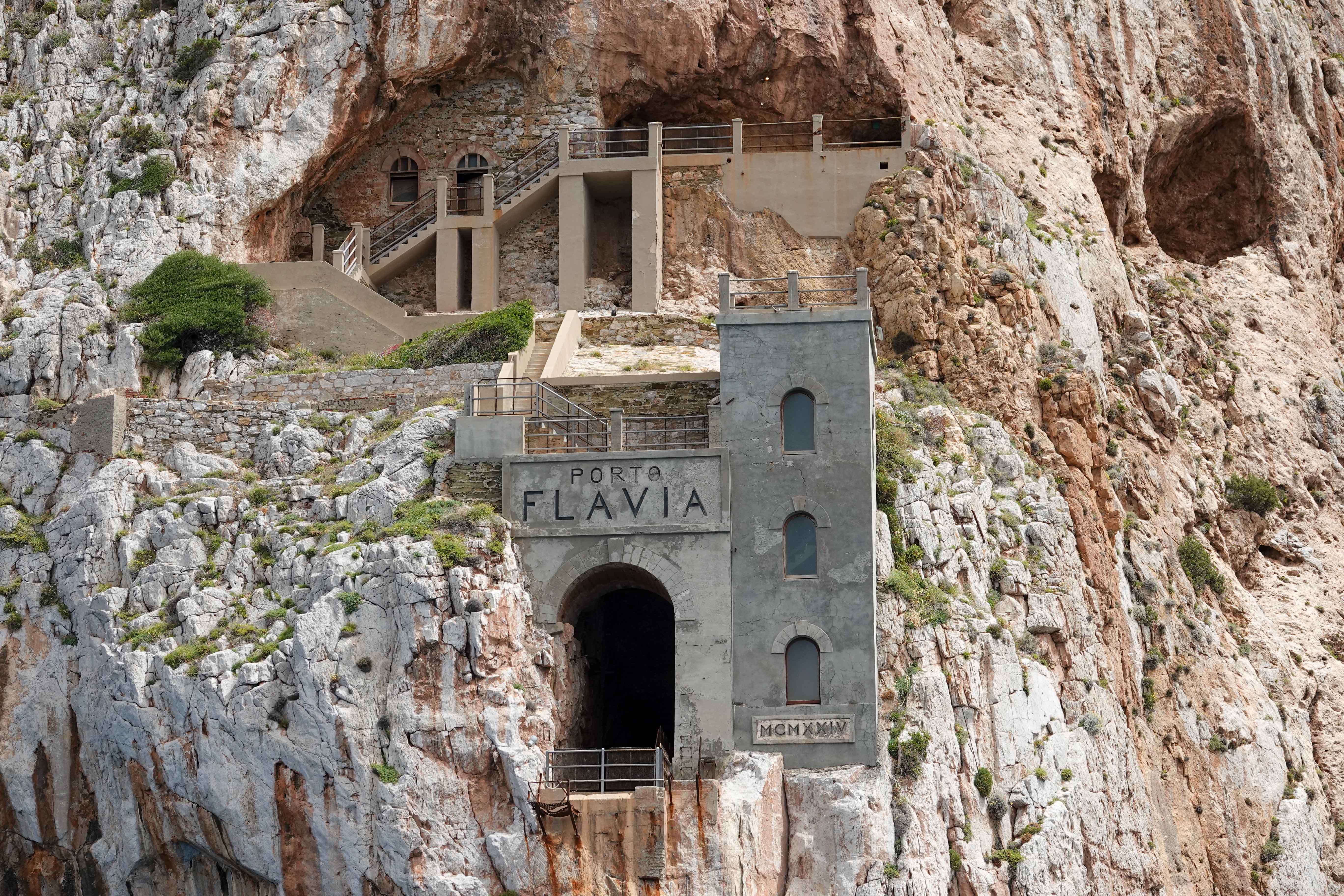
Porto Flavia
Before Porto Flavia, loading a steamship with Sardinian ore could take two months. Sailors from Carloforte would heave processed zinc and lead into wicker baskets, balance them on their shoulders, and load their bilancelles -- traditional two-masted boats -- to the breaking point. Thirty tons of ore per boat, carried thirty kilometers across open water to Carloforte Island, then manually unloaded, then reloaded onto waiting steamships. The boats sank regularly. The wages were terrible. And in bad weather, the whole process stopped entirely. Then in 1924, an Italian engineer named Cesare Vecelli blasted two tunnels through a sea cliff and made all of it obsolete.
The Sulcis Mining Country
The Iglesiente coast of southwestern Sardinia sits atop one of the richest mineral deposits in the Mediterranean -- coal, sulphur, barium, zinc, lead, and silver, exploited since at least 1600. Mining became economically significant only in the early twentieth century, when north-European corporations invested in modernizing extraction. In 1922, the Belgian Vieille Montagne Company acquired the Masua mines and accelerated production to meet the post-World War I demand for zinc and lead in reconstruction and steel alloys. The extraction itself followed a grim division of labor: men aged sixteen and older worked underground; women and children processed the ore at a centralized washing plant called the Lavatoio. The bottleneck was always transportation -- getting the processed ore from the cliff-top mines to the foundries of France, Belgium, and Germany.
An Engineer's Solution
Vieille Montagne asked Vecelli to solve the loading problem. He spent a year surveying the coastline before finding the ideal spot: the high cliffs facing the Pan di Zucchero sea stack, where deep water and natural wind protection would allow a steamship to moor safely at the cliff's base. His design was audacious. Two superimposed tunnels, each 600 meters long, were bored through the rock. Nine enormous vertical reservoirs, carved directly into the cliff, connected the upper and lower tunnels. In the upper tunnel, an electric train brought ore to hatches above the reservoirs, where gravity dropped it into storage. In the lower tunnel, a conveyor belt drew ore from the reservoirs and fed it to an extensible 16-meter conveyor that could reach directly into a ship's hold. The reservoirs held over 10,000 metric tons. A fully loaded steamship, which once took weeks or months, could be filled in about two days.
The Squadra della Morte
Drilling the tunnels presented its own hazard. Because the passages ran straight with no angles or trenches, workers had nowhere to shelter when dynamite charges detonated. Small cavities were excavated at regular intervals along the tunnel walls -- just enough space for a man to press himself flat while rock exploded a few meters away. These niches are still visible on guided tours. Working conditions in Porto Flavia were generally better than in the mines themselves -- the harbor had a powder removal system, proper ventilation, natural light, and decent wages. But the most dangerous job belonged to the Squadra della Morte, the 'Death Squad': workers who were lowered into the massive vertical reservoirs on ropes to dislodge ore that had stuck to the rocky walls. Armed with poles and picks, dangling above thousands of tons of loose mineral, they worked a job that was as lethal as its name suggested.
Named for a Daughter
Vecelli named the harbor after his daughter, Flavia -- a personal touch on an industrial monument. Porto Flavia operated at peak capacity through the mid-twentieth century, delivering over 500 metric tons of ore per hour under normal conditions. But the decline of mining in the Sulcis-Iglesiente region, which began in the 1960s, gradually drained the harbor of purpose. It closed in the 1990s when mineral production at Masua ceased entirely. Today Porto Flavia is a UNESCO-protected site, owned by IGEA SpA, a public company tasked with preserving Sardinia's industrial heritage. Daily tours led by former mine workers and technicians take visitors through the lower tunnel to the cliff-face opening, where the conveyor once reached out over the Mediterranean to feed the holds of waiting ships. The Pan di Zucchero stack still rises from the turquoise water below, unchanged since the day Vecelli first stood here and imagined cutting a harbor through solid rock.
From the Air
Located at 39.34N, 8.41E on the western coast of Sardinia, Italy, near Nebida in the Iglesias commune. The harbor is carved into dramatic sea cliffs facing the Pan di Zucchero sea stack, one of the tallest limestone stacks in the Mediterranean. Nearest airport: Cagliari Elmas Airport (LIEE), approximately 65 km southeast. From altitude, the cliff-face opening and the mining infrastructure above are visible along this spectacularly rugged coastline.