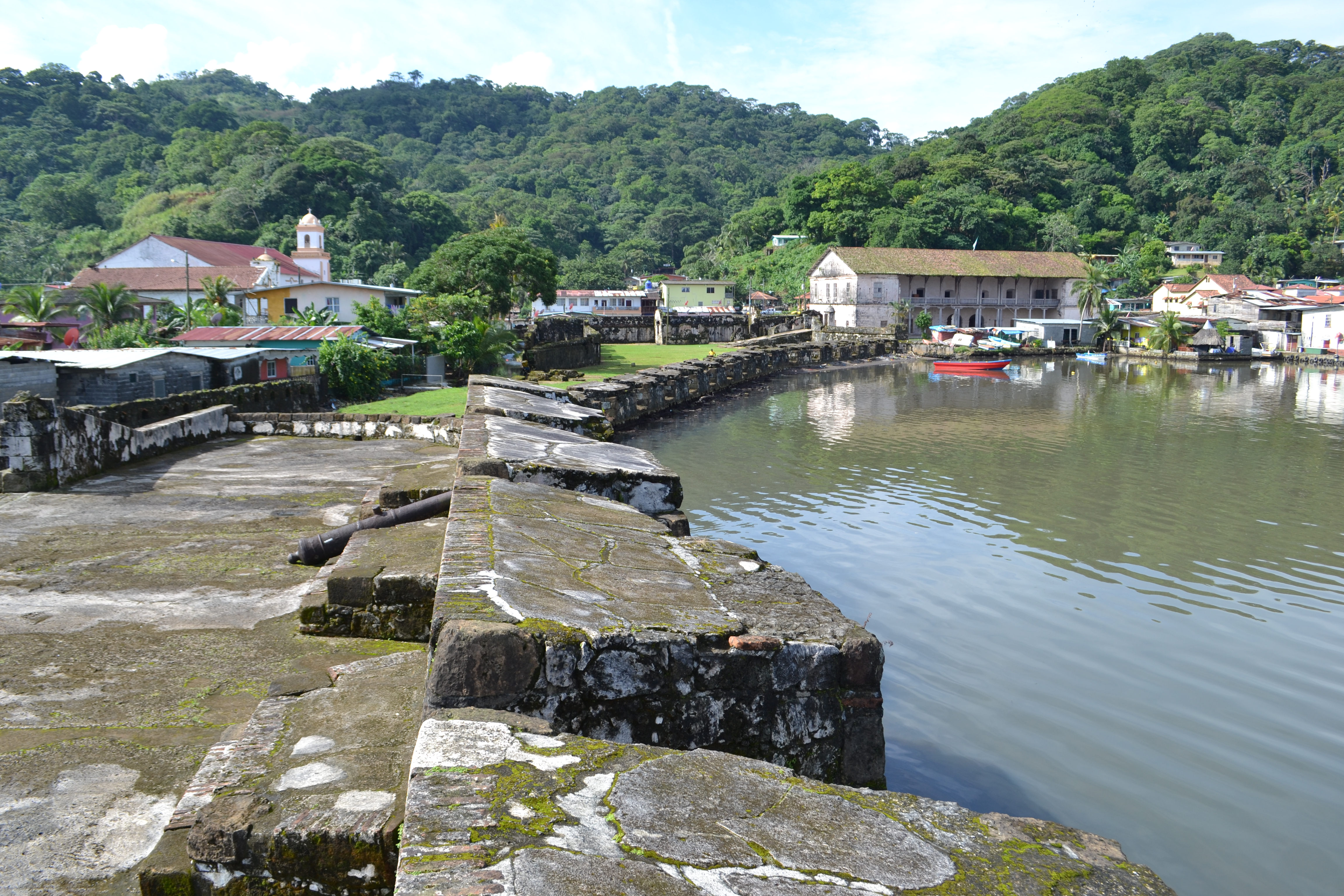
Portobelo
Somewhere in the waters of Portobelo Bay, inside a lead coffin, lies Sir Francis Drake. He died of dysentery aboard his ship in January 1596, and his crew buried him at sea near the entrance to this harbor. They are still looking for him. Divers have searched for decades without success, and the coffin remains one of the Caribbean's great unfound relics. The bay that keeps Drake's secret was, for two centuries, one of the most important harbors in the Western Hemisphere -- a terminus for Peruvian silver, a target for pirates and admirals, and a city whose wealth was legendary even by the standards of the Spanish Empire. Today, Portobelo holds around 4,500 people and a quiet that belies everything that happened here.
Silver Road's End
Spanish explorer Francisco Velarde y Mercado founded Portobelo in 1597, one year after Drake's burial nearby. The location was chosen to replace Nombre de Dios, an earlier Caribbean terminal that had proven vulnerable to both raiders and weather. Portobelo offered a deep natural harbor and defensible headlands -- critical advantages for a port that would become one of the main links in Spain's treasure chain. Silver mined in Peru traveled to Panama City, was loaded onto mule trains that crossed the isthmus along the Camino Real, and arrived in Portobelo for transfer to the galleons of the Spanish Plate Fleet. During the great trade fairs, the town's population swelled and its warehouses filled with silver bars, gold coins, emeralds, and spices. From the sixteenth to the eighteenth century, an enormous share of the wealth that funded the Spanish Empire passed through this single harbor.
Plunder, Bombardment, and the War of Jenkins' Ear
Portobelo's wealth made it irresistible to raiders. In 1668, Captain Henry Morgan led 470 privateers against the town, capturing its fortifications through a combination of tactical cunning and brutal force -- including the use of captured civilians as human shields. Morgan plundered the city for 14 days and extracted a ransom of 100,000 pesos before departing for Jamaica. Seventy-one years later, on November 21, 1739, a British fleet under Admiral Edward Vernon attacked and captured the port during the War of Jenkins' Ear. Vernon's victory created such a sensation across the British Empire that streets and neighborhoods were named "Portobello" throughout the British Isles and the Thirteen Colonies -- including London's Portobello Road, which still bears the name. Spain recovered the town, however, and Vernon later suffered a devastating defeat at Cartagena de Indias in 1741, losing over 18,000 men.
Forts, Faith, and Festival
In 1980, Portobelo's fortification ruins, along with nearby Fort San Lorenzo on the Chagres River, were declared a UNESCO World Heritage Site. The forts range from medieval Spanish designs by Antonelli to 18th-century neoclassical batteries, their spiked cannons still angled toward the bay. The old customs house, damaged in a 1744 attack and since rebuilt, now operates as a museum that tells the story of how Afro-Panamanian communities descended from enslaved Congolese people settled the region and shaped its culture. Their most visible legacy is the Black Christ Festival, held each October 19-21, when tens of thousands of pilgrims converge on Portobelo's church to venerate the Cristo Negro -- a dark-skinned statue of Christ whose origins are wrapped in local legend. The Congos and Diablos Festival, held during carnival season, dramatizes the history of enslaved people's resistance through elaborate costumes and performances.
A Harbor That Outlasted Its Empire
Modern Portobelo is compact enough to walk in an hour. One road runs parallel to the water and forks at the village square. The western fort ruins sit at one end of town, a watchtower staircase offers panoramic views of the bay, and the church and customs house museum anchor the center. The fortifications and roughly 36,000 hectares of surrounding tropical rainforest are protected as Portobelo National Park. Two dive centers operate in the harbor -- the same waters where Drake's coffin rests -- and cruising yachts fill the anchorage. Boat services connect Portobelo to the San Blas Islands and Colombia, making it a transit point for sailors heading south. Following the War of Jenkins' Ear, Spain abandoned the large fleet system that had made Portobelo essential, and the town's commercial importance faded. What remains is a place where 400 years of history sit within walking distance, unhurried and largely unrestored, waiting in the Caribbean heat.
From the Air
Portobelo sits at 9.554N, 79.655W on a deep natural harbor along Panama's Caribbean coast, approximately 100 km northeast of Panama City. From 3,000-5,000 feet AGL, the narrow harbor entrance flanked by fort ruins on both headlands is the primary visual reference. The surrounding terrain is heavily forested tropical rainforest within the boundaries of Portobelo National Park. France Field/Enrique Adolfo Jimenez Airport (MPEJ) near Colon is the nearest airfield, roughly 35 km to the west. Tocumen International Airport (MPTO) serves Panama City. Expect tropical maritime conditions with frequent low ceilings, afternoon convective activity, and heavy rainfall, particularly during the May-December wet season.