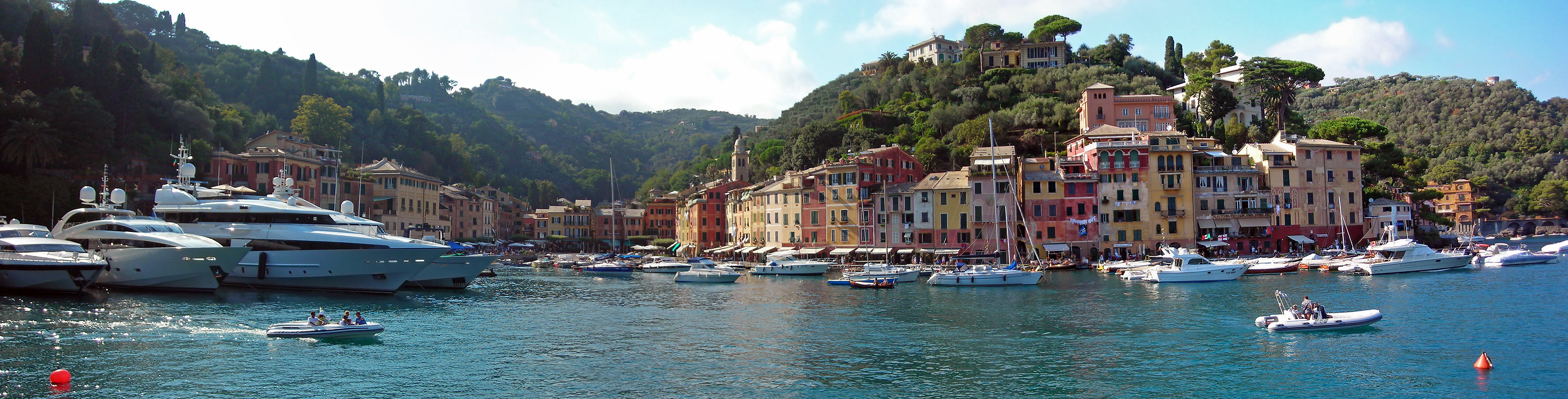
Portofino
Seventeen meters beneath the surface of the inlet at Portofino, a bronze statue of Christ stands on the seabed with arms raised toward the light above. Placed there in 1954 in memory of Dario Gonzatti, the first Italian to use scuba equipment, who died diving these waters in 1947, the Christ of the Abyss has become as iconic as the village it watches over. Above the waterline, Portofino is a crescent of pastel-colored buildings wrapped around a harbor so small that a few dozen yachts fill it completely. It is among the most photographed places in Italy, and among the most expensive. But for most of its history, it was a fishing village too cramped to matter.
Port of the Dolphin
Pliny the Elder, writing in the first century AD, recorded a settlement called Portus Delphini on the Ligurian coast between Genoa and the Gulf of Tigullio. The name stuck. A diploma from 986 AD by Adelaide of Italy assigned the village to the nearby Abbey of San Fruttuoso di Capodimonte. In 1171, Portofino was folded into the jurisdiction of neighboring Rapallo, and after 1229 it became part of the Republic of Genoa. The republic valued the harbor, but it was too cramped and shallow to serve as anything more than a temporary safe haven for the Genoese merchant fleet. In 1409, during one of the republic's periodic convulsions, Charles VI of France -- then Doge of Genoa -- sold Portofino to the Republic of Florence. When Charles lost Genoa, the Florentines handed it back. Through the 15th century, the village passed between noble families -- the Fieschi, the Spinola, the Adorno, the Doria -- each leaving their mark on the cluster of buildings around the harbor.
The English Discovery
Tourism arrived by horse and cart. In the late 19th century, British aristocrats began making the journey from Santa Margherita Ligure along the winding coastal road to a village that had barely changed since the Renaissance. Aubrey Herbert, the diplomat and orientalist who may have inspired the character of Sandy Arbuthnot in John Buchan's novels, was among the early visitors. Elizabeth von Arnim, the Anglo-German novelist, stayed at the 16th-century Castello Brown -- the fortress above the harbor -- and wrote The Enchanted April, the 1922 bestseller that introduced Portofino to the English-speaking world. The novel was adapted into a 1991 film starring Joan Plowright and Miranda Richardson, nominated for three Academy Awards. By 1950, tourism had replaced fishing as the town's chief industry, and the waterfront had become a continuous ring of restaurants and cafes.
A Village the World Could Not Leave Alone
The list of people who have passed through Portofino reads like an index of European culture. King Richard I of England stopped here in 1190, en route to the Third Crusade. Pope Gregory XI visited in 1377. Guglielmo Marconi, the inventor of radio, made it a residence. Rex Harrison and Lilli Palmer lived here. The village's hold on the imagination proved so powerful that it spawned replicas: a full-scale reproduction at Universal Orlando Resort in Florida, and the Mediterranean Harbor at Tokyo DisneySea in Japan, inspired by Portofino's crescent harbor. Ferrari named a car after it in 2017. The Pixar film Luca, set in a fictional village called Portorosso, drew its visual vocabulary from Portofino and the surrounding Italian Riviera. The architect Clough Williams-Ellis, who built the Italianate village of Portmeirion in Wales, denied that Portofino was his direct model, but confessed: 'How should I not have fallen for Portofino? Its image remained with me as an almost perfect example of the man-made adornment and use of an exquisite site.'
Still Small
For all its fame, Portofino remains astonishingly small. The permanent population barely exceeds 400 people. The harbor holds perhaps two dozen boats. There is one main road in, and on busy days it becomes impassable. The 12th-century church of San Martino still stands. The church of San Giorgio, on the headland above the harbor, still houses saints' relics. The Gothic oratory of Santa Maria Assunta remains in use. The Castello Brown, where von Arnim wrote her novel, is now a museum. From the air, Portofino appears as a tiny indentation in the forested coastline of the Ligurian promontory -- a miniature harbor ringed by buildings the color of faded sunlight, surrounded by dark green hills dropping steeply to a deep blue sea. It is the kind of place that looks too perfect to be real, which is precisely why the world keeps trying to copy it.
From the Air
Located at 44.30N, 9.21E on the tip of the Portofino promontory, on the Italian Riviera east of Genoa. The tiny harbor is visible from lower altitudes as a small crescent inlet surrounded by colorful buildings. The promontory is heavily forested, extending into the Ligurian Sea. Santa Margherita Ligure is visible to the west around the headland. Nearest airport is Genova-Sestri (LIMJ), approximately 30 km to the northwest. The Gulf of Tigullio opens to the east.