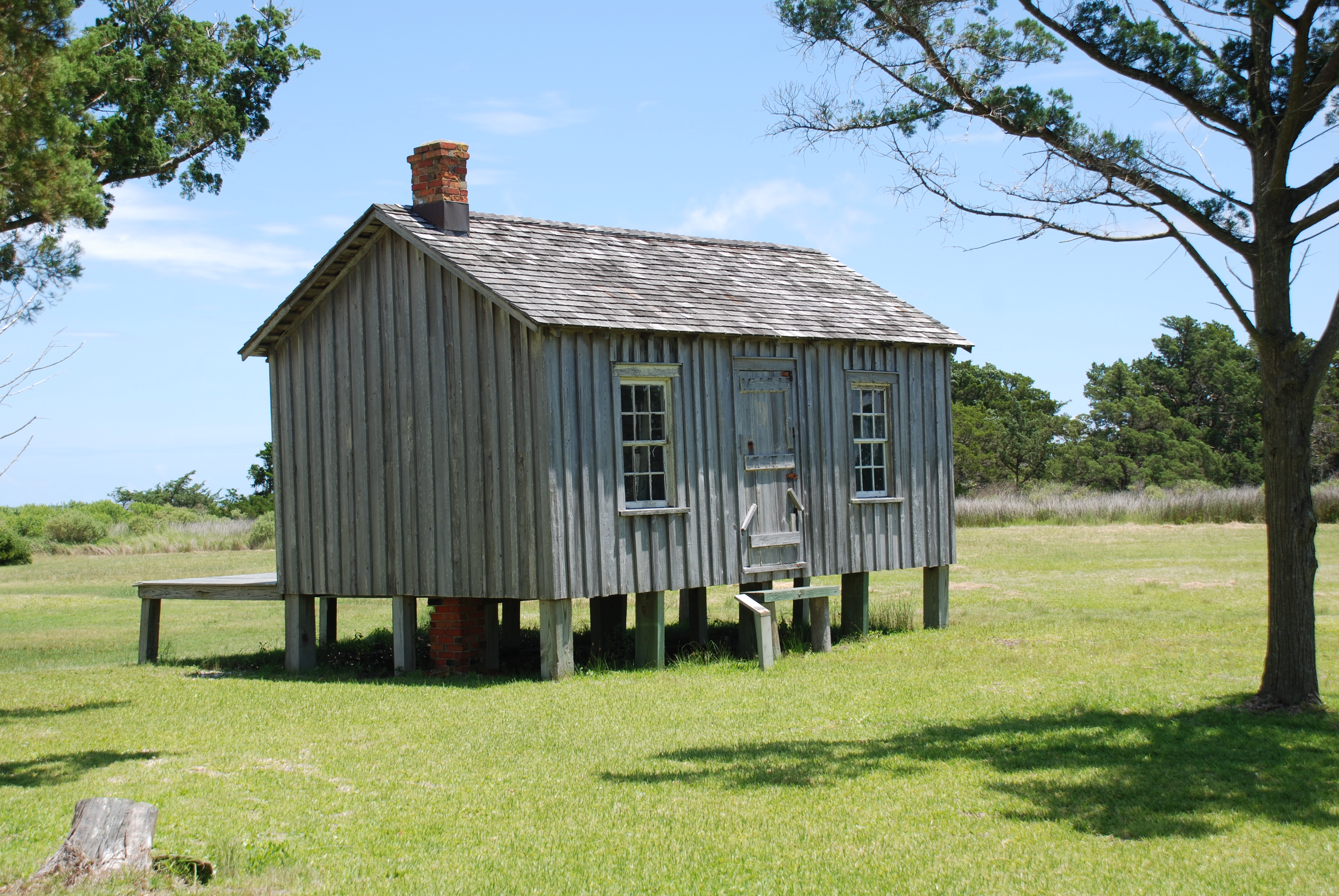
Portsmouth, North Carolina
The last two residents of Portsmouth, North Carolina left in 1971. No one has lived here since. The houses still stand -- gray-shingled, salt-scoured, arranged along sandy paths that were once streets -- but there is no electricity, no running water, no store, no school in session, no congregation gathering on Sunday morning. Portsmouth is the Outer Banks' most complete ghost town, an entire village frozen at the moment of its abandonment, preserved now by the National Park Service as part of Cape Lookout National Seashore. Getting here requires a ferry from Ocracoke, and once you step ashore, the silence is startling.
The Port That Built an Island
Portsmouth was founded in 1753 by an act of the North Carolina colonial assembly, established specifically to service Ocracoke Inlet, which was then the principal shipping channel into Pamlico Sound. The village became essential to colonial commerce through a practice called lightering: large ocean-going vessels could not cross the shallow inlet, so their cargo had to be transferred to smaller, flat-bottomed boats for the trip inland. Portsmouth's residents built Shell Castle, a small artificial island made entirely of oyster shells, to serve as a shipping depot in the middle of the inlet. By the late 1700s, Portsmouth was the busiest port south of Norfolk, Virginia, and the largest settlement on the Outer Banks. At its peak around 1860, nearly 700 people called the island home.
A Slow Unraveling
The decline began with a storm. In 1846, a hurricane opened a new inlet at Hatteras, creating a deeper, safer channel that drew shipping traffic away from Ocracoke Inlet almost overnight. Portsmouth's reason for existing -- lightering cargo through the old inlet -- evaporated. The Civil War accelerated the exodus. Union troops occupied the Outer Banks, and many residents fled to the mainland. After the war, most of the village's African American population, descendants of enslaved people who had been brought to the island, left Portsmouth. Some families remained, including the Pigotts, whose descendants would become among the last inhabitants. Through the early twentieth century, the population dwindled steadily. By 1956, only 17 people remained. The post office closed in 1959. The school had long since shut its doors. Henry Pigott, one of the island's final residents, died in 1971, and the last two villagers departed that same year.
What the Sand Preserved
Walk through Portsmouth today and you find roughly two dozen structures still standing, several of them open to the public during summer months. The Theodore and Anne Salter House, built around 1905, serves as a visitor center. The one-room schoolhouse sits quiet and intact. The white-steepled Methodist Church still holds its shape against the Atlantic wind. The U.S. Life-Saving Station, built to rescue shipwreck survivors from these treacherous waters, stands near a compost toilet -- one of the village's only modern concessions. Henry Pigott's house remains, as does the post office and general store. These buildings survive because the island's isolation protected them from development, and the National Park Service has maintained them as a historic district listed on the National Register of Historic Places.
The Homecoming
Every two years, Portsmouth fills with voices again. The island homecoming began as informal return trips by families who had left before the 1960s, many of whom had resettled in Cedar Island, North Carolina. Originally organized through the Methodist and Primitive Baptist churches, the gathering has grown into a broader celebration of Portsmouth's heritage, now managed under the aegis of the National Park Service. People with no family connection to the island attend alongside descendants of the original villagers. For a single day, the ghost town remembers what it was -- a community, a gathering place, a home -- before the ferries depart and the silence settles back in.
Wind, Water, and Wild Horses
Portsmouth Island lies just east of North Core Banks, connected to it at most tidal states by a stretch of sand. The landscape is coastal prairie: live oaks bent low by salt wind, sea oats rippling across the dunes, and wide tidal flats that shimmer in the summer heat. The island sits in hurricane country, squarely in the path of Atlantic storms that peak from late August through September. Nor'easters batter it in winter. The road connecting Portsmouth to the rest of North Core Banks is often submerged. Nearby Shackleford Banks is home to a herd of wild horses, descendants of Spanish mustangs shipwrecked centuries ago. The isolation that killed the village as a living community is precisely what makes it extraordinary today -- a place where the Outer Banks feel as raw and untouched as they did before the first colonists arrived.
From the Air
Located at 35.07N, 76.064W on the northern end of Core Banks, just south of Ocracoke Inlet. From altitude, Portsmouth Village appears as a cluster of small structures on a narrow barrier island. Look for the cleared village area contrasting with surrounding dunes and marshland. Nearest airport is Ocracoke Island Airport (W95), approximately 5 nm north across the inlet. The village is only accessible by ferry from Ocracoke. Best viewed at 2,000-4,000 ft AGL. Shackleford Banks and its wild horse herd lie to the south.