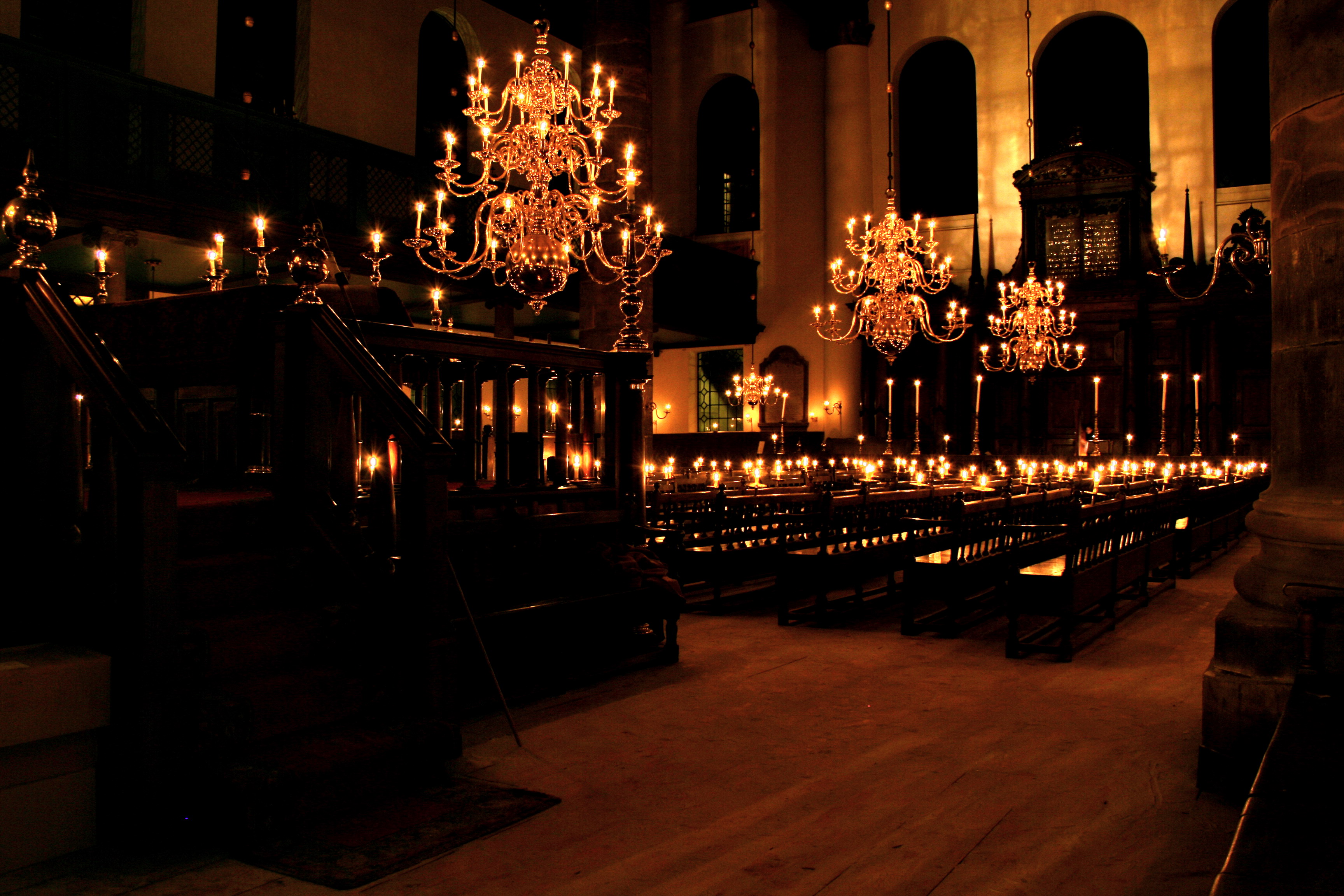
Portuguese Synagogue (Esnoga)
Walk into the Portuguese Synagogue at dusk during services, and you step into the 17th century. A thousand candles flicker in four massive brass chandeliers, casting warm light through 72 windows onto a floor covered with fine sand - an old Dutch tradition to absorb dust and muffle footsteps. No electric lighting has ever been installed in the main sanctuary. The Esnoga, as locals call it, remains much as it appeared when completed in 1675, a monument to the Sephardic Jews who fled the Inquisition and found haven in Amsterdam.
The Long Journey from Iberia
In 1492, Spain's Alhambra Decree gave the kingdom's estimated 200,000 Jews an impossible choice: convert to Catholicism, leave, or face execution. About half converted; others scattered south to North Africa or east toward the Ottoman Empire. Most crossed westward into Portugal, where respite lasted only four years before a similar decree in 1496 forced conversion there too. The Portuguese king blocked exit ports, reasoning that Jews who remained had agreed to become Christians. For the next three centuries, the Inquisition hunted "conversos" suspected of secretly practicing Judaism - often a pretext for seizing their property.
Sanctuary in Amsterdam
Amsterdam in the 17th century was one of the world's great cities, and unlike Spain and Portugal, it offered religious tolerance. Conversos migrated north from the 1600s through the early 1800s, and once in Amsterdam, many returned openly to Judaism. They called themselves "Portuguese Jews" even when they came directly from Spain, wanting to avoid association with a nation at war with the Dutch Republic during the Eighty Years' War. These Sephardic Jews became known as "the first modern Jews," pioneering a separation between religious and secular life while focusing their faith on the synagogue, the religious calendar, and Jewish education for their children.
Solomon's Temple Reimagined
On December 12, 1670, the community acquired a site for their grand synagogue. Construction began in April 1671, and the Esnoga opened with great ceremony on August 2, 1675. The design was based on plans for King Solomon's Temple. Above the entrance, Psalm 5:8 promises: "In the abundance of Thy loving kindness will I come into Thy house." The building rests on wooden piles; visitors can view the foundation vaults by boat from the canal waters underneath. Twelve stone columns supporting the women's gallery represent the Twelve Tribes of Israel. The Torah ark, crafted from a solid piece of jacaranda wood from Brazil, dates from 1744.
Survival Against the Odds
During World War II, the Nazis slated the building as a deportation center for Amsterdam's Jews. Leo Palache and a team of volunteers persuaded them otherwise. Instead, the congregation hid Jewish ritual items in the sanctuary ceiling and attic floor. The adjacent Ets Haim library - 500 manuscripts and 30,000 printed works spanning four centuries - was shipped to Germany by the Nazis but returned after the war. UNESCO added the collection to its Memory of the World Register in 2003, recognizing it as documentary heritage of global importance.
The Ban That Still Stands
One ghost haunts the Esnoga: the philosopher Baruch Spinoza, excommunicated here in 1656 with the severest possible ban for his heretical ideas. In 2021, when a Spinoza scholar requested permission to film research in the library, the congregation's leadership declared him persona non grata, asserting that the centuries-old ban "remains in force and cannot be rescinded." The board later reversed the decision and extended an invitation, but the episode revealed how this living congregation still grapples with its own history - a place where 17th-century candles illuminate 21st-century controversies.
From the Air
Located at 52.3675N, 4.9054E in central Amsterdam at Mr. Visserplein. The synagogue complex with its distinctive 17th-century architecture sits near the Waterlooplein and the Jewish Historical Museum. Nearest airport: Amsterdam Schiphol (EHAM), approximately 15 km southwest. Best identified by its prominent position adjacent to the modern city hall and opera house.