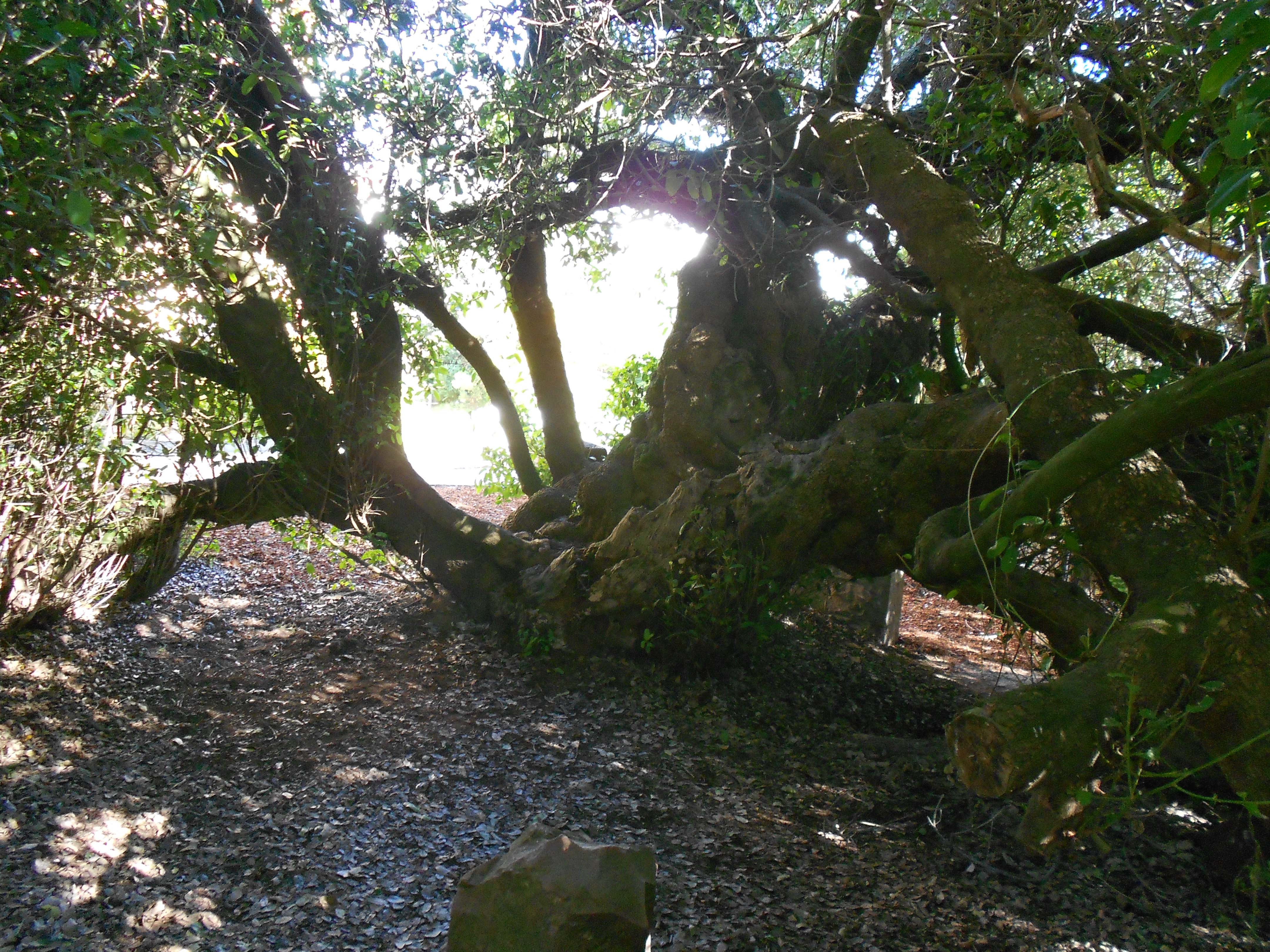
Post Office Tree
The letter was hidden in a shoe. In 1501, Portuguese navigator Pero de Ataide limped into the bay at Mossel Bay after losing much of his fleet in a storm. He needed to warn the next expedition of the disaster, so he wrote an account of what had happened, stuffed it into an old boot, and hung the boot from the branches of a milkwood tree near the spring where Bartolomeu Dias had drawn fresh water thirteen years earlier. The report was found by the very man it was addressed to, Joao da Nova, and just like that, a tree became a post office.
The Milkwood Messenger
The tree that received Ataide's desperate dispatch is a Sideroxylon inerme, commonly known as a milkwood, a species native to the Southern Cape coast. Milkwoods are slow-growing, long-lived, and remarkably tough, capable of surviving salt spray, wind, and the general hostility of coastal conditions. This particular specimen stands in the grounds of the Bartholomeu Dias Museum Complex on Market Street in Mossel Bay, where it has been growing for centuries. After Ataide's improvised mail drop, the tree served as a de facto post office for Portuguese sailors for decades, a place where dispatches, warnings, and messages could be left for ships that might not arrive for months. The system relied on the tree's location near the freshwater spring, which guaranteed that any ship stopping to resupply would pass it. In an era before postal services, telegraph lines, or any communication faster than a sailing vessel, a tree with a shoe in its branches was as reliable as anything else.
Shrine and Symbol
Joao da Nova did more than collect Ataide's letter. He erected a small shrine near the Post Office Tree, and although no physical trace of it remains, it is considered the first place of Christian worship in South Africa. The shrine marked a moment of contact that would have consequences extending far beyond what either navigator could have imagined. Portuguese exploration of this coast was not a benign exercise in cartography. It was the opening chapter of European colonial encroachment on indigenous lands, a process that would fundamentally reshape the societies, economies, and peoples of southern Africa over the following centuries. The tree witnessed the very beginning of that transformation, standing at the spot where European and African worlds first intersected on this coast. That a milkwood tree could outlast empires and remain rooted in the same soil is the kind of irony that history specializes in.
Letters from a Boot-Shaped Mailbox
Today, a boot-shaped post box stands beneath the milkwood's canopy, and letters dropped into it are franked with a special commemorative stamp. It is one of Mossel Bay's most popular tourist attractions, a whimsical nod to Ataide's desperate improvisation five centuries ago. The tree itself is protected as a national monument, part of the museum complex that surrounds it with a life-size replica of Dias's caravel, an indigenous botanical garden, and the largest shell museum in Africa. Visitors who mail letters from the boot-shaped box are participating, knowingly or not, in one of the oldest postal traditions in the Southern Hemisphere. The milkwood keeps growing, indifferent to the history accumulating around its roots, which is exactly the quality that made it a reliable postal system in the first place.
From the Air
The Post Office Tree is located at 34.18°S, 22.14°E within the Bartholomeu Dias Museum Complex grounds in central Mossel Bay. The tree is not individually visible from altitude, but the museum complex near the harbor is identifiable. Mossel Bay Airfield handles private flights, with air traffic controlled by George Airport (FAGG), 40 km east. George Airport offers scheduled domestic flights. From the air, the museum complex sits near the harbor waterfront, close to the town center. Look for the cluster of heritage buildings and gardens between the harbor and Market Street.