Postojna Cave
In 1818, a man named Luka Cec was given a simple job: light the lamps inside a cave near Postojna, in what was then the Austrian Empire, before Emperor Francis I arrived for a visit. While working in the half-dark, Cec stumbled into a passage no one had documented before -- a vast new section of what would prove to be one of Europe's most spectacular underground systems. The following year, when Archduke Ferdinand came to see the caves, Cec was appointed the first official tour guide. Two centuries later, nearly a million visitors a year follow in his footsteps, though they ride a train for the first three and a half kilometers.
Deeper Than Anyone Knew
The Postojna Cave system extends 24.34 kilometers through the karst bedrock of southwestern Slovenia, carved over millions of years by the Pivka River. Four separate caves are connected by the same underground watercourse, though speleologists note that the passages and siphons linking them have not all been traversed on foot or by swimming -- the formal requirement for declaring them a single system. If the remaining 400 meters of unexplored connection are completed, the combined system would stretch between 31 and 35 kilometers, making it one of the longest in Europe. Cave divers pushed the known boundaries in 2015 and again in 2017, exploring underwater sections toward Planina Cave and extending the measured length from 20,570 to 24,340 meters. The cave was first described in the 17th century by Johann Weikhard von Valvasor, though graffiti inside dated to 1213 proves people had been venturing in long before anyone bothered to write about it.
Rails in the Dark
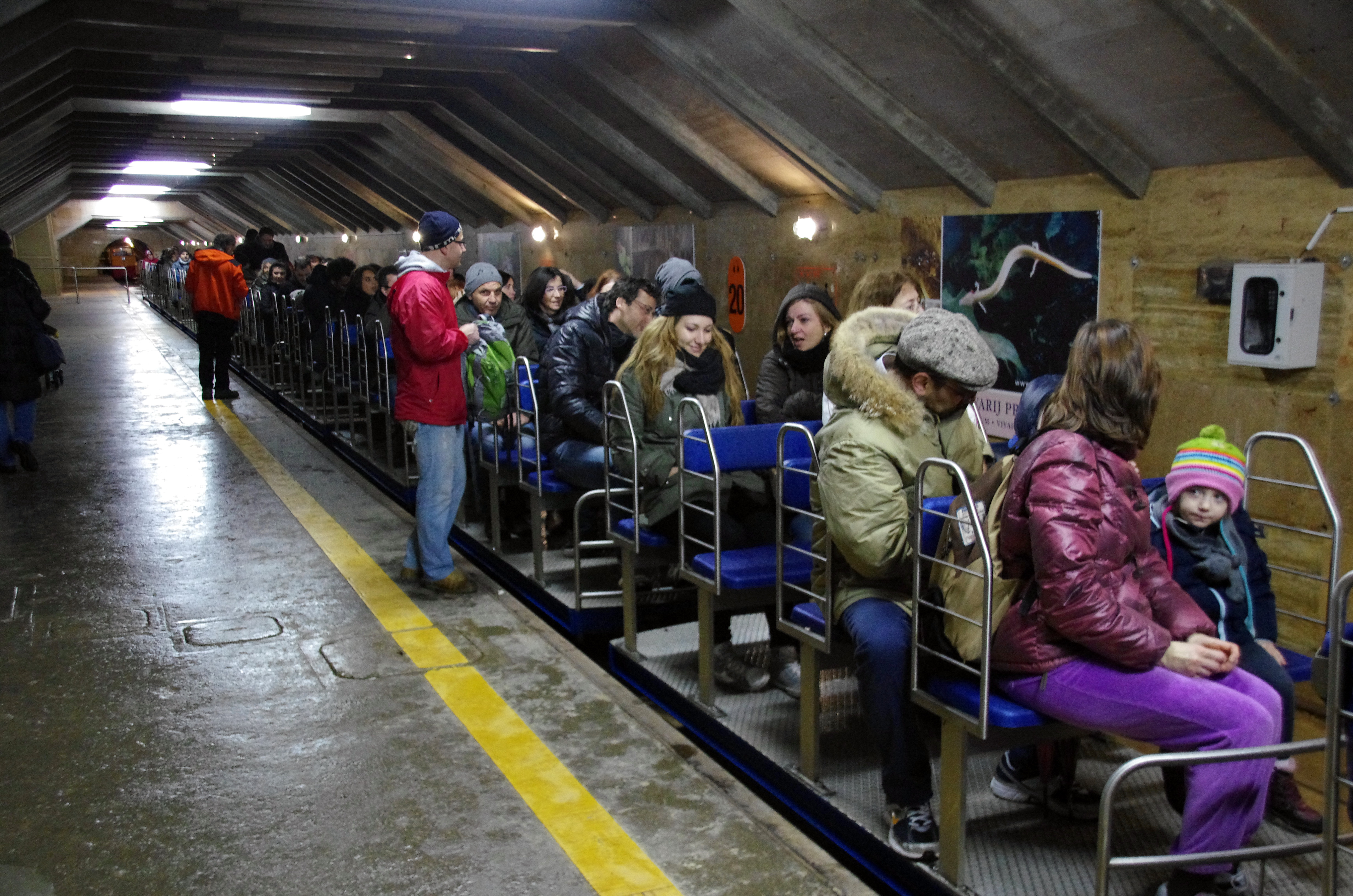
Postojna claims a distinction no other cave can match: it has had a railway since 1872. The first cave trains were pushed along the rails by the guides themselves -- a physical feat in the constant 10-degree Celsius chill of the tunnels. By the early 20th century, a gas locomotive took over. After 1945, it went electric. Today, the train carries visitors through 3.5 kilometers of illuminated chambers before depositing them for a 1.5-kilometer walk through halls with names like the Concert Hall, which seats 10,000 and hosts orchestral performances, and the Spaghetti Hall, named for its delicate tube-shaped formations. Electric lighting arrived in 1884, before even Ljubljana -- then the capital of the Austrian province of Carniola -- had it. The cave also houses the world's only underground post office, which first opened in 1899.
Baby Dragons
Deep in the cave's pools lives the olm, a blind, pale amphibian that can grow up to 30 centimeters long and live for more than a century. It is the largest cave-dwelling amphibian in the world, and Slovenians once believed the creatures were baby dragons washed out of underground lairs by floodwaters. On January 30, 2016, a female olm in the cave's aquarium began laying eggs -- more than 50 in total. The event made global headlines. Olm reproduction is extraordinarily rare in captivity; the species can go a decade between breeding cycles. Between late May and mid-July of that year, twenty-two baby olms successfully hatched, a milestone for conservation biology and a reminder that Postojna's ecosystem extends far beyond the formations tourists come to photograph.
The Weight of War and Wonder
Not all of Postojna's history is wonder. During World War I, Russian prisoners of war were forced to build a bridge across a large chasm inside the cave -- hard labor in perpetual darkness and cold, a fact that sits uncomfortably alongside the tourism brochures. The cave has absorbed centuries of human use: medieval explorers scratching their names into walls, Habsburg emperors demanding illumination, scientists from Adolf Schmidl in the 1850s to modern cave divers expanding the known limits of the system. In 2014, the permanent exhibition EXPO Postojna Cave Karst opened, the largest of its kind in the world, with interactive displays that trace the cave's geological and human history. Children follow an animated olm through the exhibits and ride a miniature cave train. The real olms, blind and unhurried, continue their ancient routines in the dark pools below.
From the Air
Located at 45.783N, 14.204E in southwestern Slovenia, roughly 50 km southwest of Ljubljana. The cave entrance is not visible from altitude, but the town of Postojna sits in a karst basin identifiable by its rolling green terrain and scattered sinkholes. Predjama Castle is 11 km to the northwest. Best approach from 3,000-5,000 feet AGL. Nearest major airport: Ljubljana Joze Pucnik Airport (LJLJ), approximately 45 nm northeast. Portoroz Airport (LJPZ) lies roughly 45 nm southwest along the coast.