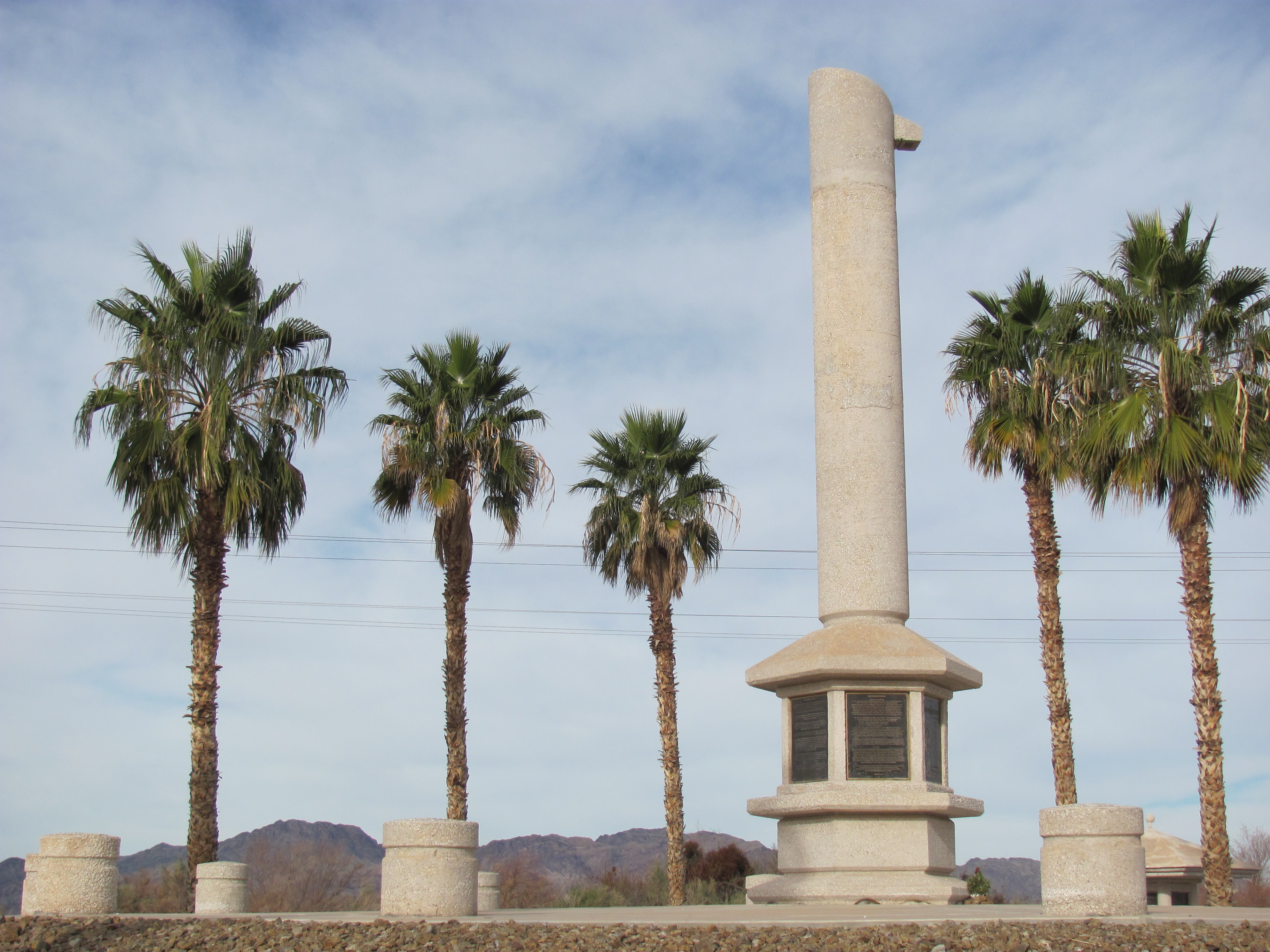
Poston War Relocation Center
The Colorado River Indian Reservation Tribal Council saw the request coming and said no. They would not allow their land to be used as a prison for Japanese Americans. Having experienced forced relocation themselves, they refused to inflict that injustice on others. The Bureau of Indian Affairs and Army commanders overruled them anyway, seeing opportunity: thousands of "volunteers" who could improve irrigation infrastructure on the War Department's budget, leaving permanent benefits for the reservation. Construction began in early 1942. Within three weeks, the first camp rose from the desert. By summer, over 17,000 people from Southern California lived behind a single fence stretching across three camps spaced three miles apart, in a place so remote that authorities decided guard towers were unnecessary. The internees gave their new homes sardonic names: Roasten, Toastin, and Dustin.
A City Built in Days
Del Webb, who would later become famous for building Sun City and other retirement communities, assembled a workforce of 5,000 to construct Poston I. Starting March 27, 1942, they completed the first camp in less than three weeks. Camps II and III followed within 120 days. The scale was staggering: at peak population, Poston was the third-largest "city" in Arizona. Around two-thirds of internees came directly from their homes, not from other assembly centers, and many early arrivals volunteered to help complete the still-unfinished barracks where they would be imprisoned. The camp was named after Charles Debrille Poston, the government engineer who had established the Colorado River Reservation in 1865, creating the very land now repurposed for incarceration, a grim irony likely lost on no one.
Life Behind the Fence
Conditions deteriorated rapidly. Tuberculosis spread through the crowded barracks, with 140 reported cases. Care for the sick was inadequate, leading to preventable deaths and lasting disabilities. By the end of 1942, heating systems still had not been installed, and clothing allowances remained undelivered. Unlike the nine other camps, Poston's agricultural areas lay within the perimeter, putting internees to work growing food in the harsh desert. Frustration mounted through autumn until it exploded on November 14, 1942. When authorities detained two men suspected of beating an informer, the community demanded their release. Refusal sparked a general strike on November 19. For five days, internees stopped working. A compromise with the Emergency Executive Council ended the strike on November 24, but the underlying tensions never fully resolved.
Bonds Across the Wire
Clara Breed was a librarian from San Diego who had met many of the children before their incarceration. She made a point of maintaining contact, corresponding with them throughout the war, sending books and gifts. The children wrote back, documenting daily life in letters that began "Dear Miss Breed." Hundreds of these postcards and letters now reside in the Japanese American National Museum, forming an irreplaceable archive of childhood behind barbed wire. Their stories became a 2006 book by Joanne Oppenheim. A camp newspaper, the Poston Chronicle, published weekly from May 1942 until October 1945, its name chosen to "record chronologically events that occur at this outpost of the desert for pioneering endeavors of the Japanese race." The final edition appeared in English on October 23, 1945, in Japanese the following day.
What Came After
The camp produced an extraordinary roster of future achievers. Jack Fujimoto became the first Asian American to lead a mainland U.S. university. Isamu Noguchi, already an established artist, volunteered to enter Poston and later became one of the twentieth century's most influential sculptors. Cinematographer Tak Fujimoto would shoot films including The Silence of the Lambs. Doris Matsui became a U.S. Representative. Judge A. Wallace Tashima was the first Japanese American appointed to a federal appeals court. Vincent Okamoto earned the Distinguished Service Cross in Vietnam. Kiyo Sato wrote memoirs; Hisaye Yamamoto short stories; Wakako Yamauchi plays. The Kawano brothers, Nobe and Yosh, spent decades as clubhouse managers for the Dodgers and Cubs respectively. Their achievements stand as testament to resilience, though no success erases the injustice of their imprisonment.
Desert Memory
When the camp closed, the land returned to the Colorado River Indian Tribes. Most buildings were removed or converted to agricultural use. Some structures remain, seriously deteriorated but still standing. In 1992, the Tribal Council that had once opposed the camp's construction agreed to host the Poston Memorial Monument on their land, a reconciliation built on shared understanding of forced removal. The Japanese American Memorial to Patriotism in Washington, D.C. inscribes the names of those confined here. Filmmaker Reed Leventis created "Poston: A Cycle of Fear" for the National Japanese American Memorial Foundation. The documentary "Passing Poston: An American Story" captures four survivors' testimonies, including Ruth Okimoto's memory of soldiers arriving with rifles at her family's door. The desert preserves what documents cannot, the heat and dust that made prisoners give their camps those bitter names.
From the Air
Poston War Relocation Center is located at 33.988N, 114.401W on the Colorado River Indian Reservation in La Paz County, Arizona. The site lies approximately 20 miles south of Parker Dam along the Colorado River, which forms the California-Arizona border here. The former camp areas have been converted largely to agricultural use, but the Poston Memorial Monument remains visible. Nearest airports include Blythe Airport (KBLH) 30nm south in California and Laughlin/Bullhead International (KIFP) 60nm north. The area is flat desert terrain with few obstructions, but summer temperatures exceed 110F and density altitude considerations apply.