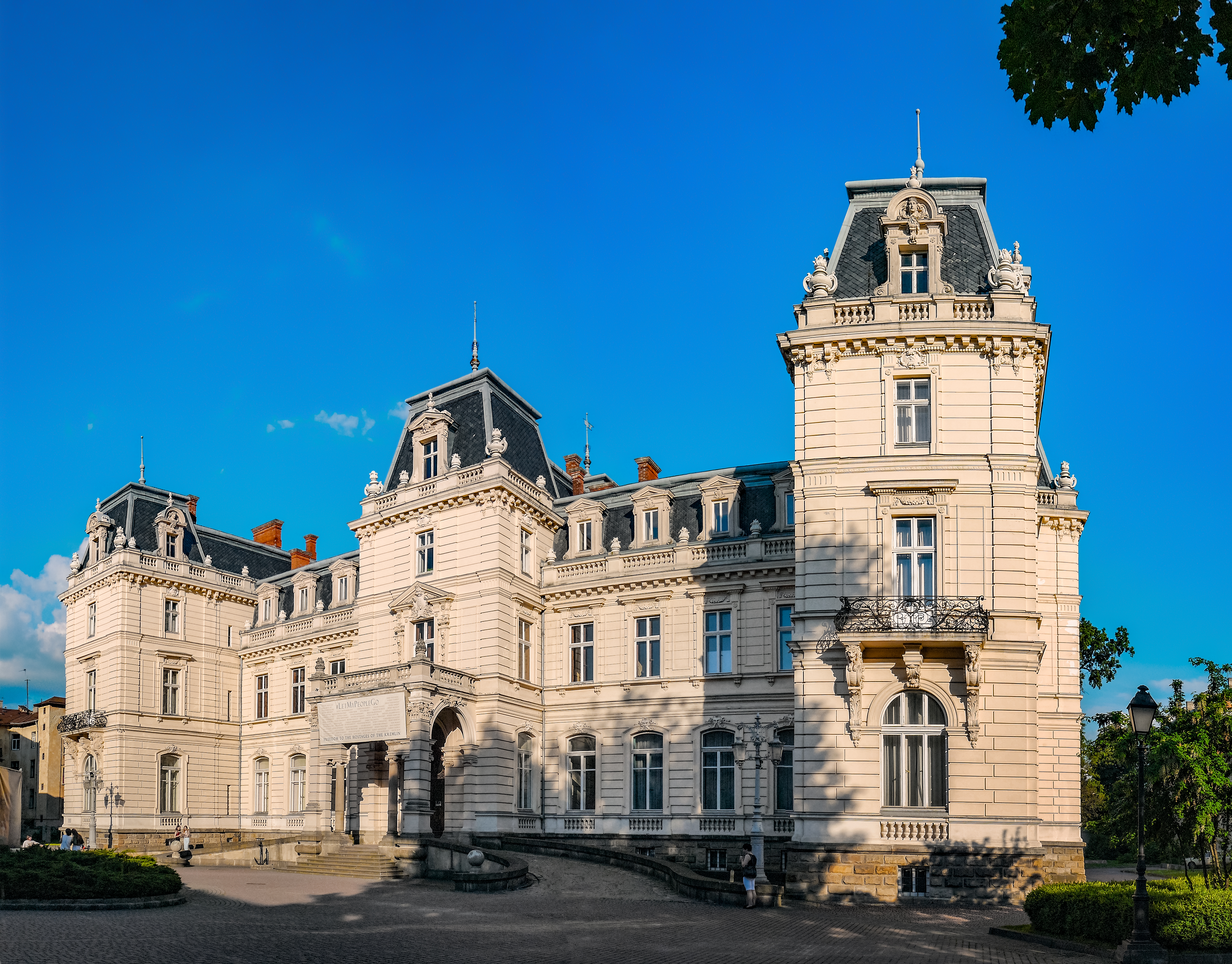
Potocki Palace, Lviv
Alfred Jozef Potocki never saw his palace finished. The former Minister-President of Austria, governor of Galicia, and one of the wealthiest men in the Habsburg Empire died in Paris on May 18, 1889, while the grand residence he had commissioned on Copernicus Street in Lviv was still under construction. His son Roman completed the building -- and then the 20th century spent the next hundred years finding new uses for it, each one reflecting whoever happened to hold power over this persistently contested city.
An Aristocrat's Paris in Galicia
The Potocki family had been acquiring property on what is now Copernicus Street since 1822, when they purchased real estate on what was then called Wide Street. A first palace, built in the neoclassical style, stood until 1860-1861, when it was dismantled. Then came three decades of delay. Construction on the replacement did not begin until 1880, when Alfred Potocki -- a patron of the arts and passionate admirer of French architecture -- hired the French architect Louis Dauvergne to design a residence in the style of Louis XIV. The project was modified and realized by architects Julian Cybulski and Ludwik Baldwin-Ramult, and by 1892 it was being exhibited at a building exposition in Lviv. The result was an H-shaped, three-story building spanning 3,100 square meters, its facades layered with rustication, ionic columns, moulded balconies, and an arched portico with stucco decoration attributed to Petr Garasimovich and likely Leonard Marconi. Stables with carved horse bas-reliefs flanked the southwest approach. No cost had been spared. The palace was the grandest nobleman's residence in the city.
A Pilot Falls from the Sky
On November 22, 1919, during an air show celebrating the first anniversary of Lviv's liberation, American pilot Edmund Graves lost control of his aircraft over the city center. The plane crashed into the Potocki Palace. The explosion of its fuel tanks set fire to the upper floors and the roof. Graves, whose parachute failed to open, fell to his death on the pavement below. It took until 1931 to fully repair the damage -- twelve years of restoration work for a building that was barely three decades old. The crash remains one of the more improbable episodes in the palace's history, a reminder that even the most solidly built monuments are vulnerable to the unexpected.
Five Flags Over One Building
The palace's subsequent owners read like a compressed history of 20th-century Eastern Europe. During World War II, the Luftwaffe requisitioned it as its headquarters in Lviv. After the war, the Soviet Academy of Sciences installed the Institute of Geology and Geochemistry of Combustible Minerals, which occupied the ornate reception halls from 1945 to 1972. That year, the palace was repurposed again -- this time as a venue for civil wedding ceremonies, a function that required yet another restoration between 1973 and 1974. In the 2000s, the President of Ukraine appropriated it as an official residence. Today, it houses a branch of the Lviv National Art Gallery, its gilded interiors and marble floors providing a fittingly extravagant backdrop for Ukrainian and European art. In 2016, the palace hosted the Women's World Chess Championship, adding one more layer to its eclectic resume.
What the Park Became
By 1879, a large city park surrounded the palace. But as Lviv grew, apartment buildings encroached from all sides, swallowing the parkland and leaving only the view from Copernicus Street unobstructed. In the late 1980s, tunnels for an underground tram were dug through the remaining park grounds, and a utilitarian annex was added -- it now houses the Museum of Ancient Ukrainian Book Art. In 2010, a miniature park of Ukrainian castles and defensive structures was installed in the remaining green space, displaying 1:50 scale models. Next door, the Lviv Palace of Arts, inaugurated in 1996, borrows some of the Potocki Palace's architectural motifs in its design. The original building remains the anchor, though, its French classicism still legible beneath a century and a half of additions, demolitions, crashes, and regime changes.
From the Air
Located at 49.838N, 24.027E on Copernicus Street in central Lviv, south of the Old Town district. The palace's H-shaped footprint and the adjacent Lviv Palace of Arts are identifiable from low altitude. The nearest major airport was Lviv Danylo Halytskyi International (UKLL), approximately 6 km southwest, though Ukrainian airspace is currently closed to civil aviation. The palace sits in a dense urban environment, its courtyard and remnant park visible among the surrounding apartment blocks.