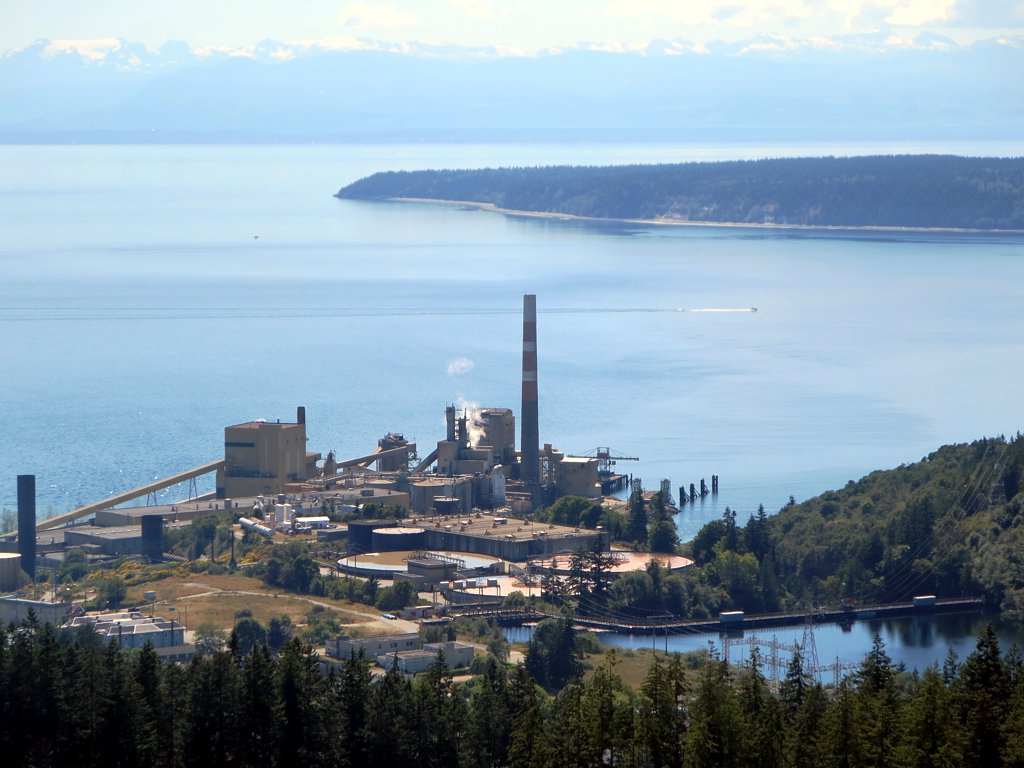
Powell River Mill
One in every 25 newspapers in the world once carried ink on Powell River paper. That statistic, staggering for a mill tucked into a remote stretch of British Columbia coastline accessible only by ferry or floatplane, defined the town of Powell River for most of the twentieth century. The mill did not just produce newsprint. It produced the town itself: the houses, the credit union, the social fabric of a community that existed because the forest met the sea in exactly the right place.
First Rolls off the Line
The Powell River Company broke ground in 1908, choosing a site where the Powell River emptied into Malaspina Strait and old-growth timber stood thick in every direction. By 1912, the first roll of newsprint emerged, making this western Canada's first manufacturer of the product. Growth was rapid: two paper machines were running by 1913, four by 1917. The company built not just a mill but a planned townsite alongside it, a model community that would eventually earn designation as one of only seven National Historic Districts in Canada. At its zenith, the operation was the largest pulp and paper mill in the world.
A Century of Changing Hands
Industrial empires rarely stay in one family. In 1960, the Powell River Company merged into MacMillan Bloedel, the British Columbia forestry giant. Ownership passed to Pacifica Papers in 1998, then to Norske Skog Canada in 2001. The Norwegian-owned operation rebranded as Catalyst Paper in 2005 and continued producing newsprint and specialty papers. Paper Excellence Group acquired Catalyst in 2019. Each transition brought new corporate logos to the mill gates, but inside, the machines kept turning and the community kept its rhythm, at least for a while.
Silence on the Waterfront
The digital revolution did what a century of ownership changes could not. As newspaper circulation collapsed worldwide, demand for newsprint fell with it. The mill began scaling back production, and in 2023 it was permanently curtailed. For a town that had defined itself by the hum of paper machines and the smell of pulp processing, the silence was disorienting. At the time of its closure, the mill still employed hundreds of workers. Three paper machines that once produced 469,000 tonnes of newsprint and uncoated fine paper annually stood idle.
What Remains
The mill's physical footprint remains enormous, a sprawling industrial complex on the waterfront visible from the air as a grid of buildings and log booms. In March 2025, the Tla'amin First Nation and Domtar reached an agreement to reclaim a large portion of the mill land, signaling a new chapter for the site. Powell River itself had already been diversifying, earning the title of Cultural Capital of Canada in 2004. The Patricia Theatre, the Sunshine Coast Trail, and a growing arts scene now carry the economic weight that newsprint once bore. But the mill remains the town's origin story, the reason 14,000 people live on this otherwise remote stretch of coast.
From the Air
Powell River Mill is located at 49.87°N, 124.56°W on the waterfront of Powell River, British Columbia. The mill complex and its log storage ponds are prominent from altitude, stretching along the shoreline of Malaspina Strait. A floating breakwater of decommissioned ships, including the concrete-hulled SS Peralta, protects the harbor. Powell River Airport (CYPW) is approximately 3 nm to the south. Approach from over the strait for the best view of the industrial waterfront.