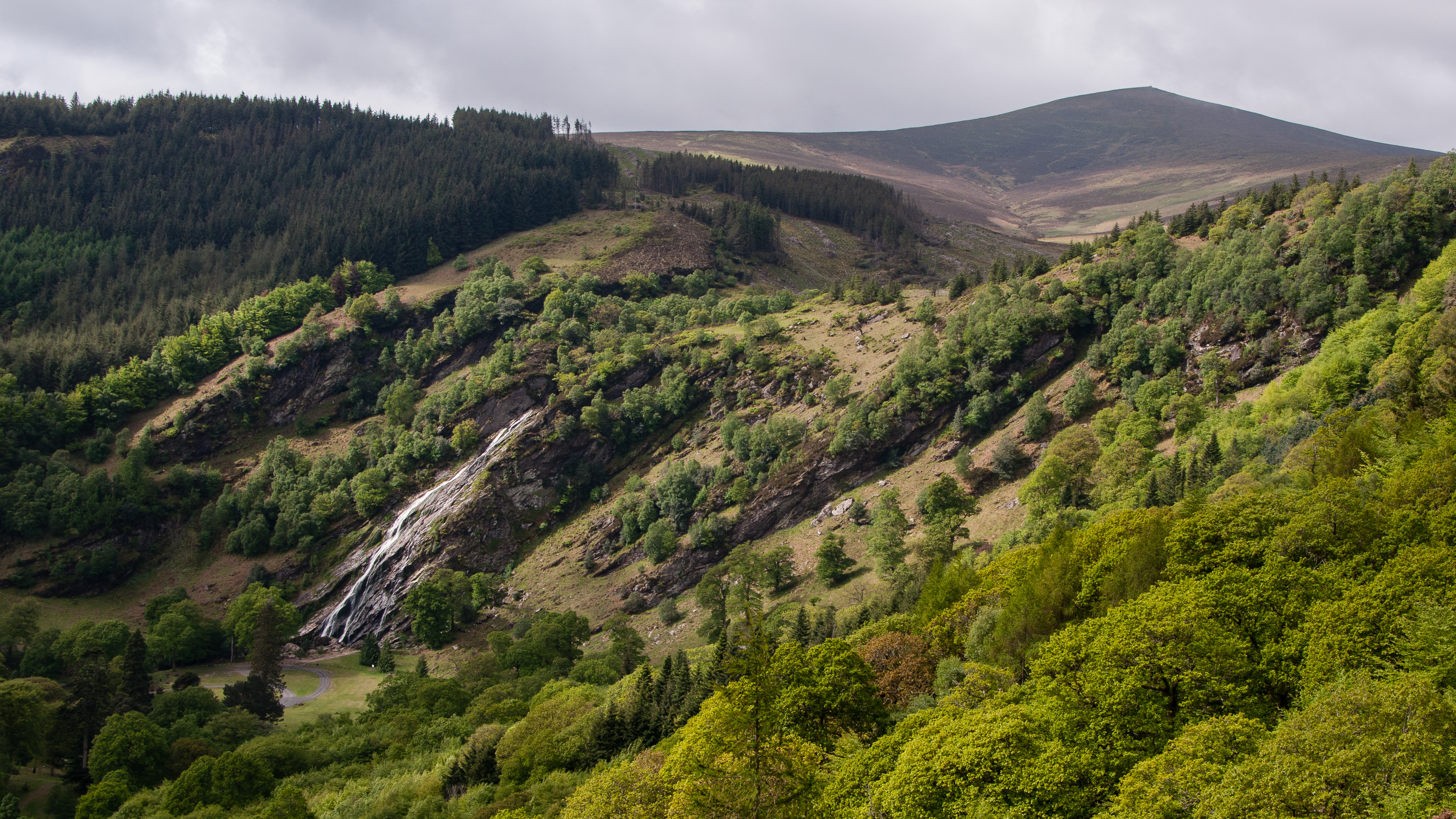
Powerscourt Estate
The place called the Killing Hollow sits near Powerscourt, and the name is not metaphorical. On 14 May 1603, the Wingfield family murdered Phelim O'Toole of Powerscourt there, despite a posthumous pardon that should have protected his family's claim to the land. King James I granted the manor to Sir Richard Wingfield five months later, for a rent of six pounds Irish and a knight's fee. From that act of violence and legal maneuvering, one of Ireland's grandest estates was born.
From Castle to Country House
The original thirteenth-century castle belonged to an Anglo-Norman nobleman named La Poer, a surname eventually anglicised to "Power" and then attached to the estate itself. The castle's position was strategic: its owner controlled access to the Dargle, Glencree, and Glencullen rivers. When the 1st Viscount Powerscourt commissioned architect Richard Cassels to transform the medieval fortress in 1731, the result was a three-storey house with at least 68 rooms and an entrance hall 60 feet long and 40 feet wide. Cassels gave the structure a severe Palladian facade bookended by two circular domed towers, creating what Vanbrugh would have called the "castle air." A mile-long avenue of beech trees led visitors to the door. King George IV was hosted here in August 1821.
Twenty Years of Gardens
In 1844, eight-year-old Mervyn Wingfield inherited the title of 7th Viscount Powerscourt. When he reached 21, he embarked on what would become his life's work: the gardens. He traveled to the Palace of Versailles, Schonbrunn Palace near Vienna, and Schwetzingen Castle near Heidelberg, returning with ideas that he spent twenty years executing. The result, completed in 1880, includes Japanese gardens, a Triton Lake with winged horse statues, a Dolphin Pond, walled gardens, and an Italian Garden modeled on Continental grandeur. The Pepperpot Tower, a whimsical stone structure, is said to have been designed after a three-inch pepperpot favored by Lady Wingfield. Perhaps the most unexpectedly affecting feature is the pet cemetery, whose tombstones have been described as "astonishingly personal." In 2014, National Geographic listed the gardens as number three in the world's top ten.
Fire and Resurrection
The 20th century brought changes that would have astonished the Wingfields. The 8th Viscount encouraged the Scout movement on the estate, allocating camping areas to various troops -- most notably the 16th Dublin Jewish Scouts. Baden-Powell himself visited a large camp here in 1928. In 1961, the 9th Viscount sold the estate to the Slazenger family, founders of the sporting goods company. Stanley Kubrick filmed scenes for Barry Lyndon here in the early 1970s. Then, on 4 November 1974, fire gutted the house, leaving it a roofless shell. It stood that way for over two decades until renovations in 1996 brought the building back to life, though only two rooms are now furnished as they appeared during the Conolly era. The rest of the ground and first floors have been converted to retail spaces.
Hollywood in Wicklow
Powerscourt's dramatic landscapes have attracted filmmakers for decades. Before the 1974 fire, Kubrick used the interiors for Barry Lyndon. At the nearby waterfall -- at 121 metres, Ireland's second highest -- John Boorman filmed the scene in Excalibur where Arthur fights Lancelot. The estate has since served as a location for The Count of Monte Cristo, David Copperfield, and several scenes from Disenchanted. In 1973, the Slazenger family invited aviator Lynn Garrison to relocate his aerial film unit and aircraft collection to the Powerscourt airfield, where it remained until 1981, supporting productions including The Blue Max, Darling Lili, and Von Richthofen and Brown. The Powerscourt waterfall also appeared in the television series Vikings and in Cocaine Bear.
The Deer Park Legacy
In 1860, the 7th Viscount established a deer park around the waterfall, introducing Japanese sika deer to Ireland for the first time. The sika thrived -- perhaps too well. They spread across the Wicklow Mountains and beyond, and their descendants now roam forests throughout eastern Ireland, a living legacy of Victorian-era enthusiasm for acclimatization. The waterfall and its surrounding valley remain part of the Powerscourt Estate, though the two parcels of land are no longer directly connected. Visitors approach the cascade through Glensoulan, a valley carved by ice and framed by the peak of Djouce behind. The Geological Survey of Ireland calls the Powerscourt corrie "a fine example of glacial erosion, where accumulated ice has scoured out a deep basin, with a waterfall flowing down the steep backwall."
From the Air
Located at 53.18N, 6.19W near Enniskerry, County Wicklow. The estate's formal gardens and Palladian house are visible on a hilltop south of the village. The waterfall is 7km south at the base of Glensoulan valley. Sugar Loaf mountain is a prominent visual reference nearby. Nearest airports: Dublin (EIDW) 25km north, Weston (EIWT) 20km northwest. Best viewed at 2,000-4,000 feet.