Powis Castle
A Mughal emperor's tiger-head finial sits in a display case inside a medieval Welsh castle. Beside it, ivory chess pieces from 18th-century India share a room with portraits of the Herbert family, whose ancestors once fought alongside the native princes of Powys. Powis Castle, near Welshpool in Powys, is a place where Welsh medieval history and British imperial history collide in ways that are illuminating, uncomfortable, and impossible to ignore. The castle itself dates from the 13th century. The collection inside it spans continents and centuries, and the gardens that cascade down the hillside below are considered the finest surviving Baroque terraces in all of Britain.
The Terraces That Survived
Garden historian Elisabeth Whittle called the gardens at Powis "the most important and magnificent in Wales." Hewn from solid rock between the 1670s and 1705 under the direction of William Winde and the French gardener Adrian Duvall, the terraces descend from the castle in a series of dramatic levels, each 150 meters long. Originally there were six, culminating in an elaborate water garden inspired by the Chateau de Saint-Germain-en-Laye near Paris. When the landscape architect William Emes -- a student of Capability Brown -- arrived in the early 19th century, he proposed demolishing the terraces with explosives to create fashionable parkland. The Earl rejected the idea. The two lowest terraces were reduced to earthen banks, and the water garden gave way to the Great Lawn, but four terraces survived. That refusal saved what is now recognized as the finest remaining Baroque garden in Britain.
Yews Like Nothing Else
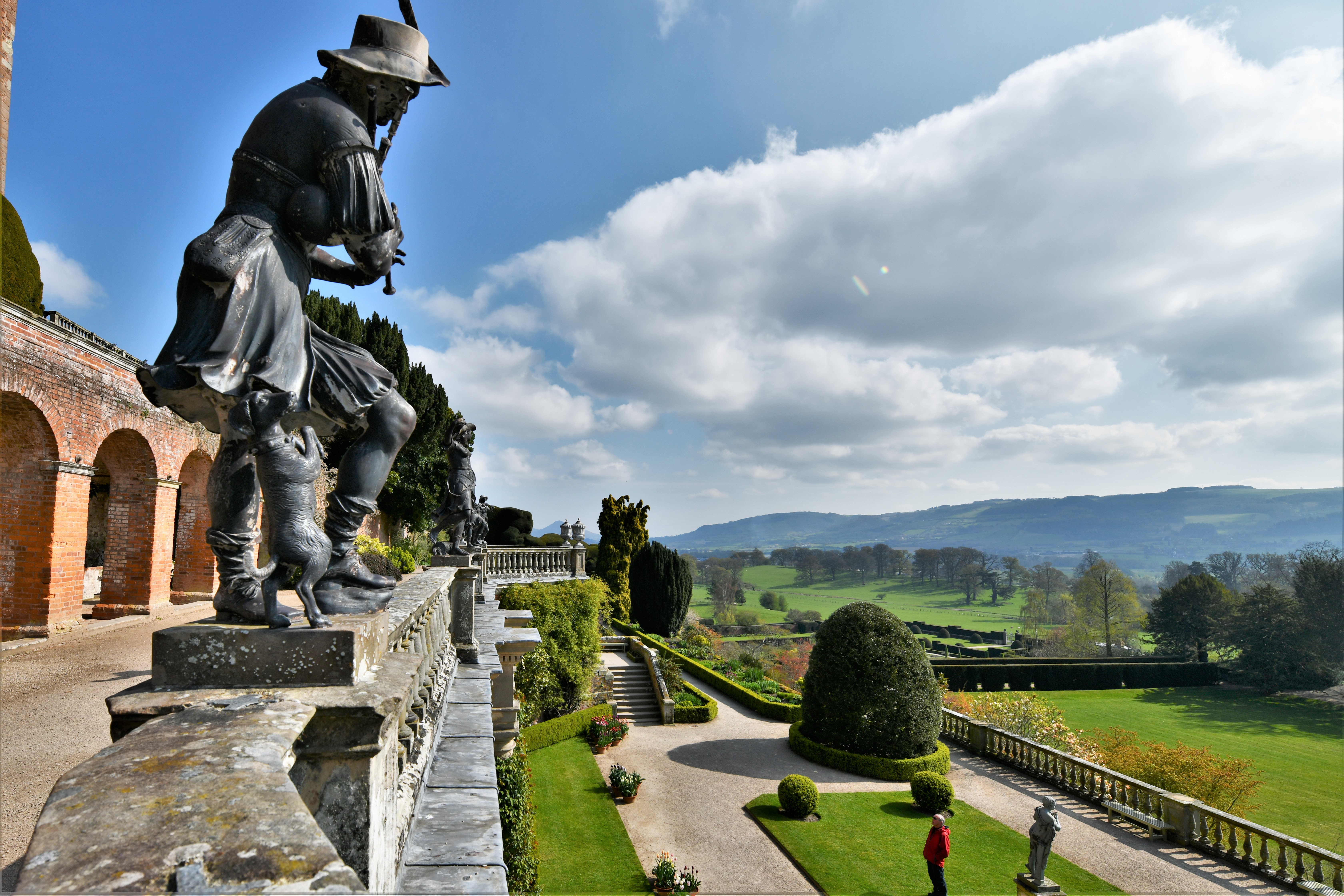
The Top Terrace's fourteen yew trees are Powis Castle's most distinctive feature. Planted by the 2nd Marquess in the 1720s and originally clipped into tight obelisks, they have been allowed over three centuries to grow into enormous, amorphous green forms that billow like frozen clouds above the terrace walls. Below them, the Aviary Terrace displays four statues of shepherds and shepherdesses by the sculptor John Nost, once painted in lifelike colors but now treated with uniform grey paint. The Orangery Terrace houses a heated arcade enclosed with windows in the early 20th century. Helena Attlee, in The Gardens of Wales, noted the distinct planting styles descending through the levels: sub-tropical on the Top Terrace, Mediterranean on the Aviary, and traditional British double-herbaceous borders on the Orangery.
Clive of India's Cabinet
The castle's interior took a dramatic turn in the 18th century when the Herbert family's fortunes became entwined with the British East India Company. Edward Clive, son of Robert Clive -- "Clive of India" -- married into the Herbert family, and the South Asian collection he brought with him transformed Powis into one of the most extraordinary private museums in Europe. Mughal textiles, ivory furniture, weapons, and jeweled ornaments accumulated through a combination of diplomatic gifts, battlefield acquisitions, and purchases. The New York Times described the collection in 1987 as a "cabinet of curiosities" that had become a museum. In the 21st century, the provenance of these objects has prompted difficult conversations about colonialism, plunder, and the ethics of country house collections.
Reckoning with History
The National Trust, which manages the castle, has committed to reinterpreting the South Asian collection in light of its colonial origins. In 2020, a post-doctoral research project was commissioned jointly with the Ashmolean Museum, and a PhD studentship with the University of Cambridge was established to investigate the history, curation, and provenance of the objects. The initiative reflects a broader reckoning with the links between country house collections and empire. Powis Castle does not hide from this conversation. The objects remain on display, but the interpretive framework around them has shifted, acknowledging that many of these treasures arrived in Wales through a system of extraction that brought immense suffering to the people of the Indian subcontinent. The castle asks visitors to hold two things in their minds at once: beauty and its cost.
Countess Violet's Fury
The last major transformation of the gardens came in the early 20th century, driven by Violet Herbert, Countess of Powis, whose ambition was to create "the most beautiful garden in England and Wales." When a storm in 1912 felled the elm trees that had screened the kitchen garden's greenhouses from the castle, the Countess was appalled. "I am greeted every day by the repulsive sight of the detestable little houses which stare in their naked horror up at the beautiful terraces and the grand old castle towering above," she wrote. She relocated the entire kitchen garden behind the Wilderness Ridge and laid out formal gardens, a fountain garden, and a croquet lawn. Her passion for the grounds ensured that Powis entered the National Trust era as one of the most carefully maintained garden estates in Britain.
From the Air
Located at 52.65N, 3.16W near Welshpool, Powys. The castle sits on a limestone ridge with the distinctive terraced gardens cascading down the south-facing slope -- clearly visible from the air. Look for the dramatic yew trees on the upper terraces. Nearest airport: Welshpool Airport (EGCW) approximately 2nm southeast. Recommended altitude: 1,500-2,500 ft for excellent views of the castle and garden terraces.