Praça da Sé
Stand on the brass-and-stone Marco Zero monument in Praça da Sé and you are, by official reckoning, at the center of São Paulo. Every highway that departs the city measures its distance from this point. Installed in 1934, the marker was originally a practical tool for numbering residences, but it has become something more — a symbolic anchor for a metropolis of 20 million people that seems, at times, to have no center at all. The square itself takes its name from the Sé, the episcopal see whose cathedral has dominated this site in one form or another since the colonial era. Around the cathedral, the square has witnessed revolution, reconstruction, protest, and the daily life of a city that never stops reinventing itself.
From Colonial Field to Urban Stage
Before it was a square, this was the Largo da Sé — the Field of the See — a clearing that developed around the religious buildings preceding the current cathedral. For centuries, the site anchored São Paulo's spiritual and administrative life, a muddy expanse where colonial and imperial architecture crowded together without much plan. At the beginning of the 20th century, the city demolished the older structures and rebuilt the downtown area according to contemporary urban planning principles. The existing cathedral, designed in a Neo-Gothic style, began construction in 1913 and took four decades to complete. It was inaugurated in 1954, timed precisely to coincide with São Paulo's 400th anniversary — the quadricentennial of the founding of the humble Jesuit mission established by Manuel da Nobrega and Jose de Anchieta alongside the indigenous chief Tibiriça.
The Square Democracy Built
On January 25, 1984 — São Paulo's 430th anniversary — roughly 300,000 people packed into Praça da Sé in the rain. They came for Diretas Já, the movement demanding that Brazilians be allowed to vote directly for their president after two decades of military dictatorship. The rally was one of the first massive demonstrations of the campaign, and the square's geography — open, central, impossible to ignore — made it the natural stage. Though the largest Diretas Já rally would later draw an estimated 1.5 million people to the nearby Anhangabaú Valley in April 1984, the January gathering at Praça da Sé carried particular weight. It proved that the movement could fill a city center, that the demand for democracy had outgrown meeting halls and student unions. The amendment for direct elections ultimately failed in Congress that year, but the momentum it built led to civilian rule by 1985 and direct presidential elections by 1989.
Geometry and Water
The square visitors see today is largely the product of a 1970s redesign led by architect Jose Eduardo de Assis Lefevre. When the São Paulo Metro opened a station beneath the square, the construction required leveling an entire city block, and the architects seized the opportunity to reimagine the space entirely. Influenced by the landscape work of Lawrence Halprin on the American West Coast, Lefevre's team designed a plaza of rigorous geometry — multiple levels connected by ramps and stairs, reflecting pools catching the tropical light, prism-like masses of vegetation and stone. The result is a public space that feels more sculpted than planted, an exercise in hard-edged modernism softened by water and by the steady human traffic that flows through it at all hours.
The Living Center
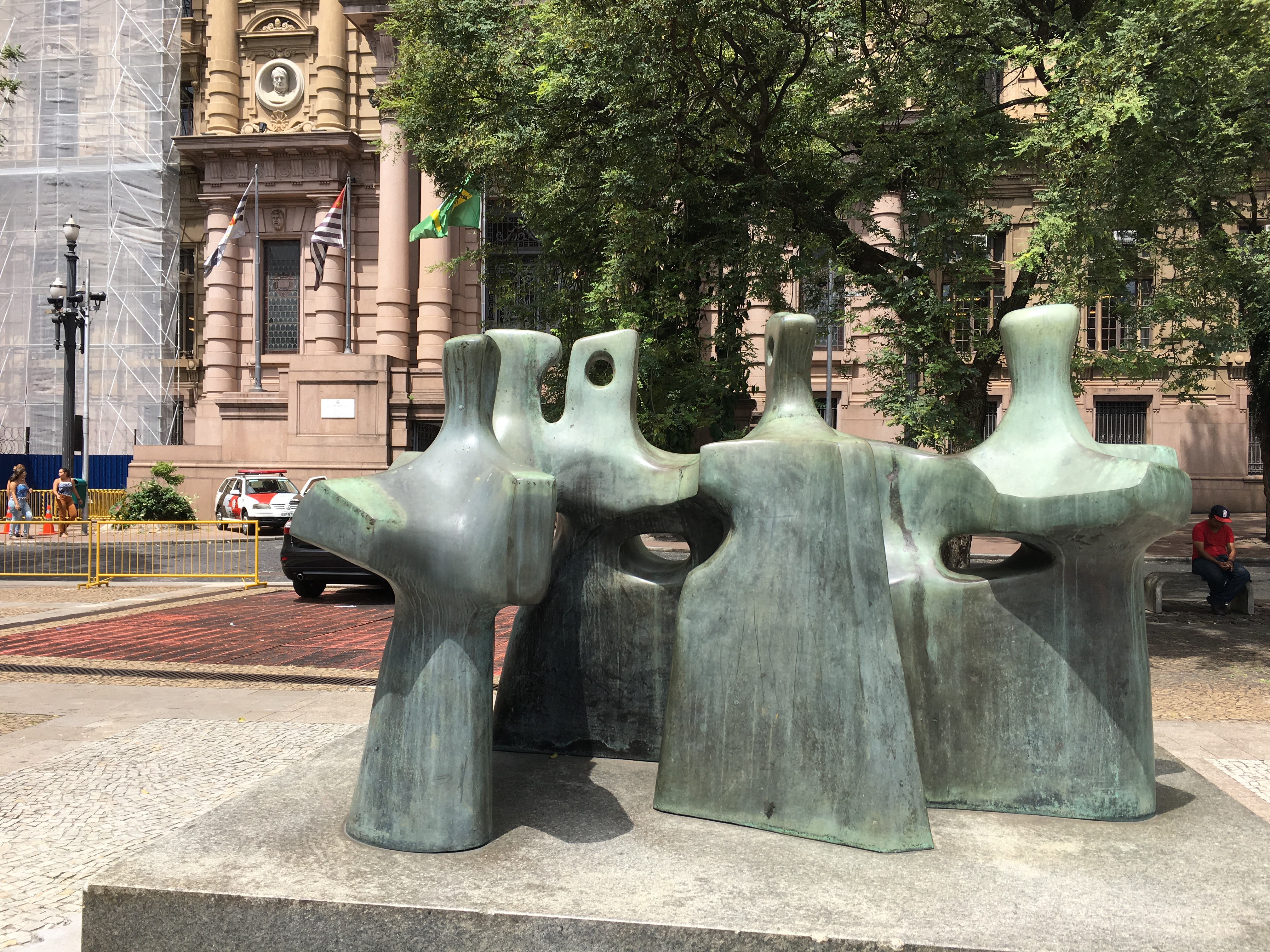
Praça da Sé is not a place you visit in reverent silence. Pigeons swarm the benches. Street vendors sell corn and coconut water. Office workers cut through on their way to the Metro station below. Homeless residents sleep beneath the palm trees that line the square's upper terraces. A 2006 renovation, re-inaugurated on the city's anniversary in January 2007 by then-mayor Gilberto Kassab, relocated flower boxes, improved the integration between the square's sculptures and their surroundings, and added pedestrian overpasses across the reflecting pools. The renovation drew criticism from NGOs working with homeless populations, who argued that the redesign reduced the space available to people who had been living in the square for years. That tension — between civic beautification and the realities of urban poverty — is woven into Praça da Sé as surely as the Marco Zero marker or the cathedral's spires. The square does not belong to any single vision of the city. It belongs to everyone who passes through it, and they do, by the tens of thousands, every day.
From the Air
Located at 23.55°S, 46.63°W in the historic center of São Paulo, adjacent to the Neo-Gothic São Paulo Cathedral. The square is identifiable by the cathedral's twin spires and the open green and paved expanse amid the dense downtown grid. Nearest airports: Congonhas (SBSP) approximately 7 km south, Guarulhos International (SBGR) approximately 26 km northeast. Best viewed at 2,000-4,000 feet AGL, where the cathedral and the geometric layout of the square stand out against the surrounding high-rise blocks.