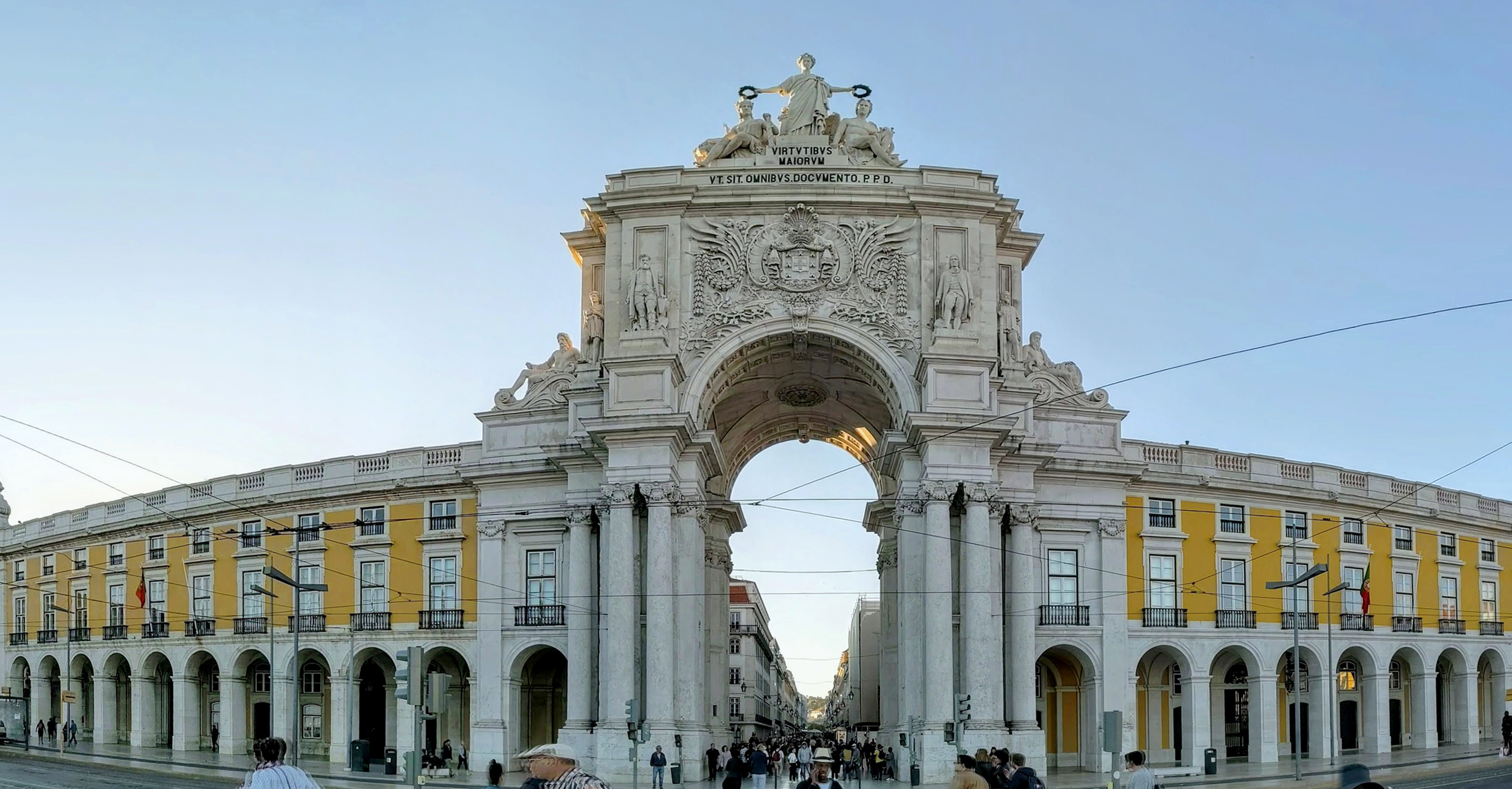
Praca do Comercio
Before the earthquake, a grand marble staircase descended from the Ribeira Palace directly to the water's edge, where royal dignitaries stepped from boats onto Portuguese soil. After the earthquake, the palace was gone, its library of over 200,000 books consumed by fire, and the staircase led to nothing but rubble. What rose in its place was something arguably more impressive: the Praca do Comercio, a vast harbor-facing square measuring 175 by 175 meters, one of the largest public spaces in Europe and the architectural embodiment of a nation reinventing itself from catastrophe.
From Royal Palace to Public Square
The site was known for centuries as the Terreiro do Paco, the Palace Yard, because the Ribeira Palace had stood here since the 16th century. The 1755 earthquake and the fire that followed obliterated the complex entirely. Sebastiao Jose de Carvalho e Melo, the 1st Marquis of Pombal, Portugal's chief minister from 1750 to 1777, seized the disaster as an opportunity. Rather than rebuilding the royal residence, he ordered the entire Baixa district reconstructed on a rational grid, with the Praca do Comercio as its ceremonial center. The name itself declared the square's new purpose: this would be the Square of Commerce, a place of trade and governance rather than royal privilege. The symmetrical buildings that lined its three landward sides housed customs offices and government bureaux that regulated Portugal's seaborne trade.
The King on Horseback
At the center of the square stands an equestrian statue of King Jose I, inaugurated in 1775. Designed by Joaquim Machado de Castro, Portugal's foremost sculptor of the period, it was the first monumental statue dedicated to a king in Lisbon. The bronze figure gazes southward toward the Tagus, as if surveying the river that carried Portuguese ships to Africa, India, Brazil, and beyond. Above the northern entrance to the square, a triumphal arch originally conceived by Santos de Carvalho but completed in 1873 to a redesigned plan by architect Veríssimo José da Costa was finished nearly a century after reconstruction began. Its upper tier bears statues of Vasco da Gama and the Marquis of Pombal, connecting the Age of Discovery to the age of reconstruction, as if the two were chapters in the same national story.
Seat of Power and Revolution
From the 19th century onward, the square's arcaded buildings housed some of Portugal's most important ministries, including Finance, Internal Administration, Agriculture, and Maritime Affairs. Before the 1974 Carnation Revolution, the War Ministry and the Navy Ministry also operated here, and the square became a metonym for the Portuguese central government itself. In June 1910, months before the monarchy fell to republican forces, the Praca do Comercio was classified as a National Monument. The Supreme Court still sits within the square's colonnaded walls. Each year on 10 June, Portugal Day, the plaza fills with military formations and civilian crowds, the national celebration unfolding in the very space where a devastated nation chose to rebuild itself not around a throne, but around commerce.
A Plaza That Endures
Today the square serves as both transportation hub and gathering place. A tram departing from its western edge carries passengers to Belem, while ferries from the southern waterfront cross the Tagus to the opposite bank. The western tower, once home to the Navy and Colonies Ministries, now houses a branch of the Museum of Lisbon. Martinho da Arcada, established in 1782 within the square's arcades, is the oldest cafe in the city. The monumental Pousada Hotel occupies another section of the colonnaded buildings. The marble steps at the water's edge, the only surviving element that predates the earthquake, still descend into the river, connecting the rebuilt city to the water that made Portugal a global power.
From the Air
Located at 38.708N, 9.136W on the north bank of the Tagus River in central Lisbon. The large, symmetrical square is immediately recognizable from the air, framed by uniform yellow buildings on three sides and open to the river on the fourth. The triumphal arch on the north side and the equestrian statue at center are visible landmarks. Nearest airport is Lisbon/Humberto Delgado (LPPT), 7 km north. Best viewed at 2,000-5,000 ft AGL.