Prahladpuri Temple
According to tradition, the festival of Holi began here. Not in India, but in Multan, in what is now Pakistan's Punjab province, at a temple built by the devotee Prahlada to honor Narasimha -- the avatar of Vishnu who burst from a pillar to destroy a tyrant king. For centuries the Prahladpuri Temple stood on its raised platform at the southern tip of the Fort of Multan, adjacent to the mausoleum of the Sufi saint Bahauddin Zakariya. Hindu shrine beside Muslim tomb, sharing the same hilltop. That proximity tells the story of this place better than any single event: coexistence tested, broken, and tentatively rebuilt across a thousand years.
A Pillar and a Promise
Hindu tradition holds that Prahlada, son of the demon-king Hiranyakashipu, built the temple around the very pillar from which Narasimha appeared to disembowel his tyrannical father and reward Prahlada's unwavering devotion to Vishnu. The temple was constructed to enclose that pillar, and the festival of Holika Dahan -- the bonfire night that precedes Holi -- is said to have commenced here. The structure sits on the ruins of pre-Muslim buildings, its foundations reaching back further than any single religious tradition can claim. By the time the British explorer Alexander Burnes visited in 1831, the temple was a low structure supported by wooden pillars, with figures of Hanuman and Ganesha guarding its entrance. Burnes noted it was the only place of Hindu worship in all of Multan. He was denied entry.
Shells, Spires, and Walls Between Neighbors
The temple's modern history is a chronicle of damage and contested repair. In 1810, when the temple's height was raised, tensions with the neighboring Muslim community flared. Then came the Siege of Multan in 1848: a shell from the East India Company's artillery struck a gunpowder magazine in the fort and blew the temple's roof clean off. After the siege, the Company controlled the fort for two years before returning the shrines to their communities in July 1852. When local Hindus sought to refurbish the temple the following month, the custodian of the adjacent mausoleum petitioned the British Commissioner for a cease order. The compromise that followed was architectural segregation -- a well built for the Hindus in an adjacent plot, a wall erected between mausoleum and temple. Coexistence, but with a barrier.
The Weight of Distance
After the partition of British India in 1947, most of Multan's Hindus migrated to India. The few who remained continued to manage the temple, which persisted as a city landmark and maintained a dharamshala -- a rest house for pilgrims and travelers. Then, on December 6, 1992, Hindu mobs in Ayodhya, India, demolished the Babri Masjid, a 16th-century mosque. The violence echoed across the border. In Multan, a Muslim mob destroyed the Prahladpuri Temple and its dharamshala in retaliation, targeting local Hindus as well. A temple that had survived artillery bombardment, communal riots, and the upheaval of partition was leveled because of events in a city a thousand miles away. The symmetry was cruel and precise: mosque for temple, destruction answering destruction.
Rebuilding What Was Lost
Efforts to restore the Prahladpuri Temple have been halting and politically fraught. In May 2015, the Evacuee Trust Property Board announced restoration plans and granted five million Pakistani rupees to the Punjab Archaeology Department. The local administration refused to issue the required No Objection Certificate, apparently fearing a violent response from religious extremists. In February 2021, the Supreme Court of Pakistan established a commission to investigate the status of minority religious shrines. It criticized the Trust Board's handling of Hindu sites and ordered the immediate restoration of the temple, along with construction of lodging for tourists. The court directed Punjab's government to prepare the shrine for that year's Holi festival. A local peace committee -- government representatives, civil society members, and Islamic scholars sitting together -- announced its own plans to ensure the restoration moved forward in the name of religious harmony.
What the Hilltop Holds
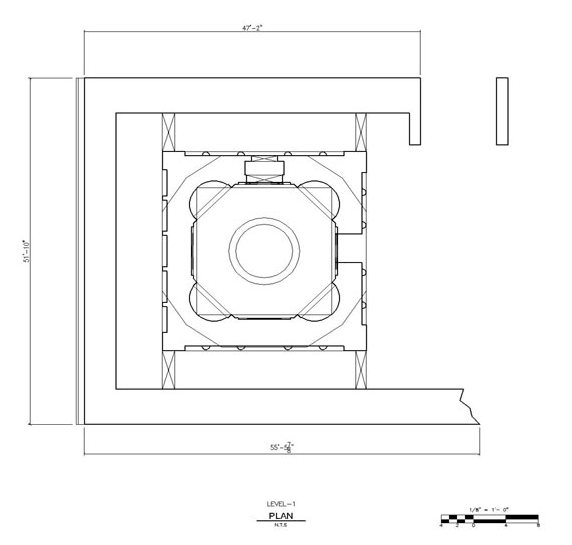
Before it was destroyed, the temple featured a main hall with circumambulatory passages lit by skylights. A replica of the deity stood under a baldachin in the central chamber. Today the site belongs to the Evacuee Trust Property Board, one of hundreds of abandoned Hindu and Sikh properties managed by the Pakistani state. The Fort of Multan still rises above the city, and the mausoleum of Bahauddin Zakariya still draws devotees. Whether the temple beside it will ever again draw its own is an open question. What is not in question is the depth of what this hilltop represents: Hindu mythology, Sufi devotion, colonial violence, partition's rupture, and the ongoing struggle to honor the past without repeating its worst chapters.
From the Air
Located at 30.20N, 71.47E atop the Fort of Multan in Punjab, Pakistan. The fort mound is visible from moderate altitude as a raised area in the dense urban fabric of Multan's old city. The mausoleum of Bahauddin Zakariya with its blue-tiled dome is the most prominent landmark on the hilltop. Nearest major airport is Multan International (OPMT), approximately 10 km west of the fort. Best viewed at 3,000-6,000 ft AGL. Multan is one of the hottest cities in South Asia; summer haze can reduce visibility significantly.