Prambanan
Of the 240 temples that once filled this compound, most survive only as scattered foundations. The few that have been rebuilt soar above the Prambanan plain with a vertical ambition that stops visitors mid-step. The tallest, the Shiva temple, reaches 47 meters, its stepped pyramid silhouette sharpened against the volcanic skyline of Central Java. Built in the mid-9th century and dedicated to the Trimurti -- Brahma, Vishnu, and Shiva -- Prambanan was likely the Hindu Sanjaya dynasty's monumental reply to Borobudur, the Buddhist masterpiece only 40 kilometers to the west. If Borobudur whispers contemplation, Prambanan shouts conquest.
A Dynasty's Statement in Stone
Construction began around 850 CE under King Rakai Pikatan. A short inscription in red paint bearing the name "pikatan" was found on a finial atop the Shiva temple's balustrade, confirming his role in initiating the project. His successor, King Lokapala, expanded and inaugurated the temple, and the Shivagrha inscription of 856 CE records November 12 of that year as the consecration date. Building on this scale required reshaping the landscape itself: the Opak River, which originally curved too close to the temple site, was redirected along a north-south axis to protect the compound from volcanic lahars flowing off Mount Merapi. The old riverbed was filled and leveled, creating space for the hundreds of ancillary temples that would eventually surround the three main shrines.
The Architecture of the Cosmos
Prambanan's design is a map of the Hindu universe laid out in stone. Three concentric zones represent the three realms of existence: Bhurloka, the earthly realm of mortals, in the outer courtyard; Bhuvarloka, the middle realm of saints and ascetics, in the temple bodies; and Svarloka, the heavenly realm of the gods, in the soaring rooftops crowned with ratna finials shaped like diamonds. The inner compound holds eight main structures. Three Trimurti temples honor Shiva, Vishnu, and Brahma. Three Vahana temples face them, dedicated to each god's mount: Nandi the bull, Garuda the eagle, and Hamsa the sacred goose. Two Apit temples flank the rows on the north and south. Surrounding this sacred core, 224 smaller pervara temples once stood in four concentric square rows, though only six have been fully reconstructed so far.
Stories Carved in Relief
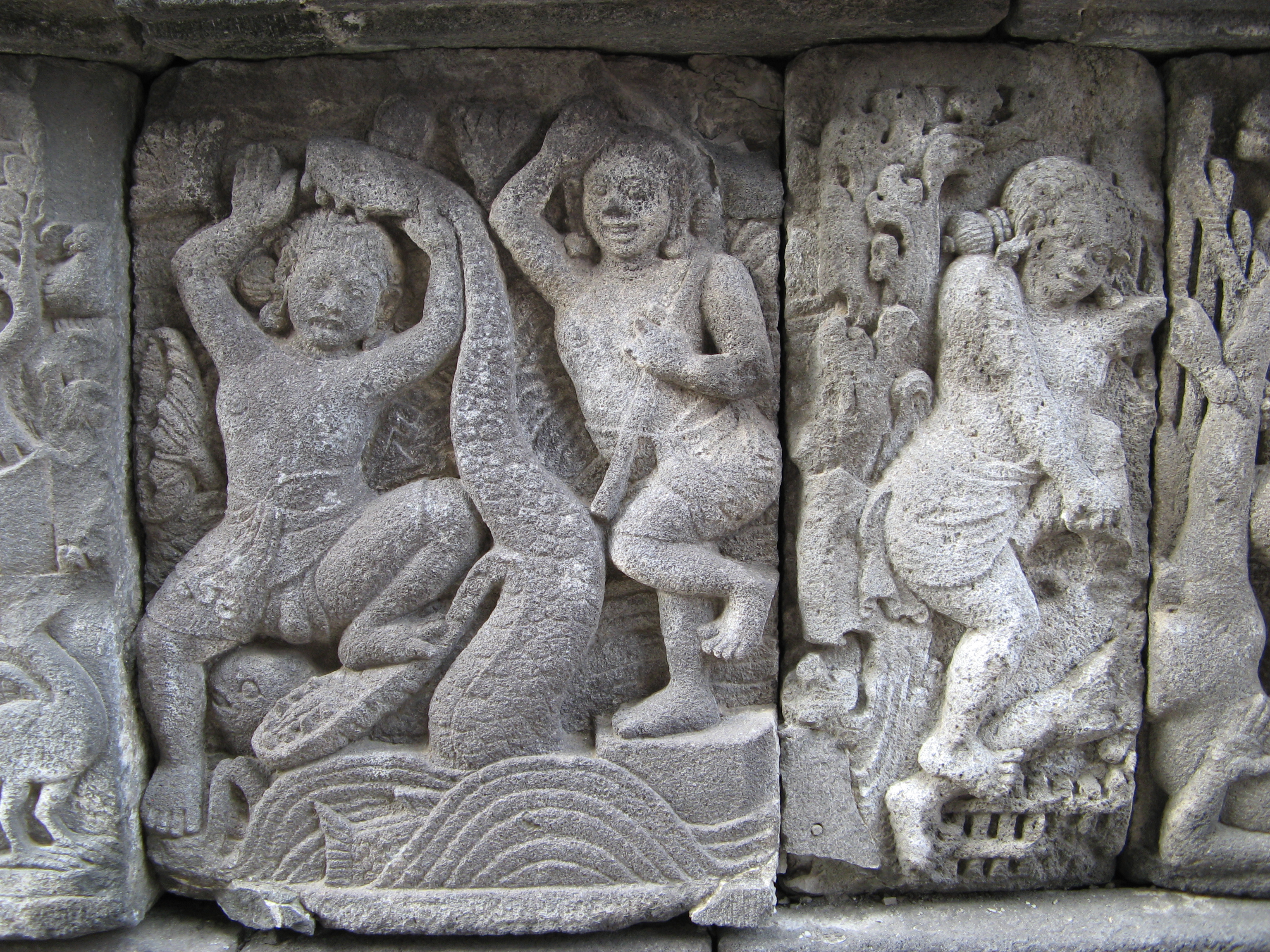
The inner balustrades of the three main temples carry narrative bas-relief panels that reward patient circumambulation. Beginning at the east entrance and moving clockwise in the ritual direction of pradaksina, the Shiva temple's galleries depict scenes from the Ramayana: Sita's abduction by Ravana, the alliance with the monkey king Hanuman, the great battle and rescue. The story continues seamlessly onto the Brahma temple's walls. On the Vishnu temple, the panels shift to episodes from the Bhagavata Purana, recounting the adventures of Lord Krishna. Below these narrative friezes, a repeating decorative motif unique to Prambanan runs along the lower walls: a lion seated in a niche, flanked on each side by kalpataru trees, the mythical wish-fulfilling trees of Hindu-Buddhist tradition, attended by pairs of kinnaras, birds, deer, and elephants.
The Curse of the Slender Maiden
Local legend offers its own explanation for the temple's existence. Princess Rara Jonggrang, daughter of King Boko, rejected the marriage proposal of Prince Bandung Bondowoso, who had killed her father. Forced to agree, she set an impossible condition: he must build a thousand temples in a single night. Bandung summoned supernatural beings from the earth and, by near-dawn, had completed 999 structures. Desperate, Rara Jonggrang ordered her maids to pound rice and light fires in the east, tricking the spirits into believing sunrise had arrived. They fled underground. Enraged, Bandung cursed the princess, turning her to stone. She became, the legend says, the statue of Durga in the northern chamber of the Shiva temple, still known as Rara Jonggrang, the Slender Maiden. The unfinished thousandth temple is said to be the Sewu Buddhist compound nearby, whose name means "thousands" in Javanese.
Earthquake, Ash, and Slow Revival
Prambanan's modern story is one of patient reconstruction against recurring natural forces. The 2006 Yogyakarta earthquake scattered carved debris across the grounds and closed the site for months. In 2014, volcanic ash from the eruption of Kelud, 200 kilometers to the east, blanketed the compound and shut it down again. Restoration follows a strict rule: a shrine can only be rebuilt if at least 75 percent of its original stonework survives, a discipline called anastylosis. At current pace, with each pervara temple requiring eight to twelve months of reconstruction, restoring all 224 would take roughly 200 years. Yet the site is far from static. In November 2019, Indonesian Hindus performed the Abhiseka ceremony at Prambanan for the first time in 1,163 years, reconsecrating the temple as a place of active worship. The Ramayana Ballet has been staged on the western side of the compound on full-moon nights since the 1960s, the illuminated temple towers serving as the most dramatic backdrop any dance performance could ask for.
From the Air
Located at 7.75S, 110.49E on the Prambanan Plain in the Special Region of Yogyakarta, about 17 km northeast of Yogyakarta city center. The temple compound sits along the Yogyakarta-Solo highway (Indonesian National Route 15) and is bounded to the west by the Opak River. Mount Merapi (2,930 m) dominates the northern horizon. The Sewu Buddhist temple complex is visible about 800 m to the north. Nearest airport: WAHH (Adisucipto International Airport), approximately 5 km west. At moderate altitude, the three towering main temples are distinguishable from the surrounding archaeological park, with the Ratu Boko palace complex visible on higher ground to the south.