Prater
On October 12, 2019, Eliud Kipchoge ran 26.2 miles in 1 hour, 59 minutes, and 40 seconds on a chestnut-lined avenue in Vienna's Prater park. The route required multiple laps of the Hauptallee, a 4.4-kilometer straight road carved through forest in 1538 to connect the Augarten palace grounds to the imperial hunting lodge. Kipchoge chose the avenue for the same reason Emperor Maximilian II chose the Prater itself: flat ground, sheltered from wind, long enough to run without turning. What began as a royal preserve where only nobles could walk has become six square kilometers of public parkland, amusement rides, ancient trees, and the kind of democratic open space that imperial Vienna never intended but eventually embraced.
From Royal Game Reserve to People's Park
For three centuries, the Prater belonged to the emperor. First documented in 1403, it served as a fenced hunting ground where Maximilian II introduced enclosures and lodges. Access required imperial permission, and ordinary Viennese could only imagine what lay beyond the gates. That changed in 1766, when Joseph II - the reforming emperor who also abolished serfdom - opened the Prater to all social classes. Coffee houses and inns appeared almost immediately. Swings, carousels, and bowling alleys followed, laying the foundation for the Wurstelprater amusement area. By the early 19th century, the annual Praterfahrt carriage procession had become Vienna's premier social event, a rolling fashion show where the city's elite paraded new styles before thousands of spectators. The emperor had given the people a park, and the people had turned it into a stage.
The Year Everything Burned
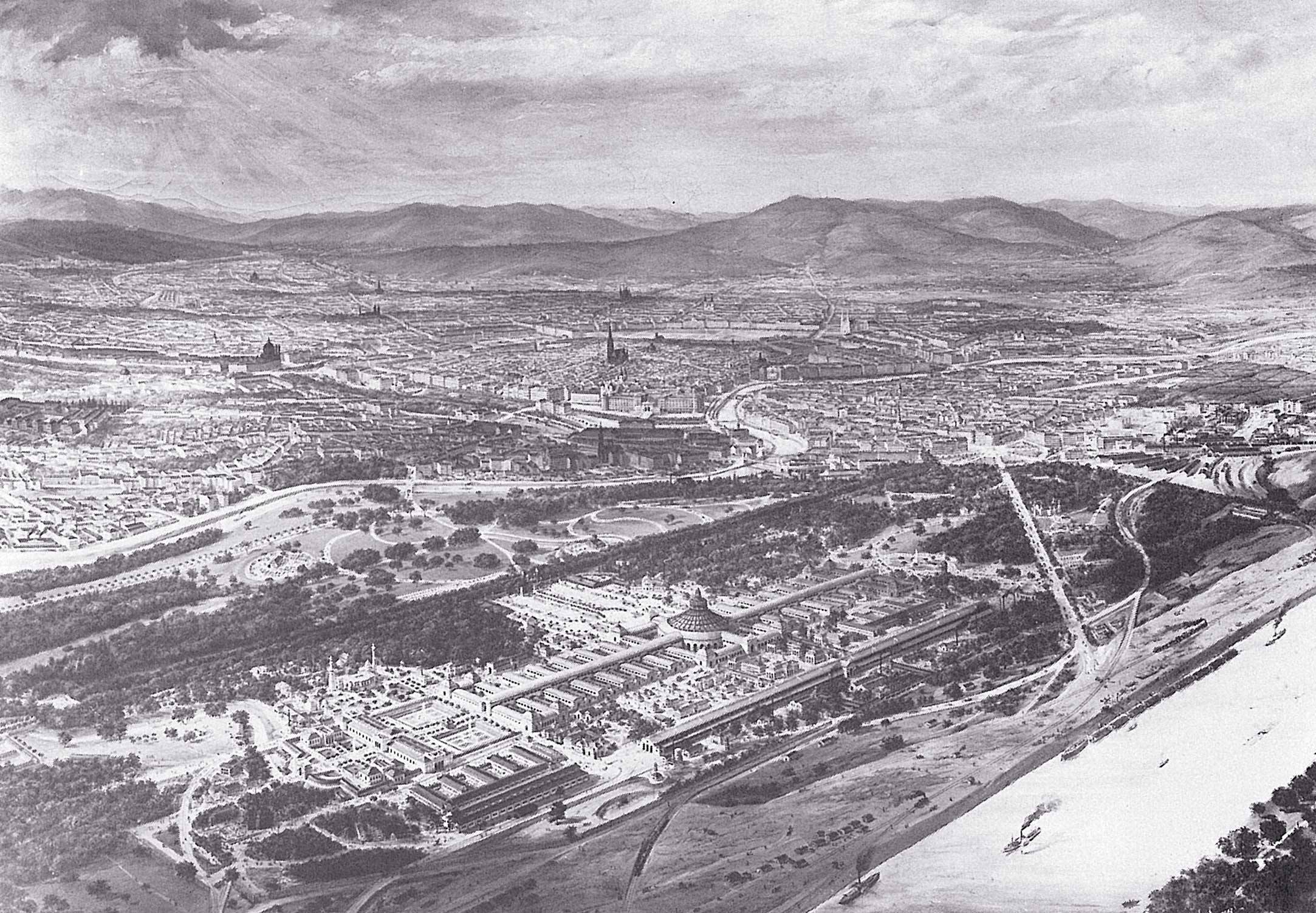
The Prater has witnessed both spectacle and catastrophe in roughly equal measure. The 1873 World Exposition drew 7.25 million visitors and left behind the Rotunde, at 108 meters in diameter the world's largest dome at the time. The exposition also left a deficit of 14.9 million gulden and two million square meters of cleared forest. The Rotunde survived for over 60 years until a massive fire destroyed it on September 17, 1937. World War II inflicted far worse damage. The northern Wurstelprater, including the Venediger Au area, was completely destroyed. The Planetarium, opened in 1930, was reduced to rubble. The Riesenrad ferris wheel, the racing tracks, the Lusthaus hunting lodge, and the Stadionbad swimming complex all sustained damage. Only a shooting gallery, a carousel, and a single restaurant emerged unscathed. Restoration, complicated by the Prater falling within the Soviet-occupied sector of Vienna, was not completed until 1953.
Where Workers Marched and Soldiers Fought
The Prater's political history runs as deep as its recreational one. During the revolutionary upheaval of 1848, the Praterschlacht on August 23 saw the Vienna National Guard clash with demonstrating workers along the park's pathways - a reminder that open public spaces attract more than leisure seekers. In October of that same year, revolutionary forces and imperial soldiers fought near the Lusthaus and Praterstern. Decades later, the park became hallowed ground for a different kind of movement. On May 1, 1890, Austria's first May Day march proceeded down the Hauptallee, a demonstration that drew attention across Europe and established the Prater as a gathering place for organized labor. The Social Democratic movement left its mark in concrete: the Praterstadion, now the Ernst-Happel-Stadion, was opened on July 11, 1931, during the 2nd Workers' Olympiad. With a capacity of 60,000 and a drainage system that cleared the field in seven to eight minutes, it was considered Europe's most modern stadium.
A Forest Inside a City
Beyond the amusement rides and running paths, the Prater remains fundamentally a riparian forest. Ancient black and silver poplars, maples, and ash trees - some over 200 years old - form a canopy that muffles the urban noise of Vienna's second district. The park's waterways are remnants of former Danube branches, cut off from the main river during the 19th-century regulation project and transformed from flowing channels into still ponds and narrow lakes. The Heustadelwasser stretches over a kilometer, just ten meters wide. Beavers have returned to these former river branches. Kingfishers and grey herons hunt along the banks. Aesculapian snakes sun themselves in clearings, and European pond turtles occupy the quiet waters. The meadows, mowed only once or twice a year to protect habitat, host roe deer, red foxes, and European badgers. Raccoons, a more recent arrival, have also established themselves. It is a remarkable ecosystem for a park reachable by subway from the city center.
From the Air
The Prater lies at 48.216°N, 16.396°E in Vienna's Leopoldstadt district, a large green expanse between the Danube Canal and the Danube River clearly visible from altitude. The park's six square kilometers make it one of the most prominent green spaces in the city - look for the distinctive straight line of the Hauptallee and the circle of the Riesenrad ferris wheel at the park's western edge. Vienna International Airport (LOWW/VIE) is approximately 17km to the southeast. The Danube River and Danube Island run along the park's northeastern boundary. The Ernst-Happel-Stadion is visible in the southern portion of the park.