Pre-Columbian Gold Museum
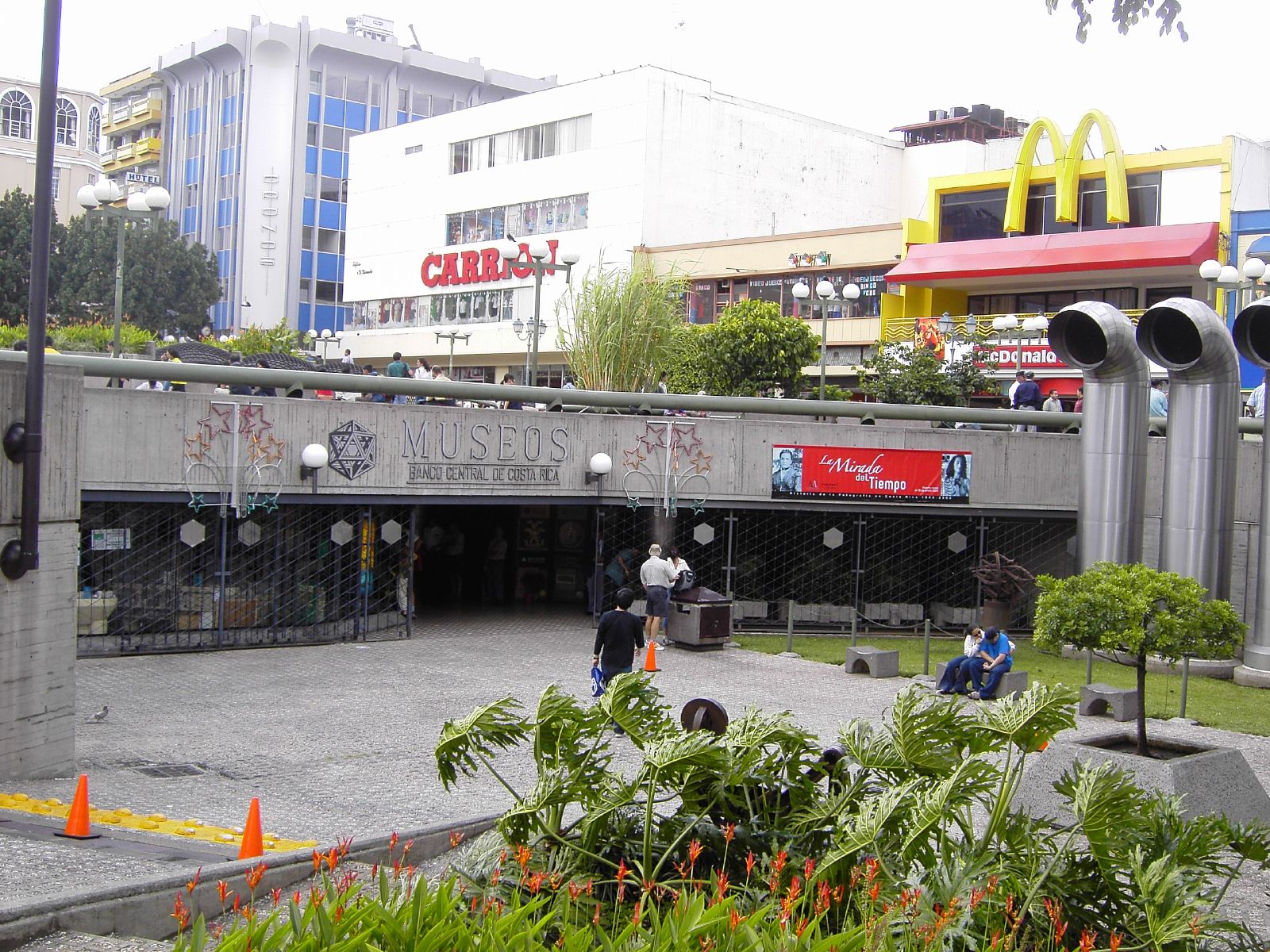
You descend to reach it. The Pre-Columbian Gold Museum sits beneath San Jose's Plaza de la Cultura, in a subterranean building where 1,586 gold objects glow under carefully calibrated lighting. The collection spans roughly two millennia, from 300-400 BC to 1550 AD, and the effect of encountering it underground -- below the streets where modern Costa Ricans walk to work and tourists hunt for coffee shops -- is disorienting in exactly the right way. You step down into the earth and emerge into a civilization's understanding of power, spirituality, and the natural world, all rendered in metal that has not tarnished in two thousand years.
A Vault Beneath the Plaza
The museum is owned and curated by the Banco Central de Costa Rica, the nation's central bank, which makes it one of the few major archaeological collections in the Americas managed by a financial institution rather than a cultural ministry. The full collection comprises 3,567 pre-Columbian artifacts: 1,922 ceramic pieces, 1,586 gold objects, 46 stone items, 4 jade pieces, and 9 glass or bead objects. The decision to house this collection underground was practical as much as atmospheric -- the subterranean space beneath the plaza provides climate control and security that a conventional above-ground museum would struggle to match. But the descent also serves a narrative purpose: visitors leave the contemporary city behind and enter a space that belongs to the people who shaped this gold long before the Spanish arrived.
Gold as Language
In pre-Columbian Costa Rica, gold was not currency. It was communication. The figures in the collection -- frogs, eagles, jaguars, alligators, deer -- were not decorative trinkets but symbols of authority, spiritual power, and connection to the natural world. A gold frog signified fertility and transformation. A jaguar represented strength and the boundary between the human and the divine. The artisans who created these objects worked with sophisticated techniques including lost-wax casting, hammering, and alloying gold with copper to produce tumbaga, a material that could be treated with acid to remove surface copper and leave a rich golden finish. The craftsmanship required technical knowledge that was passed through generations, and each piece functioned simultaneously as art, insignia, and theological statement.
The Warrior and the Grave
Two exhibits anchor the collection's emotional impact. El Guerrero, a life-sized gold warrior figure displayed in a glass case and adorned with gold ornaments, stands as a direct encounter with the scale of pre-Columbian metalwork -- this was not miniature jewelry but full-body regalia designed to transform the wearer into something more than human. Equally striking is the replica of a pre-Columbian grave containing 88 gold objects, unearthed on a banana plantation in southeastern Costa Rica in the 1950s. The grave demonstrates how gold accompanied the dead into the afterlife, its presence in the burial asserting the deceased's status and spiritual importance. The discovery on a banana plantation adds an unintended layer of meaning: the same land that produced twentieth-century agricultural wealth had been consecrated centuries earlier by a civilization with a fundamentally different understanding of what the earth was for.
Three Museums in One Building
The gold museum does not stand alone. The same building houses the Museo Numismatico, Costa Rica's National Coin Museum, on the ground level. Its displays trace the country's monetary history back to 1236, including coins, banknotes, and the unofficial coffee tokens that once circulated as a parallel currency in the plantation economy. The collection includes Costa Rica's first official coin, the Media Escudo, minted in 1825. Also on the ground level, the Casa de Moneda documents the history of minting in Costa Rica, illustrating how the production of currency evolved from colonial-era workshops to modern facilities. Together, the three collections create an unintentional narrative arc: from gold as spiritual authority, to coins as colonial commerce, to paper money as national identity. The building contains not just artifacts but an argument about how civilizations assign value to objects.
From the Air
Located at 9.93N, 84.08W in the center of San Jose, Costa Rica, directly beneath the Plaza de la Cultura. The museum is near the National Theatre and within the compact historic core of the city. Juan Santamaria International Airport (MROC) lies approximately 17 km northwest in Alajuela. San Jose sits in the Central Valley at roughly 1,170 meters elevation, surrounded by volcanic highlands. Best viewed at 3,000-6,000 feet to see the urban grid and the plaza under which the museum is hidden.