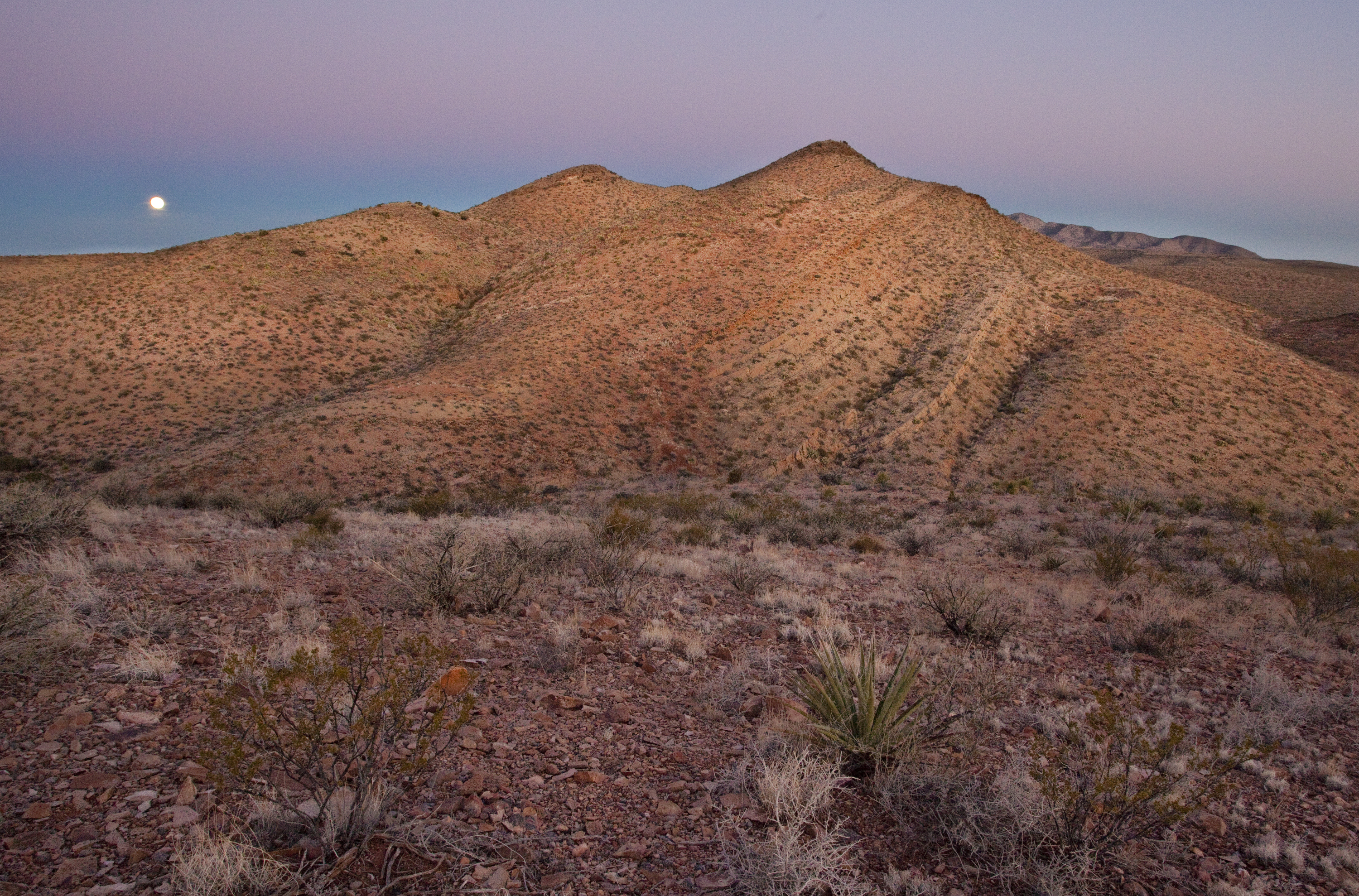
Prehistoric Trackways National Monument
Jerry Paul MacDonald strapped another stone slab to his back and began the long hike out of the Robledo Mountains. It was 1987, and he had just discovered what scientists would call one of the most significant Paleozoic fossil sites on Earth. Over years of solitary work, MacDonald would carry more than 2,500 slabs down from these dusty slopes, each one bearing the fossilized footprints of creatures that walked this ancient seacoast 280 million years ago. Before dinosaurs, before mammals, before flowering plants, something left its tracks in the mud here, and the desert kept its secrets until a determined fossil hunter came looking.
Ghosts in the Stone
The footprints preserved in these rocks predate the dinosaurs by nearly 50 million years. During the Permian Period, this corner of New Mexico lay at the edge of a tropical sea, its tidal flats teeming with creatures that left their marks in soft sediment before the mud hardened into rock. Scientists have identified at least 13 distinct trace fossils here, each with names that hint at their mysterious origins. Dimetropus records the passage of the sail-backed Dimetrodon. Batrachichnus preserves the hopping track of an ancient amphibian. Selenichnites traces moon-shaped impressions from creatures whose identities remain debated. These are not bones or shells but something rarer: frozen moments of movement, evidence of lives being lived rather than deaths being recorded.
A One-Man Mission
For decades, scattered footprints had turned up in the Robledos, but no one had followed the trail to its source. Jerry MacDonald spent years interviewing local hikers, quarrymen, and fossil hunters, piecing together clues that led him to what he named the Discovery Site on June 6, 1987. What he found exceeded all expectations: continuous trackways stretching across multiple rock layers, a paleontological treasure trove hidden in plain sight. Working alone, MacDonald excavated three major trackways, hauling each slab out on his own back through the rugged terrain. The majority of his finds now reside at the New Mexico Museum of Natural History and Science in the Jerry MacDonald Paleozoic Trackways Collection, with additional specimens at the Carnegie Museum of Natural History and the Smithsonian.
The 100th Monument
On March 30, 2009, President Barack Obama signed the Omnibus Public Land Management Act, and with that stroke of a pen, Prehistoric Trackways became the 100th active national monument in the United States. Not the 100th ever designated, as some monuments have come and gone over the years, but the 100th still standing at that moment in history. Senators Jeff Bingaman and Pete Domenici, both of New Mexico, championed the legislation that protected these ancient footprints for future generations. The monument joined the National Landscape Conservation System, becoming the first national monument established under the Obama administration and a fitting milestone for America's public lands legacy.
Life at the Desert's Edge
The monument sits at the northern tip of the Chihuahuan Desert, where modern life continues among the ancient stones. Ocotillo and creosote bush dot the landscape alongside prickly-pear cactus and Torrey yucca. Mule deer browse through the brush while rattlesnakes sun themselves on warm rocks. The climate swings between extremes: January highs hover in the mild range while June temperatures climb toward scorching. August brings the monsoons, the wettest month in a land that measures its annual rainfall in single digits. In this harsh environment, both the Permian trackways and their modern guardians endure.
A Monument Still Becoming
Unlike many national monuments with paved trails and visitor centers, Prehistoric Trackways remains largely wild. No maintained hiking trails guide visitors to the fossil sites. No facilities ease the journey. A single interpretive sign marks the Discovery Site, the best spot for viewing the ancient tracks. The Bureau of Land Management offers periodic guided hikes led by interpretive staff for those willing to make the trek. For the prepared and determined, the monument rewards with an experience unlike any other: standing where ancient creatures walked, reading their stories in stone, and confronting the humbling scale of deep time written in footprints older than the dinosaurs by millions of years.
From the Air
Prehistoric Trackways National Monument is located at 32.35N, 106.90W in the Robledo Mountains northwest of Las Cruces. From the air, the monument appears as rugged, undeveloped mountain terrain west of the Rio Grande valley. The nearest airport is Las Cruces International (KLRU), approximately 10 nautical miles southeast. Best viewed at 3,000-5,000 feet AGL, though the fossil trackways themselves are not visible from altitude. The monument boundary encompasses desert mountain slopes without developed facilities. Use the Robledo Mountains ridge as a visual reference, with Las Cruces and the Organ Mountains visible to the southeast.