Prehistory of Iran
Seven-thousand-year-old jars of wine sit in a display case at the University of Pennsylvania, excavated from the Zagros Mountains of western Iran. They are among the oldest evidence of winemaking on Earth, and they are far from the oldest artifacts found in this region. The Iranian plateau has been a crossroads for human migration since archaic humans first wandered out of Africa, drawn by a landscape of extraordinary geographic variety: mountains, river valleys, deserts, and coastal plains that offered shelter, food, and passage toward southern and eastern Asia. The prehistory of Iran spans from roughly one million years ago to the eighth century BC, when Assyrian records begin to document the peoples of the plateau. In between lies a story of Neanderthals, early farmers, the first domesticated animals, the birth of cities, and a writing system that remains undeciphered to this day.
First Footprints on the Plateau
The oldest evidence of human presence in Iran comes from stone artifacts found in gravel deposits along the Kashafrud River Basin in eastern Khorasan, dating to nearly one million years ago. Other early sites are scattered across the country: Mashkid and Ladiz in the southeast, Ganj Par in Gilan, Darband Cave in the north, Shiwatoo in Kurdistan, and Pal Barik in Ilam. These sites span from one million to 200,000 years ago. Neanderthals left a heavier mark. Mousterian stone tools have turned up across the Zagros region at caves including Kobeh, Kaldar, Bisitun, and Warwasi. In 1949, archaeologist C.S. Coon found a Neanderthal radius bone in Bisitun Cave. Nearly seventy years later, in October 2018, a tooth from a six-year-old Neanderthal child was discovered in the Kermanshah mountains, the first such find in the country.
Hunters in the Caves
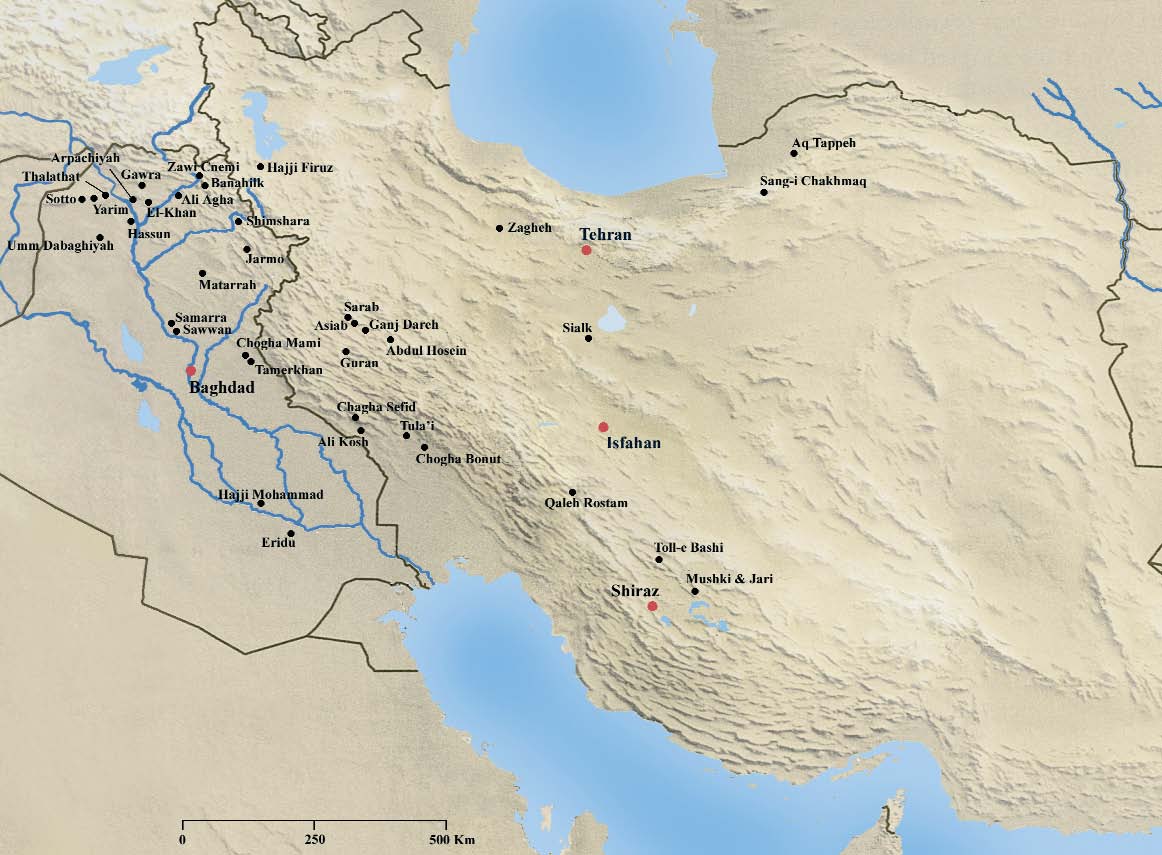
Between roughly 18,000 and 11,000 BC, during the Epipaleolithic period, groups of hunter-gatherers lived primarily in the caves of the Zagros Mountains. Their diets broadened compared to earlier populations. They hunted smaller vertebrates, gathered pistachios and wild fruit, and began consuming snails and aquatic animals like crabs. After 11,000 BC, a gap of roughly 2,500 years leaves almost no archaeological trace. The record picks up again around 8,500 BC at Asiab, a seasonal camp near Kermanshah where hunters pursued wild goats and sheep. Archaeologists found enormous quantities of snail shells there, interpreted as evidence that when hunts failed, the inhabitants resorted to food they would otherwise have avoided. It is a small, human detail: even ten thousand years ago, people had preferences, and sometimes circumstances overruled them.
The Revolution in the Mountains
The Zagros foothills witnessed one of the most consequential transformations in human history. Between 8,000 and 6,800 BC, settlements like Ganj Dareh and Abdul Hosein appeared, communities that lacked pottery but kept flocks of sheep and herds of goats for the first time. This shift from hunting to managing animals rippled outward into every aspect of life, particularly the construction of permanent houses. At Chogha Golan, evidence of early agriculture dates to around 10,000 BC. By the eighth millennium BC, villages like Chogha Bonut, the earliest known settlement in Susiana, had formed in western Iran. The earliest clay vessels and terracotta figurines of humans and animals were produced at Ganj Dareh and Teppe Sarab. Susa, one of the oldest continuously inhabited cities on Earth, was already established by 7,000 BC. Southwestern Iran formed part of the Fertile Crescent, and settlements like Chogha Mish, dating to 6,800 BC, confirm that this region was among the first places where humans stopped wandering and began building.
Cities, Script, and the Undeciphered
By the Bronze Age, the Iranian plateau had produced true urban centers. Susa, with a foundation date around 4,395 BC based on radiocarbon dating, may predate the rise of Mesopotamian civilization. It became the capital of Elam, a state that emerged around 4,000 BC and produced objects of extraordinary artistry: engravings on chlorite, copper, bronze, terracotta, and lapis lazuli depicting animals and mythological figures unlike anything found elsewhere. Elam developed its own writing system, but the Proto-Elamite script remains undeciphered, one of the great unsolved puzzles of ancient history. Meanwhile, the ziggurat of Chogha Zanbil, one of the few surviving ziggurats outside Mesopotamia and considered the best-preserved example in the world, testifies to Elamite ambition and engineering.
The Peoples Arrive
By the first millennium BC, waves of migration from the Pontic-Caspian steppe had reshaped the plateau. The Elamites, who had dominated western Iran for millennia, retreated into Khuzestan as Iranian-speaking peoples spread across the region. By the mid-first millennium BC, the Medes, Persians, and Parthians occupied the plateau, though all remained under Assyrian domination until the Medes broke free. Northwestern Iran was briefly incorporated into Urartu. The prehistoric period ends where recorded history begins, with Assyrian inscriptions documenting the peoples and kingdoms of the Iranian highlands. Historian Igor Diakonoff argued that modern Iranians descend primarily not from Indo-European migrants but from the pre-Iranic inhabitants of the plateau, the very populations whose stone tools, cave shelters, and early villages make up the deep archaeology of this land.
From the Air
Centered on the western Zagros region near Kermanshah at approximately 34.22N, 47.22E, at elevations of 1,200-1,500 meters. The nearest airport is Kermanshah Airport (OICC). The Zagros range runs northwest-to-southeast, with prominent ridgelines and intermontane valleys visible from altitude. Key archaeological sites like Bisitun are located along ancient routes through the mountains. The terrain transitions from rugged Zagros peaks to the Mesopotamian lowlands toward the southwest.